How much does an AI video cost? Pricing from $3 per clip to $10,000+
AI video costs range from $3 per clip (DIY) to $10,000+ (agency). This guide breaks down pricing for Runway, Sora, Pika, Synthesia and full-service production.


A basic 30-second AI clip costs $3 to $10 using a self-service tool. A fully produced five-minute video with custom styling, voiceover, and sound design runs $5,000 to $10,000 through an agency. Everything in between depends on three things: whether you do it yourself, hire a freelancer, or outsource to a production team.
AI video crossed the line from novelty to real tool in late 2024. By mid-2026, marketing teams, L&D groups, and content creators use it daily for social ads, product demos, training, and content in multiple languages. But pricing is still confusing because platforms charge in credits, subscriptions, and per-minute fees that are hard to compare side by side.
This guide lays out the real costs across every approach, names the tools, and gives you the math to budget your next project.
Key takeaways
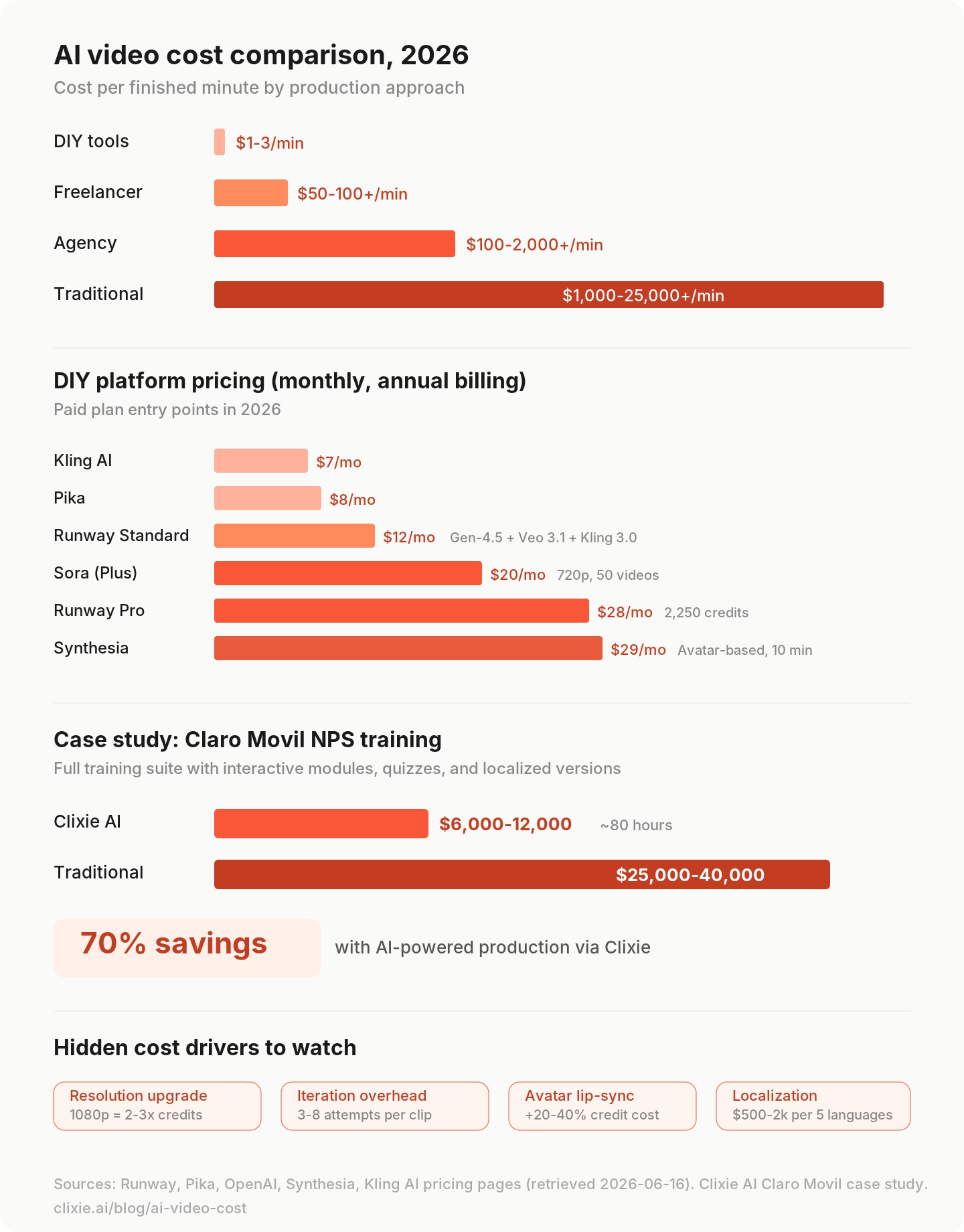
- DIY AI video tools cost $8-28/month (Pika, Runway, Sora). Finished video runs $1-3 per minute for basic outputs.
- Freelancers charge $50-100+ per finished minute. Best for teams that need quality without building internal expertise.
- Agencies charge $100-2,000+ per minute. A five-minute animated piece can cost $5,000-10,000.
- Resolution is the biggest hidden cost driver. 1080p can triple credit consumption compared to 720p.
- Clixie AI delivered a complete Claro Movil training suite for $6,000-12,000, compared to $25,000-40,000 for traditional production.
AI video cost comparison at a glance
What do DIY AI video tools cost in 2026?
Self-service platforms are the cheapest entry point. You write prompts, the AI generates clips, and you edit the output yourself. Monthly subscriptions range from $8 to $28 for most users, with per-minute costs of $1-3 for basic text-to-video output.
Platform pricing breakdown
Runway is the most significant shift in 2026: one subscription now gives you access to Runway's Gen-4.5, Google Veo 3.1, and Kling 3.0 Pro from one dashboard (Runway, 2026, retrieved 2026-06-16). If you were paying for multiple AI video tools separately, a single Runway Standard plan at $12/month may replace them all.
What "credits" actually buy
Credits are confusing because each platform counts them differently. On Runway, a 5-second generation at standard resolution costs about 10 credits. On Gen-4.5 (the top model), it costs 25 credits per second (Runway pricing page, 2026, retrieved 2026-06-16). That means Runway Standard's 625 monthly credits produce either 125 seconds of Gen-4 Turbo footage or 25 seconds of Gen-4.5 footage. The gap is huge.
Expect to use 3 to 5 generations per acceptable output. Experimentation, upscaling, and resolution upgrades all burn credits beyond the base generation.
Hidden costs to budget for
- Free tiers cap at 480p with watermarks. Not usable for commercial work.
- Most freemium plans restrict commercial usage rights. Check the license before publishing.
- High-resolution exports often cost premium credits on top of generation credits.
- Post-production tools like Topaz Video AI ($299 one-time) are needed to upscale AI footage to 4K or clean up motion artifacts.
How much do freelancers charge for AI video?
Freelancers on Fiverr, Useme, and similar platforms charge $50 to $100+ per finished minute for moderately customized AI video content. A 2-minute product explainer runs $100-200, with turnaround times of 3 to 7 days depending on revisions.
The freelancer handles tool selection, prompt optimization, and basic editing. You provide the creative brief, reference materials, and feedback. The trade-off is scope: freelancers execute well but rarely provide brand strategy, complex post-production, or multi-format delivery.
When freelancers make sense
- You need 1 to 5 videos per month with moderate customization
- Your internal team doesn't have time to learn AI video tools
- Budget is between $200 and $1,000 per project
- You can provide a clear brief and reference materials
When they don't
- You need brand consistency across 20+ videos
- The project requires hybrid AI-traditional production
- You need full commercial rights, sound design, and localized versions
- Timeline is under 48 hours
What does agency AI video production cost?
Agencies charge $100 to $2,000+ per finished minute, depending on complexity. A fully produced five-minute animated video with custom styling, professional voiceover, sound design, and brand alignment costs $5,000 to $10,000. Complex hybrid projects blending AI generation with traditional filmmaking can exceed that.
What you get for agency pricing
Agencies handle everything from start to finish. That means creative direction, scripting, voiceover, scene creation with top AI models (Sora, Runway Gen-4.5, Midjourney), editing, sound design, and full rights to use the video however you want.
Agency vs. freelancer vs. DIY: cost per minute
What factors drive AI video costs up?
Four variables have the biggest impact on your final bill, regardless of which approach you choose.
Resolution is the biggest hidden multiplier
Standard definition (480p) generation costs 40-60% less than 720p. Going to 1080p can double or triple credit consumption. On Sora, the difference is stark: ChatGPT Plus gives you 50 videos at 720p for $20/month, while ChatGPT Pro gives you 500 videos at 1080p for $200/month (OpenAI, 2026, retrieved 2026-06-16). The 10x price increase is mostly a resolution upgrade.
Iteration adds up fast
Most AI video generations need 3 to 8 attempts to get a usable result. Each attempt burns credits. A 60-second video that costs $12.50 in credits per generation actually costs $37-100 in credits after iteration, revisions, and upscaling.
Lip-sync and avatar work costs extra
Avatar tools that create synthetic talking heads add 20-40% to your credit cost. Lip-sync accuracy is around 85-90%, so some shots need manual fixes or a second take. Budget 10-15 credits per minute of avatar footage on Runway ($2-4 per finished minute).
Audio and localization stack on top
Sound design, voiceover, and multi-language versions are rarely included in base platform pricing. Synthesia handles voiceover natively with 230+ AI avatars and 140+ languages (Synthesia, 2026, retrieved 2026-06-16), but most other tools don't. Adding 5 languages to a video can cost $500-2,000 extra, depending on whether you use AI dubbing or human voice talent.
How does AI video compare to traditional production costs?
The cost gap between AI and traditional video production is where the business case gets clear. We see this daily at Clixie when L&D teams compare quotes for training content.
A traditional training video (camera crew, location, actors, editing, post-work) costs $1,000 to $5,000 per finished minute at mid quality. High-end work runs $5,000 to $25,000+ per minute. An AI version of the same content costs $100-500 per minute through a freelancer or agency, or $1-3 per minute DIY (plus your editing time).
AI vs. traditional production cost comparison
Case study: Claro Movil NPS training program
The Claro Movil NPS Training project shows what large-scale AI production looks like in practice. Built with Clixie AI, the program covers the full NPS training curriculum. It includes scenario-based modules, interactive quizzes, synthetic presenters, versions in multiple languages, and branded visual assets.
The production pipeline combined script development, AI-generated scenes, avatar-based narration, and structured module assembly. The project required roughly 80 hours of focused work and achieved consistent visual quality across all modules.
Doing this the old way would have meant cameras, on-site crews, paid actors, and reshoots for each language version. That would have pushed the budget to $25,000-40,000. With Clixie AI, the same training suite came in at $6,000-12,000. That's roughly 70% less.
For L&D teams making training at scale, this changes the math. Instead of 2-3 videos per quarter with a traditional crew, the same budget covers 10-15 AI-built modules with quizzes, branching, and analytics built in.
How should you budget for AI video in 2026?
Your budget depends on three things: how many videos you need per month, what quality level is acceptable, and whether you have internal expertise.
Budget-constrained projects (under $500/month)
Self-service platforms are the right choice. Runway Standard at $12/month or Sora Plus at $20/month can produce social media clips, internal communications, and proof-of-concept work. Budget 3-8 hours per finished minute as you learn the tools.
Quality-critical projects ($1,000-10,000)
Freelancers or agencies make sense when brand consistency, narrative quality, or commercial polish matter. This is the range for product explainers, investor presentations, and customer-facing training content.
Volume production (10+ videos/month)
Calculate your cost-per-video across subscription tiers. Sora Pro's unlimited relaxed generation at $200/month becomes cost-effective at high volume. Agency retainers reduce per-project costs by 20-30%.
Interactive training at scale
For L&D teams, the real question isn't just "how much does the video cost?" It's "how much does the video plus the quizzes, branching, analytics, and SCORM packaging cost?" A plain video gives you a file. Interactive video gives you a training system with completion tracking and learner data. Claro Movil got all of that for $6,000-12,000 total. Traditional production can't match that price for the video alone.
FAQs
How much does a 1-minute AI video cost?
A 1-minute AI video costs $1-3 using DIY tools like Runway or Pika (excluding your time), $50-100+ through a freelancer, or $100-2,000+ through an agency. The range depends on resolution, customization, and whether you need voiceover, sound design, and commercial rights.
Is AI video cheaper than traditional video production?
Yes, significantly. A mid-quality traditional corporate video costs $1,000-5,000 per finished minute. AI-produced video costs $1-500 per minute depending on the approach. The Claro Movil training program cost $6,000-12,000 with AI versus an estimated $25,000-40,000 for traditional production of the same content.
What is the best AI video tool for beginners?
Runway Standard at $12/month is the strongest starting point in 2026. One subscription gives you access to Runway Gen-4.5, Google Veo 3.1, and Kling 3.0 Pro from one dashboard. Pika at $8/month is a cheaper option for short social clips. Synthesia at $29/month is best if you specifically need avatar-based talking-head videos.
How many credits does a 1-minute Runway video use?
On Runway's Gen-4 Turbo model, a 1-minute video uses about 300 credits (5 credits/second x 60 seconds). On Gen-4.5, it uses about 1,500 credits (25 credits/second). The Standard plan gives you 625 credits/month, so one minute of Gen-4 Turbo footage uses about half your monthly allotment.
Can I use AI-generated video commercially?
It depends on the platform and plan. Free tiers usually restrict commercial use. Paid plans on Runway, Pika, Sora, and Synthesia generally grant commercial rights, but check each platform's terms. Agency-produced content typically comes with full commercial usage rights included in the project fee.
How long does it take to make an AI video?
DIY production takes 2-8 hours per finished minute, including prompt writing, generation, iteration, and basic editing. Freelancers deliver in 3-7 days. Agencies take 2-6 weeks for complex projects. The fastest path is a self-service tool with a clear script and simple visual requirements.
.png)
.png)