Top 10 SaaS Video Agencies in the US
Compare the top 10 SaaS video agencies in the US for 2026, including their services, timelines, strengths, weaknesses, and ideal use cases.



Most SaaS companies hit the same wall. A product too complex for a single landing-page paragraph, a demo that loses prospects after thirty seconds, and an internal team already stretched thin. Hiring a generalist video shop rarely fixes it. The editor who cut a restaurant ad last week won't intuitively grasp API orchestration layers or multi-tenant permission models.
The agencies below focus, to varying degrees, on turning technical software products into video that actually moves pipeline. Some handle animation only. Others run full campaigns, from scripting all the way to paid distribution. Pricing ranges from flat project fees to monthly subscriptions, and timelines swing from under three weeks to several months.
What separates these agencies: how deeply they specialize in SaaS, how much of the production they own, the outcomes they can document, and how they cope with the particular chaos of software launches. Feature sets that keep moving, stakeholders scattered across time zones, and products that aren't finished yet.
Ranking of the 10 Best SaaS Video Agencies in the US
1. Represent Studio
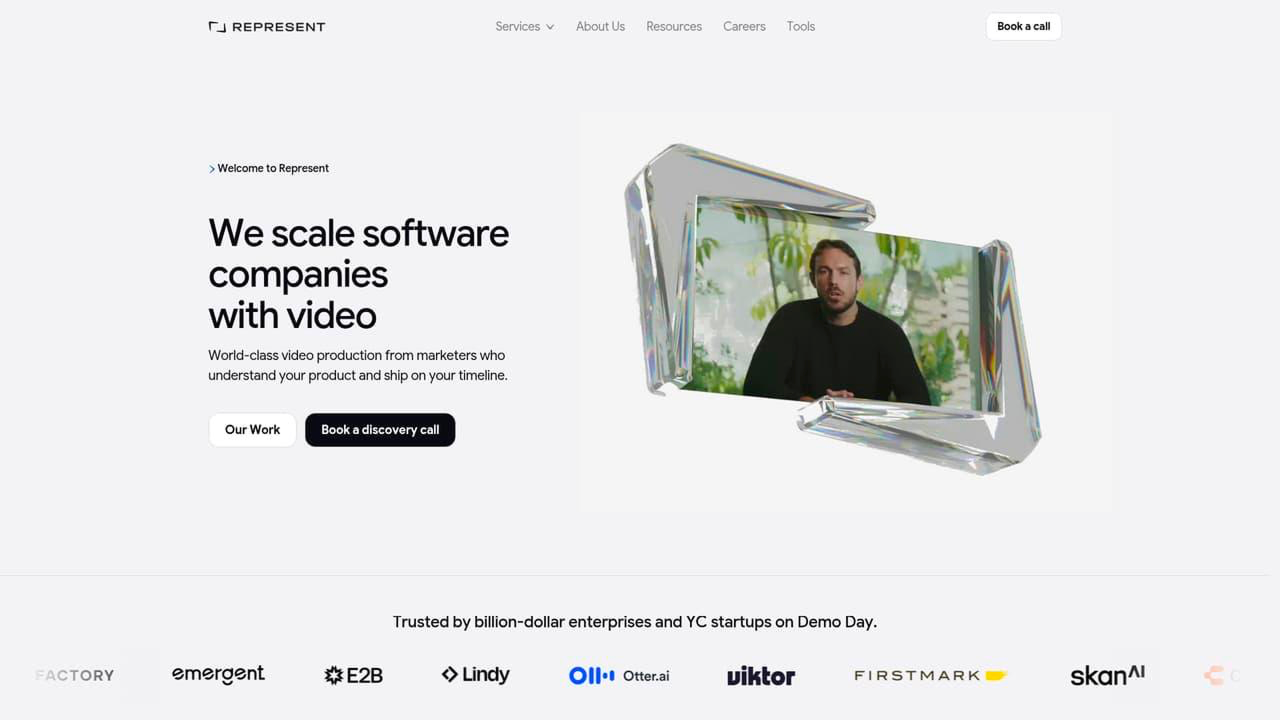
Represent Studio has taken a different approach from most agencies on this list. Rather than producing video for anyone who comes along, it works exclusively with SaaS, AI, and dev-tool companies. Its work covers launch films, product demos, customer testimonials, tutorial libraries, and long-form YouTube content, all handled by the same dedicated team from the initial script through to the final render. No freelancers coming in and out from one project to the next.
That specialization also shapes the way the studio approaches video. Founder Renat Gabitov describes his team as “marketers who picked up cameras,” and that mindset comes through in the metrics they focus on: signups, demo requests, and pipeline, rather than vanity metrics like views. Bardeen is a good example. Its launch video helped the product grow from 0 to 200,000 users and contributed to an $18.8M funding round. Other clients include enterprise companies such as Dataiku, as well as startups like E2B and Mutiny.
The production process fits naturally into the way SaaS teams already work. Scripts are developed in Notion, wireframes in Figma, and revisions are handled through timestamped feedback rather than long email threads. A typical launch video takes around two to three weeks to produce, well below the six-to-eight-week industry average. And for teams that want to maximize reach alongside production quality, Represent can also amplify launches through niche B2B influencers, helping some campaigns reach more than one million views.
Pros:
- End-to-end dedicated team with no outsourced production, which closes the coordination gaps that usually open up between scripting, design, and edit
- Transparent process built on Notion and Figma, tools software teams already run, so feedback cycles stay short
- Six distinct video formats under one roof, from 30-second explainers to full YouTube content programs, meaning you don't juggle multiple vendors as your needs grow
- Documented outcomes across fundraising, user growth, and video view milestones
Cons:
- Built for companies that want a full-spectrum video partner; a team needing a single quick standalone clip may find a smaller, lighter shop a simpler fit
2. Superside
.avif)
Superside isn't a video-first shop. It's a subscription creative service with an 800-person global team spanning design, branding, copywriting, and video. That breadth is exactly what sets it apart here. You don't hire Superside for one launch film. You plug it into your marketing operation as an ongoing creative extension.
The model runs on adjustable monthly subscriptions rather than per-project quotes. Teams manage everything through Superspace, a proprietary platform that connects to Jira, Asana, Monday.com, and Slack. The company reports roughly 35% efficiency gains over traditional agency workflows and claims a 94% ROI over three years, according to client-reported data. With over 40,000 projects delivered since 2015, volume is the defining trait.
AI runs across the whole creative pipeline, from concept generation to asset optimization. It's a capability none of the SaaS specialists in this ranking push to the same degree.
Pros:
- Flexible subscription pricing lets you scale output up or down each month without renegotiating a contract, useful when campaign demand is unpredictable
- Native integrations with the project management tools most SaaS teams already live in, so briefs don't get lost in translation
- AI-assisted workflows across the full creative process, not just video, which helps when you need banners, decks, and clips from one partner
Cons:
- Video is one service among many, so the production people are generalists rather than SaaS video specialists
- The subscription can overserve a company that needs five videos a year, not a steady stream of creative
- Less suited to a single high-stakes launch where deep product-specific storytelling matters more than throughput
3. Venture Videos
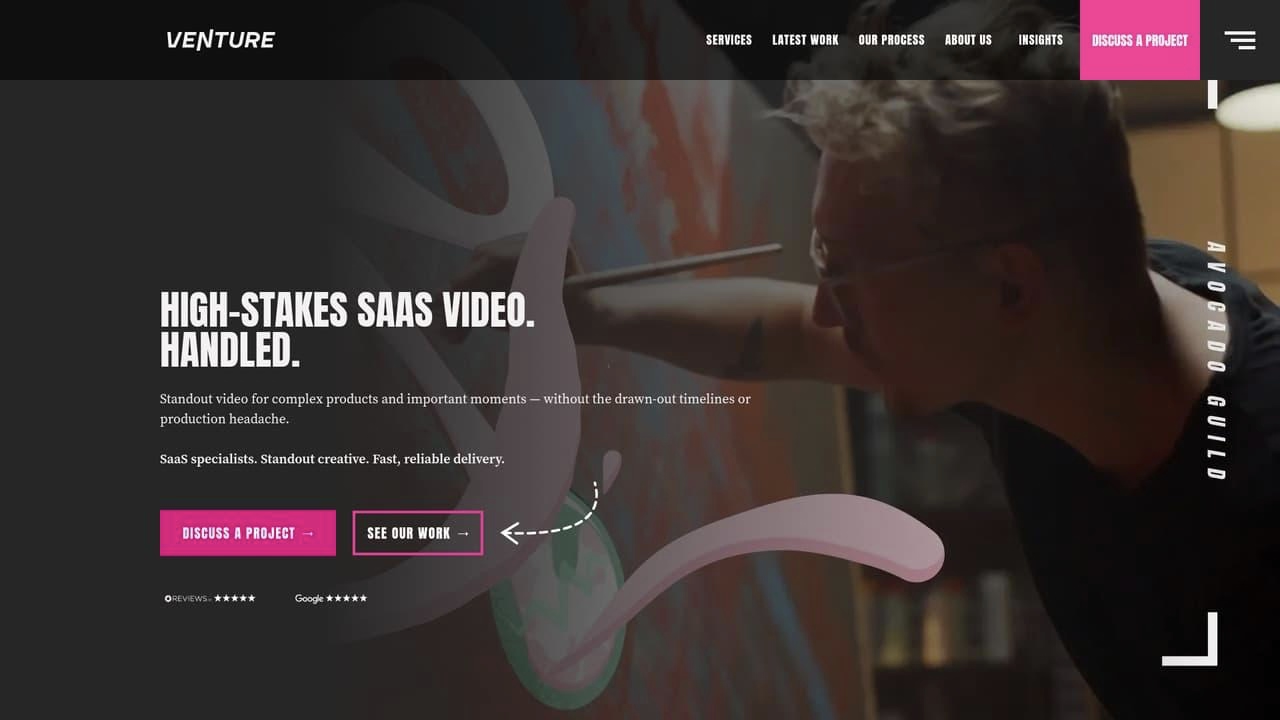
Venture Videos positions itself as the agency you call when the product isn't finished yet. That situation is common in SaaS. A launch date is locked, features are still shipping, and the demo environment breaks twice a week. Most agencies here assume a stable product to film. Venture builds its whole process around evolving interfaces and incomplete feature sets.
Guaranteed timelines set it apart in concrete terms. Product launch videos land in four weeks, enterprise explainers in six. No other agency in this ranking publishes commitments like that. The team owns strategy, messaging, creative, production, and delivery without subcontracting, and supports distributed teams across the US and Europe.
With 200+ SaaS clients documented, the B2B focus runs deep. The structured feedback process absorbs multiple stakeholders without slipping the schedule, a real concern on enterprise deals where six people need to sign off on a single script.
Pros:
- Published delivery guarantees of 4–6 weeks, rare among SaaS-focused agencies, which lets you commit to a launch date with confidence
- A process designed for incomplete products and shifting feature sets, so you're not penalized for building while filming
- Single-team ownership from strategy to final delivery, with no handoffs to external vendors to slow things down
Cons:
- Focused exclusively on B2B SaaS, so teams outside that vertical won't find relevant experience
- No subscription or retainer model visible, unlike Superside's ongoing creative arrangement
4. Demo Duck
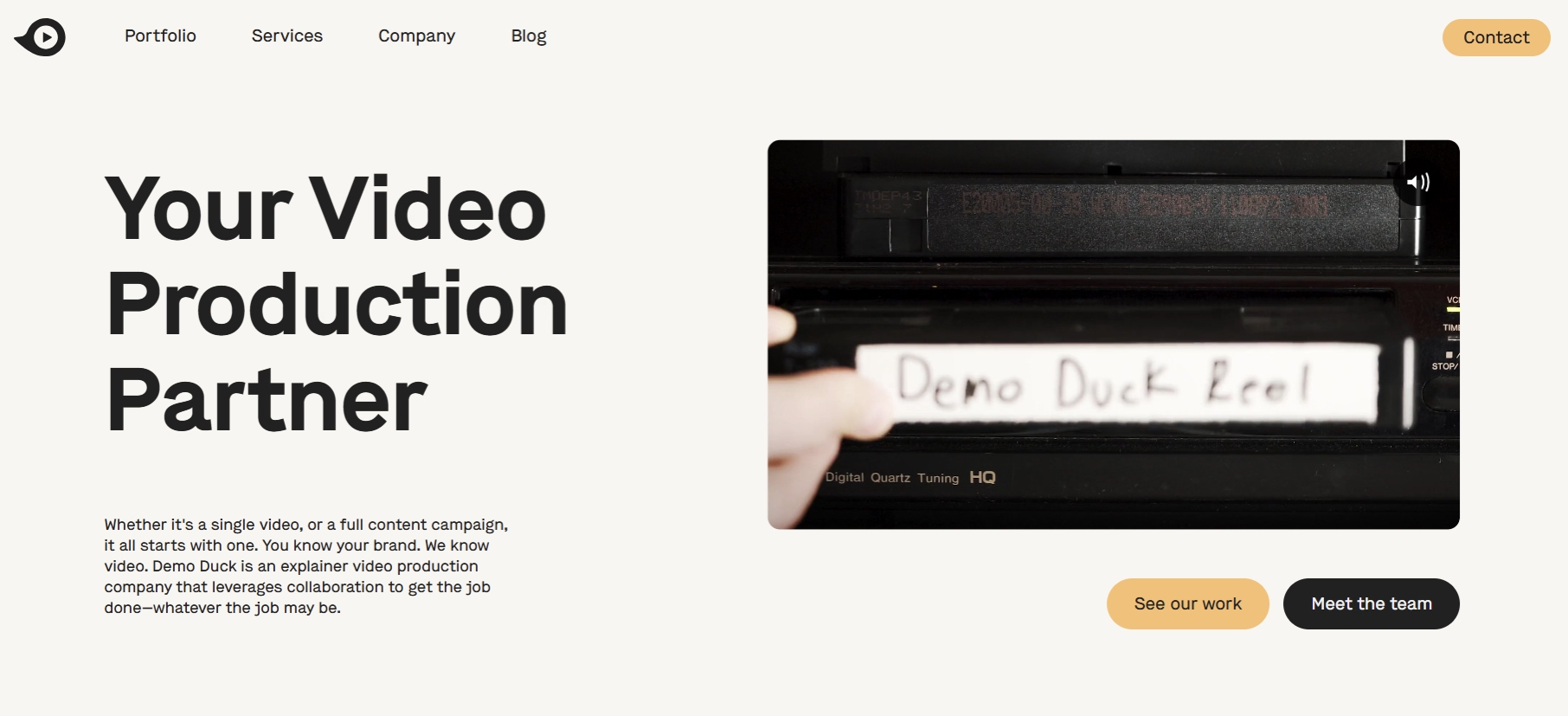
Founded in 2011, Demo Duck brings more than a decade of production experience across animation, live action, and mixed media. Versatility is the whole point. Rather than locking clients into one visual style, the team matches format to message. A product sizzle reel might use kinetic text, while a customer testimonial runs docu-style live action.
The client roster covers Google, GEICO, Rippling, Northwestern Mutual, and Newsela. That spread signals comfort with consumer-facing brands and complex B2B products alike. Demo Duck builds long-term partnerships rather than transactional projects, which fits companies producing video regularly across campaigns.
Where the SaaS-only agencies here go deeper on software storytelling, Demo Duck trades that depth for stylistic range. A brand that needs animated explainers one quarter and live-action commercials the next gets both from the same team.
Pros:
- Spans animation, live action, mixed media, and digital ad campaigns under one roof, so you're not rebuilding a creative relationship every time the format changes
- More than a decade of work with major brands across tech, insurance, education, and healthcare
- Adapts visual identity to your existing brand guidelines instead of imposing a house style
Cons:
- Not SaaS-specialized, so the team won't bring the same product-launch instincts as Represent or Venture Videos
- No published timelines or pricing, which makes upfront budget planning harder to pin down
5. Sandwich Video
Sandwich Video has spent 17 years making technology feel human on screen. Its roughly 700 videos for over 300 clients include work for Slack, Airbnb, Square, Brex, and Instacart. That portfolio reads like a directory of Silicon Valley launches from the last decade, and the cultural visibility of those spots is the real draw.
Based in Los Angeles, Sandwich leans toward launch films and commercials rather than the full-funnel content suites from agencies like Represent or Explainify. You hire Sandwich when the video needs to become a moment, not just another asset in a campaign folder.
The trade-off is scope. Sandwich doesn't advertise product walkthroughs, onboarding sequences, or tutorial libraries. If you need one unforgettable launch film, few peers here compare. If you need ten videos across the funnel, you'll probably pair Sandwich with another production partner.
Pros:
- Unmatched roster of marquee tech clients and 17 years of category-defining launch films, which buys instant credibility with a technical audience
- Cultural reach that turns product videos into shareable media events, extending your spend well beyond paid distribution
Cons:
- Narrow offering focused on launch films and commercials, with no demo or tutorial production visible
- Premium positioning likely prices out early-stage startups compared to agencies like Anyway Studio
- Less suited to ongoing content programs that need regular output across multiple formats
6. Explainify
Explainify wraps its positioning around a branded methodology it calls Frustration-Free™. The process covers messaging strategy, scripting, animation, and project management end to end, built to keep clients out of the weeds of production coordination. That lands hardest for teams at regulated companies (fintech, medtech, biotech) where approval workflows already eat enough energy.
Conversion data published by the agency includes a 5x increase in conversions, a 311% CTR lift, and a 23% conversion gain across client campaigns. These are reported figures, not independently verified, but they point to a culture that ties video to measurable business metrics rather than creative awards. Clients include Pfizer, GE, and Panasonic.
With 14+ years of production experience, Explainify covers 2D animation, motion graphics, stock footage integration, and live-action shoots. The free strategic consultation offered upfront is uncommon in this ranking, and it lowers the barrier for teams still deciding whether video even solves their problem.
Pros:
- Reported results include a 5x conversion lift and 311% CTR gains, which tie production directly to pipeline instead of vanity metrics
- End-to-end managed process that lifts coordination load off your internal marketing team
- Free strategic consultation before you commit, rare among comparable agencies, so you can gauge fit at no cost
Cons:
- Conversion claims are self-reported and lack independent verification
- Primarily animation-focused, which limits options for companies wanting live-action production at scale
7. Epipheo
Volume defines Epipheo. The agency reports 6,000+ videos produced for over 3,000 brands since 2009, a scale no other agency in this ranking matches numerically. Clients run from Google and Amazon to Deloitte and smaller startups needing their first explainer. Telly Award recognition adds third-party validation to the quality claims.
The studio handles 2D and 3D animation, whiteboard videos, live action, brand storytelling, testimonials, and social ads. One unusual sideline: Epipheo also produces original entertainment content, including Quokka's Wild Life distributed through Angel Studios. That creative ambition feeds back into client work as a higher visual ceiling than most explainer-focused competitors deliver.
Epipheo's challenge is also its strength. At 6,000 videos, the operation is built for throughput. Companies wanting a boutique, deeply embedded SaaS storytelling partner may find the experience less tailored than what Represent or Venture Videos provide.
Pros:
- Largest documented output in this ranking at 6,000+ videos across 3,000+ brands, which means almost no production challenge is new to them
- Third-party recognition through Telly Awards and Fortune 500 relationships, useful reassurance for risk-averse buyers
- Original entertainment production signals creative range well beyond standard explainer work
Cons:
- High volume may mean less bespoke attention per project than smaller SaaS-specialist agencies
- Broad industry focus dilutes depth of SaaS product expertise compared to pure-play competitors
8. Thinkmojo
Thinkmojo builds its reputation on a handful of heavyweight SaaS relationships: Salesforce, Zendesk, and Square. Rather than listing hundreds of logos, it leans on depth of partnership with a small set of major platforms. That positioning appeals to companies wanting a strategic video partner, not a vendor who ships files and vanishes.
The approach blends creative production with business strategy, what the agency calls a hybrid model. Working from both San Francisco and Montreal gives Thinkmojo access to North American talent pools while staying close to Silicon Valley product teams. Services cover video campaigns, product presentations, launch content, and event coverage.
Where Superside and Epipheo emphasize scale, Thinkmojo plays the opposite game. Fewer clients, deeper engagements, and a focus on turning abstract software concepts into shareable content anchored in brand strategy.
Pros:
- Documented work with Salesforce, Zendesk, and Square, which signals enterprise-grade trust to your own stakeholders
- Hybrid creative-strategy model that pushes past production into long-term video programming, so you get a roadmap, not just deliverables
Cons:
- Small public portfolio makes it harder to judge range of style and execution
- No published pricing, timelines, or client volume, leaving comparison with peers largely qualitative
- Best for established SaaS brands with existing video strategy budgets, not early-stage teams
9. Anyway Studio
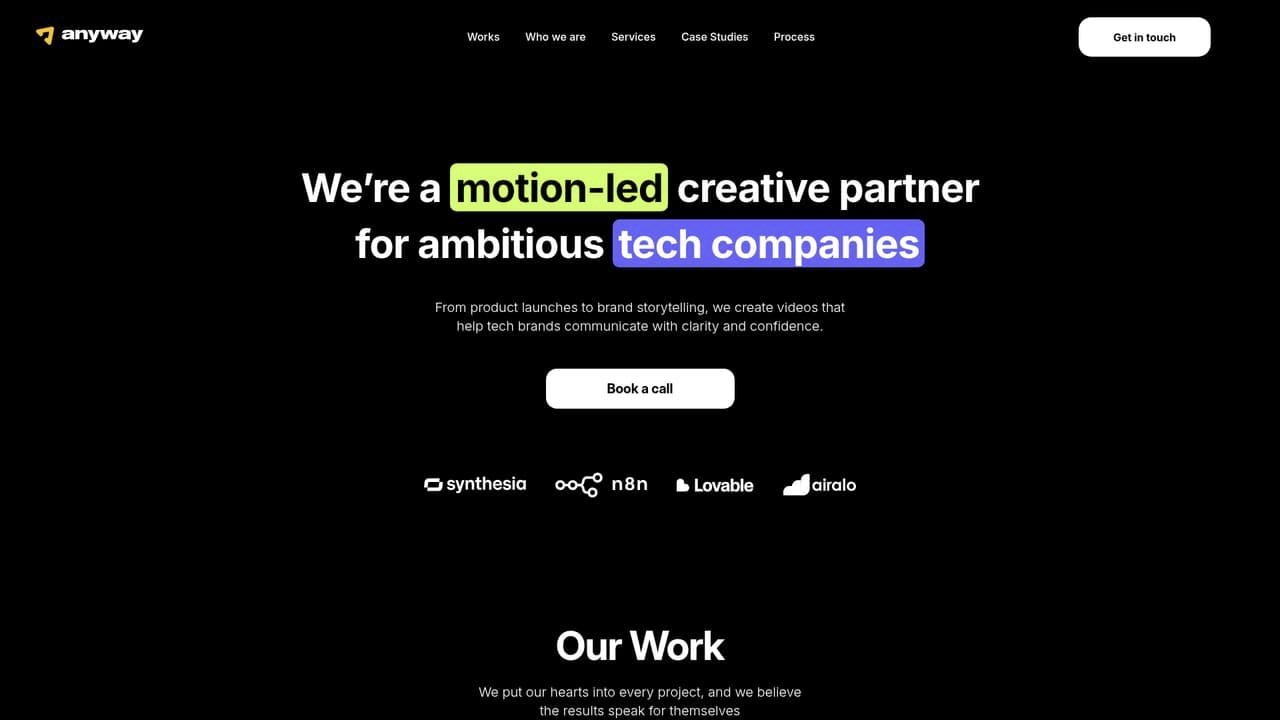
Eight years in, Anyway Studio targets a gap most agencies here ignore: early-stage tech companies and crowdfunding campaigns that need polished video on constrained budgets. The motion-led approach keeps UI designers on staff, which means product interfaces get recreated and animated rather than screen-recorded with a shaky cursor.
AI tools sit inside the production workflow to cut costs and accelerate timelines, a practical choice for clients launching on Kickstarter or Indiegogo, where every week of delay bleeds campaign momentum. Flexible pricing and three revision rounds per production stage keep budgets from running away.
Full copyright ownership and source file delivery come standard. That's a detail easy to overlook until your next agency asks you to relicense your own launch video. Among the agencies here, Anyway Studio holds the budget-conscious tier without dropping to freelancer-level quality.
Pros:
- In-house UI designers produce motion-accurate product animations instead of raw screen captures, so the interface looks intentional
- Full copyright and source file ownership included, unlike some competitors who hold your assets hostage later
- AI-assisted workflow keeps pricing accessible for seed-stage and crowdfunding projects that can't justify a premium quote
Cons:
- Less proven with enterprise-scale SaaS companies than Represent, Venture, or Thinkmojo
- Crowdfunding emphasis may signal less depth in long-cycle B2B sales enablement content
10. Apollo Studio
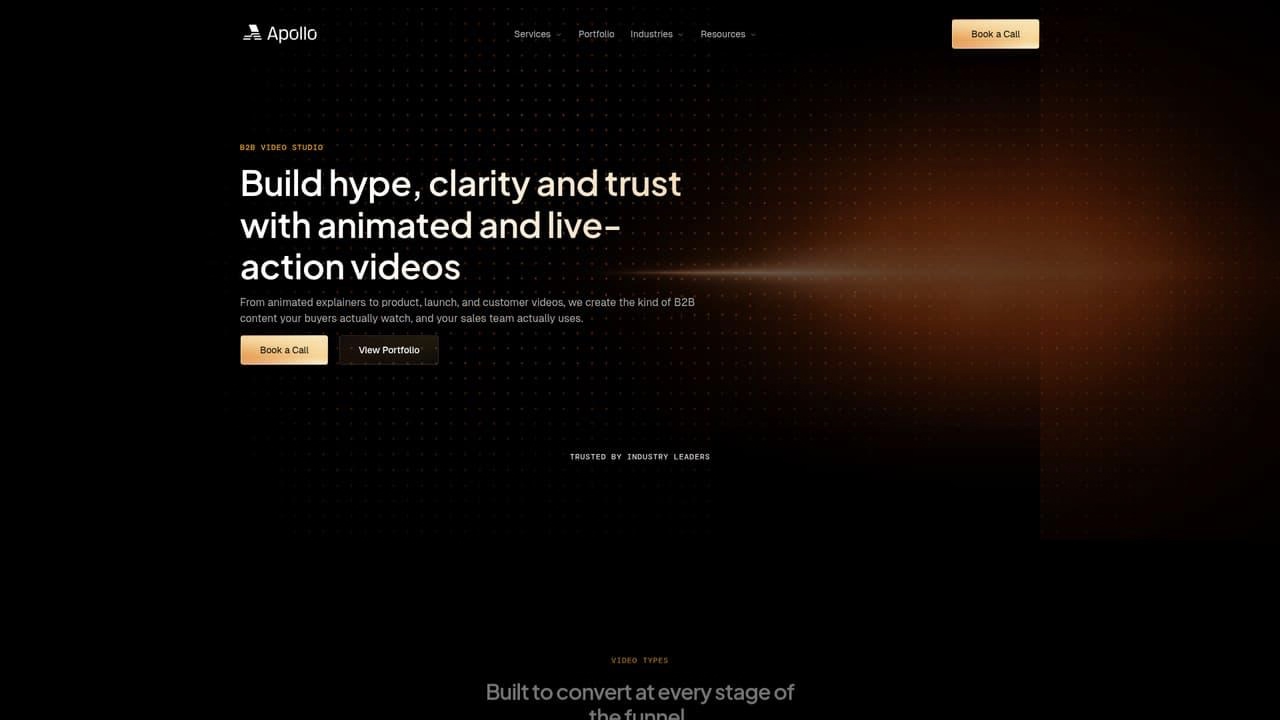
Apollo Studio leads with speed. A 72-hour turnaround on strategy and scripts is the fastest published commitment in this ranking, a pace built for SaaS, AI, and fintech teams working on compressed launch cycles. Co-founder Cade Biegel offers 30-minute strategy sessions directly, adding a consultative layer before production starts.
The studio pairs broadcast-quality live action with data-driven motion graphics, optimizing every asset for web, social, and paid distribution at once. That multi-format delivery matters for B2B sales teams building libraries of enablement content rather than producing a single hero video.
Sector focus spans AI, fintech, cybersecurity, healthcare, and B2B services. The emphasis on cinematic production value lifts Apollo above utility-focused explainer shops, while the sales enablement angle sets it apart from brand-storytelling agencies like Epipheo or Sandwich Video.
Pros:
- A 72-hour script turnaround, the fastest documented commitment among ranked agencies, which suits teams racing a fixed launch window
- Multi-format optimization delivers assets ready for web, social, and paid channels at once, so one production covers several distribution needs
- Direct access to a co-founder for strategic consultation before production begins
Cons:
- Younger agency without the published client volume of Epipheo's 6,000+ videos or Sandwich's 700+
- Speed-first positioning may not suit companies that value deep creative exploration over rapid delivery
A few questions come up again and again when SaaS teams start shopping for a video partner. Here's what matters most.
FAQ
What should a SaaS company look for when choosing a video agency?
SaaS product expertise counts for more than raw video skill. Look for agencies that have worked with complex software interfaces and know how to simplify technical concepts without dumbing them down.
Check whether the agency handles scripting and strategy in-house or farms those steps out. A team that owns the full pipeline from messaging to final edit trims coordination overhead and keeps the product narrative consistent across every deliverable.
How much does a SaaS video typically cost?
Most agencies in this space don't publish pricing. As a rough market benchmark, a single explainer video often runs somewhere between $8,000 and $50,000, depending on length, animation complexity, and live-action requirements. Treat that as an order of magnitude, not a fixed quote.
Subscription models like Superside's monthly retainer fit teams with ongoing needs. Per-project pricing works better when you're producing one or two videos a quarter. Always confirm whether revision rounds and source files are included before you sign.
How long does SaaS video production take?
Timelines vary widely. Venture Videos guarantees four to six weeks for launch and explainer videos. Apollo Studio publishes a 72-hour turnaround on strategy and scripts, though full production takes longer.
Expect most projects to land between four and eight weeks from kickoff to final delivery. Compressed timelines are possible, but they usually demand that your product team prioritize feedback speed and keep the approval chain short.
Should a SaaS company choose a specialist agency or a generalist?
SaaS-specialist agencies like Represent Studio and Venture Videos already understand shifting product roadmaps, incomplete feature sets, and technical buyer audiences. That context saves weeks of onboarding.
Generalists like Demo Duck or Epipheo bring broader creative range and can run campaigns across industries. The right call depends on your primary challenge: explaining a complex product, or producing high volumes of visually diverse content across channels.
When does it make sense to invest in SaaS video content?
Video earns its budget fastest at two moments. Product launch, when you need to communicate value before prospects can try the thing. And sales enablement, when deals stall because buyers can't picture the solution.
If your sales cycle runs past 30 days or your demo-to-close rate is underperforming, video tackles both by shortening comprehension time. Teams already running paid acquisition campaigns also see measurable lifts when they swap static ads for motion content.
.png)
.png)