


The 2026 Agency Evolution: Mastering AI Tools, Video, and Interactivity Video for Marketing Growth
Stop selling hours and start selling outcomes. Explore how AI video for marketing is slashing production costs while interactive features drive 1:1 engagement.



Beyond the Hype
The "hype phase" of Artificial Intelligence has officially ended. In 2026, we have entered the era of Grounded Reality. For marketing agencies, this transition isn't about robots taking over creative chairs; it’s about a quiet, powerful restructuring of how value is created, priced, and delivered.
According to the Productive AI Report 2025, which surveyed over 180 global agencies, 65% of firms are already seeing a direct positive impact on their revenue or profitability thanks to AI. This isn't coming from "magic buttons," but from streamlining the "admin stuff," speeding up production, and scaling without the immediate need for new hires.
In this 2,300+ word deep dive, we explore how the most successful agencies are utilizing AI tools for marketing, the revolution in AI video, and the untapped potential of interactive video to define the next generation of digital services.
Part 1: The State of AI in Marketing Agencies (2026 Data)
Is AI Actually Moving the Needle on Agency Revenue?
The short answer is yes. But the long answer is more nuanced. While headlines once predicted the collapse of the agency model, the reality is that agencies are streamlining their way to better profits.
- Profitability via Efficiency: Most of the revenue boost doesn't come from "new work" but from doing existing work smarter. Agencies are maintaining full prices while delivering faster and cheaper internally.
- The 27% Margin Club: Approximately 27% of agencies report they are keeping or even increasing their prices while AI significantly improves their internal margins.
- Production Speed: Tools for storyboarding, visual generation, and creative ideation are now standard, allowing 3D design teams to increase efficiency by 3-4x.
The Pricing Tug-of-War: Resisting the "AI Discount"
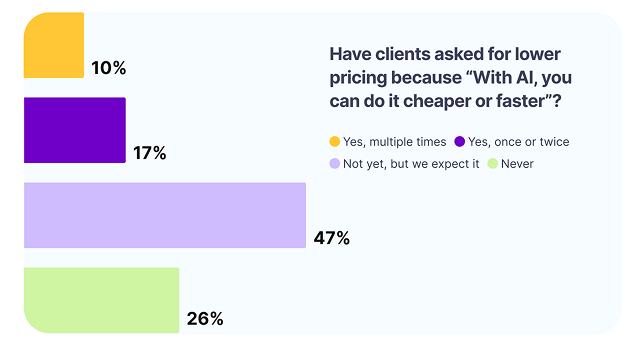
A major trend in 2026 is the "AI Discount" request. Clients see AI as a way for agencies to work "for free," but the data shows agencies are holding their ground.
- Client Pressure: 27% of agencies have been asked by clients to cut rates because "AI is doing the work".
- The Agency Response: Only 13% of agencies have actually lowered their prices. The consensus among leaders is to "defend the value, not the math".
- The Shift to Value-Based Pricing: To survive, agencies are moving away from "time and materials" (hours worked) toward Outcome-Based Models. As Yonah C.L. Van Andel, Owner of On a Daily Basis, puts it: "Trying to reach your revenue targets through hours won't be sustainable because clients expect a lot more within the same budget".
Part 2: AI Tools for Marketing – Beyond the Chatbot
In 2026, the "AI Tool" conversation has moved beyond ChatGPT. Agencies are now "institutionalizing" AI across four key pillars of operation.
1. Operational & Administrative Automation
The first win for most agencies is killing the "admin fatigue" that eats at margins.
- Automated Reporting: Moving campaign data directly into client-ready insights.
- Meeting Intelligence: Auto-generating notes, SOPs, and project READMEs.
- Sales Smoothing: Using AI to draft tailored RFPs and proposals based on historical success data.
2. Content Strategy & Multilingual Expansion
AI has effectively removed the technical and linguistic barriers to global marketing.
- In-House Localization: Agencies are now using AI for translation to deliver non-English campaigns with 80-90% accuracy, eliminating the need for expensive external freelancers.
- GEO (Generative Engine Optimization): A new revenue stream has emerged—optimizing content for visibility within AI-based search engines like Gemini, ChatGPT, and Perplexity.
3. The New "Agentic" Workflow
We are seeing the rise of AI Agents—systems that don't just "chat" but actually execute multi-step workflows.
- The AI Kickstart: Some agencies now sell "AI Education" as a service, teaching clients how to build and use their own agents in secure environments.
Part 3: AI Video for Marketing – The 2025 Creative Revolution
Video remains the most powerful medium in the marketer's toolkit, but in 2025, AI has fundamentally changed how it is produced and scaled.
Why Traditional Video Production is Dying
The old model—renting locations, hiring full crews, and spending weeks in post-production—is becoming a luxury, not a standard.
- Cost Reduction: AI video generators can reduce production costs by as much as 70%.
- Speed to Market: Presenter-led videos that used to take days can now be generated from a text script in under 30 minutes using realistic AI avatars.
- Iterative Testing: Marketers can now run 10 variations of a video ad to see which "hook" resonates best, something previously impossible due to budget constraints.
Personalization at Scale
The "Holy Grail" of marketing has always been 1:1 video. In 2025, it is a reality.
- Dynamic Customization: AI can adjust video content in real-time based on viewer data, such as calling the viewer by name or showing products they previously viewed.
- Predictive Creation: AI tools now analyze viewer behavior to suggest the most effective visual styles or "hooks" before a single frame is rendered.
Part 4: Interactive Video – Moving from Passive to Active
If AI Video is about speed, Interactive Video is about engagement. In 2025, simply "watching" a video is no longer enough for the modern consumer.
The Rise of Shoppable Video
The line between content and commerce has officially blurred.
- In-Video Purchases: Shoppable videos allow viewers to click on items within the video and purchase them without leaving the player.
- Virtual Feel: Interactive elements allow users to change colors, shapes, or view dimensions of a product within the video stream, providing a "virtual feel" that increases conversion rates.
Gamification and Choose-Your-Own-Adventure
Modern audiences, particularly Gen Z and Millennials, want a sense of control over the narrative.
- Branching Narratives: Brands are using "choose-your-own-adventure" formats to let users drive the story, which significantly increases brand recall and "shareability".
- Engagement Loops: By embedding polls, surveys, and Q&As directly into the video, agencies are fostering deeper trust and loyalty than passive ads ever could.
Part 5: The Human Differentiator – Why You Won't Be Replaced
Despite the technological surge, the Productive AI Report highlights a critical truth: Agencies are not replacing people with machines. They are learning to combine the two.
The "Last 10%" and Human Artistry
Thomas Lichtblau of wild digital studio notes that even with AI-accelerated workflows, the "last 10%" that makes work special still requires a human touch.
- Original Thought: AI is stripping away technical barriers, which actually makes original thought and human insight more valuable.
- The Trust Premium: As AI-generated content becomes "table stakes," audiences are beginning to crave authenticity. "Raw" behind-the-scenes content and "Lo-Fi" (low-fidelity) videos often outperform highly polished AI ads because they feel more "human".
The Shift in Workforce Strategy
The data shows agencies are not jumping to cut staff.
- Stability: 64% of agencies have made no layoffs and have no plans to do so.
- Hybrid Roles: Instead of firing, agencies are upskilling. Copywriters are learning "prompt craft," and designers are becoming "AI curators".
- Scaling Capacity: Most teams are simply handling more work with the same number of people, delaying the need for new hires while increasing revenue.
Conclusion: The Agency of 2026 and Beyond
As we move toward 2026, the successful agency will not be the one with the most AI tools, but the one that uses those tools to rethink the value they provide.
- Stop selling hours; start selling outcomes. If you can produce a 3D asset 4x faster, don't charge 4x less—reinvest that time into strategy.
- Embrace Video Interactivity. Passive video is the billboard of 2025. Interactive, shoppable, and personalized video is the storefront.
- Institutionalize AI Literacy. As Thomas Van Sundert from November Five says, "AI is no longer optional". It must be part of the daily workflow for everyone from HR to Engineering.
The AI era isn't replacing the agency model—it is forcing it to evolve. The agencies that adapt the fastest will define the future of the industry.
FAQ: Common Questions on AI in Marketing (2025)
Q: Are clients really asking for AI discounts?
A: Yes, about 27% of agencies report being asked, but the vast majority (nearly 90%) have refused to lower their rates, choosing instead to emphasize the value of human strategy.
Q: What is the most common use of AI in agencies today?
A: Most agencies focus on "streamlining operations"—automating admin, meeting notes, and internal reporting to free up time for creative work.
Q: Does AI video look "fake"?
A: While early versions did, 2025-era AI video includes realistic avatars and "emotionally responsive" visual generation that is often indistinguishable from traditional low-to-mid-budget productions.
Q: How is AI video for marketing affecting the hiring of creative talent?
A: Most agencies are not using AI to replace staff. Instead, they are utilizing AI video tools to scale production capacity and "stretch" their existing teams. In fact, 64% of agencies report having made no layoffs and have no plans to do so, choosing instead to prioritize evolving human skills over cutting headcount.
Q: Can interactive video content actually provide a measurable ROI for clients?
A: Yes, because it shifts the focus from passive "hours worked" to measurable "outcomes and impact". Interactive features like shoppable links or branching narratives allow agencies to price based on results, which aligns incentives and eliminates the need for "speed discounts" associated with traditional video production. This helps agencies keep or even raise prices while improving their own margins.
Q: What is the biggest barrier to adopting new AI tools for marketing in 2025?
A: The primary barrier isn't the technology, but the "narrative" of anxiety and the gap between expectations and reality. Successful agencies are overcoming this by institutionalizing AI literacy and making it a non-optional part of daily workflows. Many agencies are currently in "trial mode," where the challenge lies in moving from small-scale experimentation to creating truly meaningful new revenue streams.
.png)
.png)



.avif)
