Why Video Revision Cycles Are Quietly Killing Your L&D Team's Output (and How to Fix It)
L&D teams blame slow video production on creation time, but revision cycles are the real drain. Here's why feedback loops stall content, and how to fix them.


Most Learning & Development (L&D) teams don't have a content creation problem. They have a video revision cycle problem, and it's the one nobody budgets for.
A new compliance module gets scripted, filmed, and edited on schedule. Then it sits in review for three weeks while legal, a subject matter expert, and a regional manager each leave conflicting comments in three different places. By the time everyone agrees on a final cut, the "quick training video" has eaten a month of calendar time and nobody can say exactly where it went.
This is the part of training video production that quietly determines whether your team ships four modules a quarter or twelve.
What's Actually Slowing Down Your Video Revision Cycle?
The bottleneck is rarely the editing itself. It's the gap between "send for review" and "approved for publishing."
When feedback comes in through email threads, shared drives, and chat messages, someone on the production side has to translate all of it into something an editor can act on. A comment like "fix the audio around the two-minute mark" means re-watching the whole video to find the spot, then cross-referencing it against four other emails saying different things about the same section.
Multiply that by every reviewer (HR, compliance, the SME, a regional stakeholder), and a single round of "minor edits" can take longer than the original edit.
How Much Time Do These Cycles Actually Cost?
More than most L&D teams realize, and the data backs this up.
One multinational manufacturer saw AI cut its content drafting time by 55%, but review cycle time increased by 18% because subject matter experts were asked to weigh in more often. Deployment timelines for the finished training didn't move at all, the bottleneck simply shifted from writing the content to validating it.
That's the pattern across most L&D teams: production speeds up, but the back-and-forth around approval doesn't. The result is a queue of "almost done" videos sitting in inboxes instead of LMS modules in front of learners.
Why Doesn't Faster Content Creation Fix the Bottleneck?
Because creation and review are two different workflows, and only one of them has been getting faster.
AI tools have made it dramatically quicker to draft scripts, generate voiceovers, and assemble first cuts. But none of that touches the part where five people need to agree on a finished video before it can be published. If anything, faster drafts mean reviewers see more versions, more often, which is exactly the dynamic that drove that 18% increase in review time.
Fixing the revision cycle requires a different kind of tool than the one that fixes content creation.
How Can Centralizing Feedback Shorten the Revision Loop?
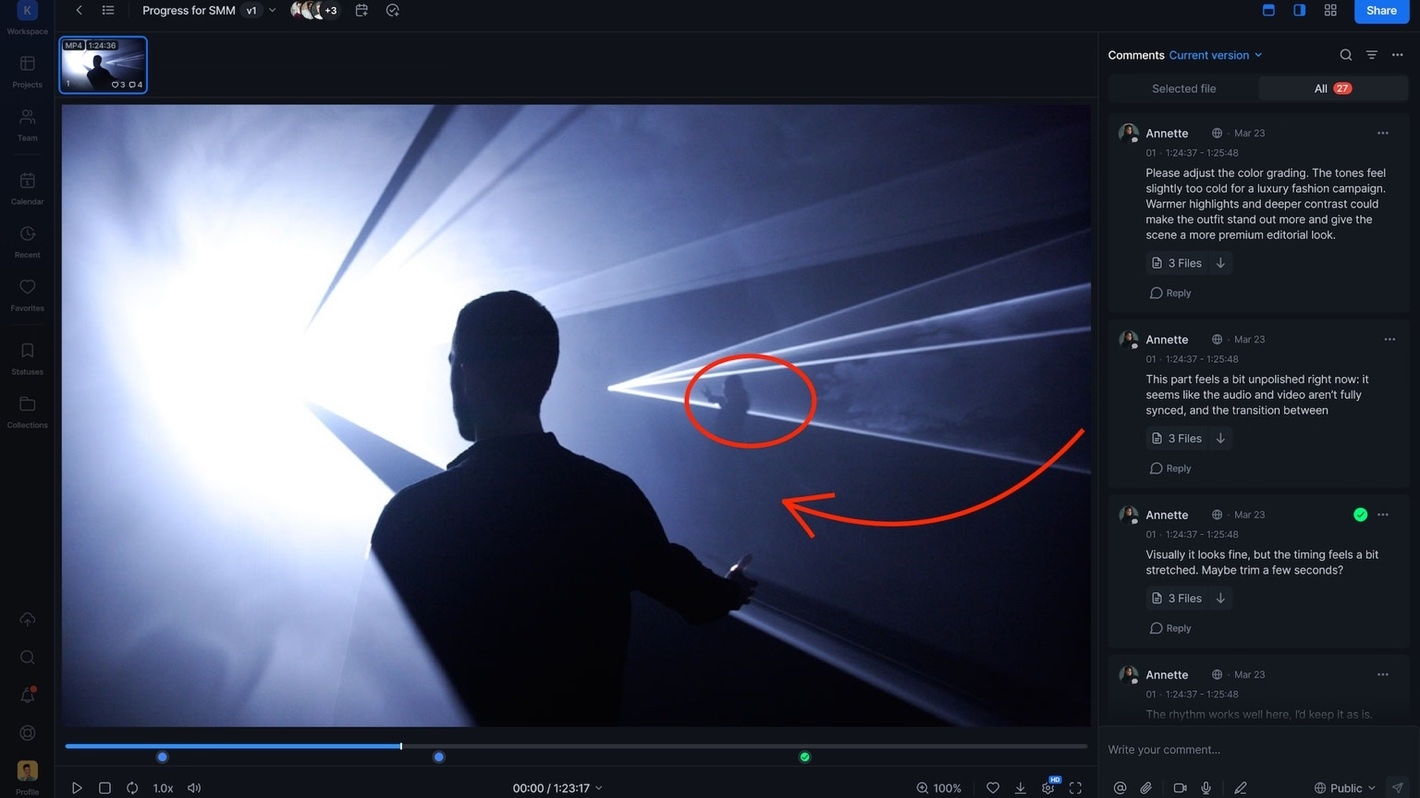
The fastest fix most L&D teams overlook is moving feedback off email and into a tool built around the video timeline itself.
Instead of "the audio issue around two minutes in," a reviewer drops a timestamped comment directly on the frame where the problem occurs. Every stakeholder (legal, the SME, the regional manager) comments on the same version of the video, in the same place, with no version-naming confusion ("Final_v3_REAL_FINAL.mp4"). The editor opens one dashboard and sees every piece of feedback mapped to the exact second it applies to.
For L&D teams managing multiple reviewers across departments, this is where platforms built specifically for this, like the best video review software, earn their keep. The point isn't just speed; it's removing the translation step entirely, so feedback goes straight from reviewer to editor without anyone acting as a go-between.
Many production teams already have a tool like Frame.io in place for creative review, but L&D's approval chain looks different: legal, compliance, SMEs, and regional managers, not just creative leads. That's often the gap a frame.io alternative is built to close, with permission and workflow structures designed around cross-departmental sign-off rather than single-team creative feedback.
What Happens After the Video Is Locked?
Once a training video clears review, the work isn't over, it just moves into a different phase.
A locked video is still a passive asset. Learners watch it, but there's no way to confirm they understood it, and no data on which sections they rewatched or skipped. This is where interactive layers come in: turning a finished video into a module with embedded knowledge checks, branching scenarios, and chapter markers that feed directly into an LMS as SCORM-compliant content.
Tools like Clixie AI handle this stage by adding quizzes, decision points, and analytics on top of an already-approved video, without requiring a re-shoot or another round of stakeholder review, since the underlying footage hasn't changed.
How Should L&D Teams Restructure Their Video Workflow?
Three changes consistently shorten the gap between "filmed" and "published":
- Set a hard cap on revision rounds before production starts. Two rounds, agreed upon in advance, forces reviewers to consolidate feedback instead of trickling in comments over weeks.
- Get every reviewer commenting on one version, in one place. Scattered feedback channels are the single biggest source of duplicated and contradictory comments.
- Separate "is this video correct" from "is this video effective." Compliance and accuracy review should happen before interactivity is added. Engagement and learning-design review can happen after, on the interactive version, without re-opening the accuracy debate.
None of this requires a bigger production budget. It requires treating the review stage as a workflow to be designed, not a gap between two "real" steps.
Frequently Asked Questions
How many revision rounds are normal for a training video?
Two rounds is a reasonable target for most training videos: one for factual accuracy and compliance, and one for final polish. More than three rounds usually signals that feedback isn't being consolidated before it reaches the editor.
Why does AI-generated content increase review time instead of reducing it?
Faster drafting means reviewers see more versions in less time, and SMEs are often asked to weigh in more frequently as a result. Without a faster review process to match, the extra drafting speed gets absorbed by longer approval queues.
What's the difference between video review and video approval?
Video review is the back-and-forth of collecting feedback on a draft. Video approval is the formal sign-off that a version is final. Teams that blur these two steps tend to keep "reviewing" approved videos, which is a common source of scope creep in revision cycles.
Can L&D teams fix revision bottlenecks without changing their video tools?
Some improvements, like capping revision rounds or assigning a single point of contact for consolidated feedback, can be done with existing tools. But timestamped, centralized feedback is difficult to replicate in email or chat, which is why most lasting fixes involve a dedicated review tool.
Does adding interactivity to a video create more revision rounds?
Not if it's sequenced correctly. Accuracy and compliance review should happen on the base video before interactive elements are added. Adding quizzes or branching paths afterward is a design layer on top of already-approved content, not a reason to reopen the approval process.
The Real Fix Is Sequencing, Not Speed
Training video production doesn't slow down because teams can't create content fast enough. It slows down because review and approval aren't designed as a workflow, they happen by accident, across whatever channels reviewers prefer that week.
L&D teams that get this right separate the process into two distinct stages: lock the video for accuracy first, then layer in interactivity and analytics second. Get the sequencing right, and the revision cycle stops being the place where training projects quietly stall.
.png)
.png)