Water Management: How Motmot Used AI Video Production to Transform Technical Training
Discover how Motmot used Clixie's AI video production to create compliant, interactive training for water infrastructure in just 72 hours.
.png)


Data that Keeps the Water Flowing
Training field crews on complex municipal water infrastructure is a massive challenge. Traditional methods—like on-site filming or high-end 3D animation—are often too slow, too expensive, or simply impossible when trying to visualize underground assets.
Motmot, a leader in water infrastructure intelligence, faced this exact problem. They needed to teach non-technical stakeholders and municipal field teams how to prepare hydrants for inspection using autonomous underwater robots. The catch? They needed to visualize "invisible" internal valve mechanics, adhere to strict AWWA C651 compliance standards, and deliver the final asset in just three days.
By partnering with Clixie.ai, Motmot bypassed the limitations of traditional media. Using an end-to-end AI video production workflow, they created a fully interactive, compliant training module in record time.
Here is how generative AI for business is reshaping technical training for the utility sector, and how you can apply these same strategies to your operations.
The Challenge: Visualizing the Invisible
For companies in the heavy industry and utility sectors, water infrastructure management is often about what you can’t see.
Motmot deploys autonomous underwater robots (AUR) into active water mains to collect inspection data. To launch these robots, field crews must follow a precise sequence of hydrant operations, including backflow prevention, disinfection, and pressure testing.
Filming this process presented three major hurdles:
- Physical Limitations: You cannot easily film the inside of a pressurized hydrant or an underground isolation valve to show a student exactly how the seat cleans itself.
- Budget Constraints: Hiring a full film crew, plus motion graphics artists to animate the underground cross-sections, would have cost thousands of dollars—far exceeding the budget for a single training asset.
- Urgent Timeline: Motmot needed a finished product in days to meet a critical municipal partner deadline.
The traditional route was a dead end. Motmot needed a technical explainer video solution that was fast, accurate, and engaging.
The Solution: An AI-First Production Workflow
To solve these challenges, Clixie implemented a workflow that leveraged three distinct AI technologies: ChatGPT for technical scripting, Midjourney for static visualization, and Google Veo 3 for generative video.
Here is the step-by-step breakdown of how this AI video production workflow came together.
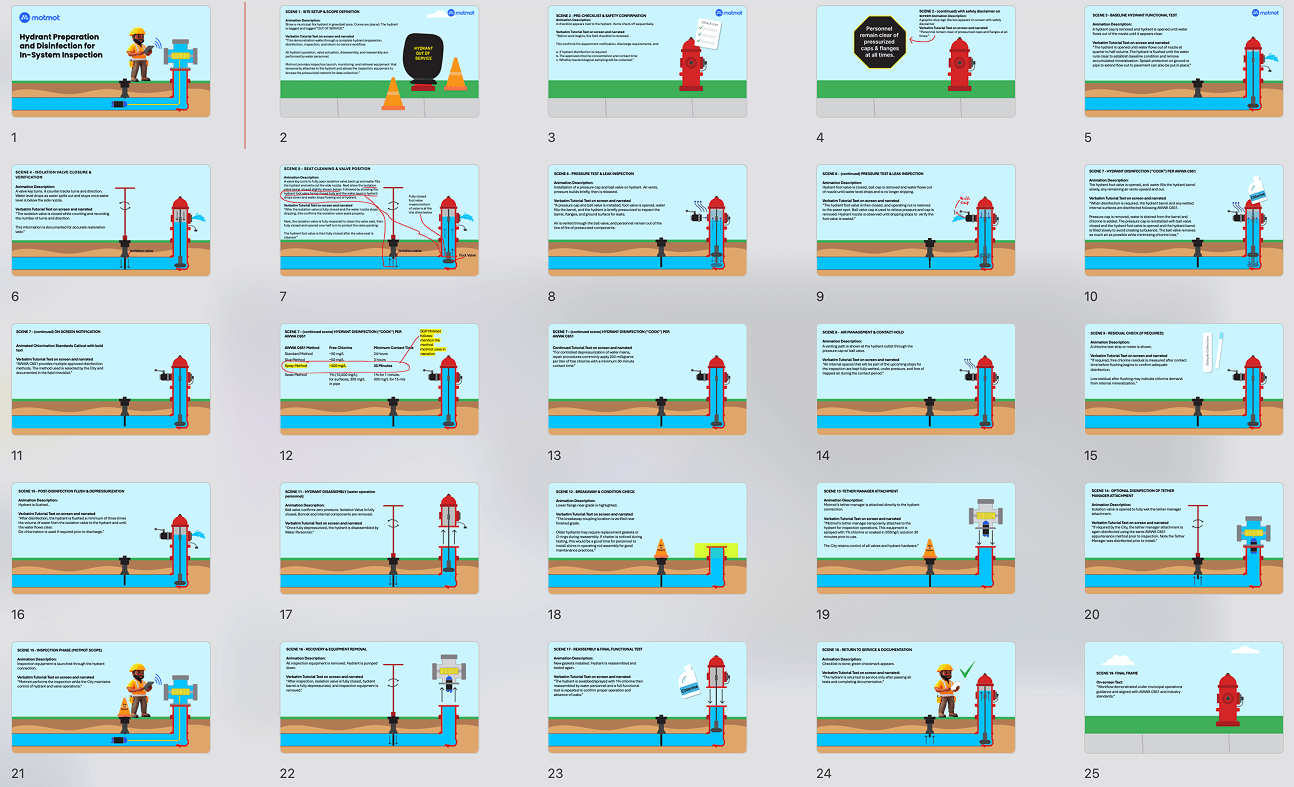
1. Automated Compliance Scripting
Writing a script for municipal training isn't just about creativity; it's about accuracy. One wrong phrase regarding chlorine contact time or pressure relief could render the training non-compliant.
Clixie utilized ChatGPT to ingest Motmot’s raw technical storyboards and standard operating procedures (SOPs). The AI was prompted to structure the content into a clear, narrated script that aligned strictly with AWWA C651 standards.
The result was a precision-engineered script that accurately described complex procedures—like the "slug method" vs. the "spray method" for disinfection—without requiring days of back-and-forth editing.
2. Generative Visuals for Underground Assets
This was the most critical phase: visualizing underground water infrastructure without a camera.
Standard stock footage of fire hydrants is easy to find. Cross-sections of specific isolation valves showing water flow and sediment flushing? That is nearly impossible to source off the shelf.
Clixie used Midjourney to generate high-fidelity diagrams of the hydrant internals. Then, they utilized Google Veo 3, a state-of-the-art generative video model, to animate these images.
The AI generated realistic clips showing:
- Water filling the hydrant barrel.
- The mechanical actuation of the foot valve.
- Sediment being flushed out during the "baseline functional test."
This allowed Motmot to show the "cause and effect" of valve operations that are usually hidden underground, significantly improving the educational value of the content.
3. Interactive Delivery for Engagement
Linear videos are passive. For safety-critical training, you need active engagement.
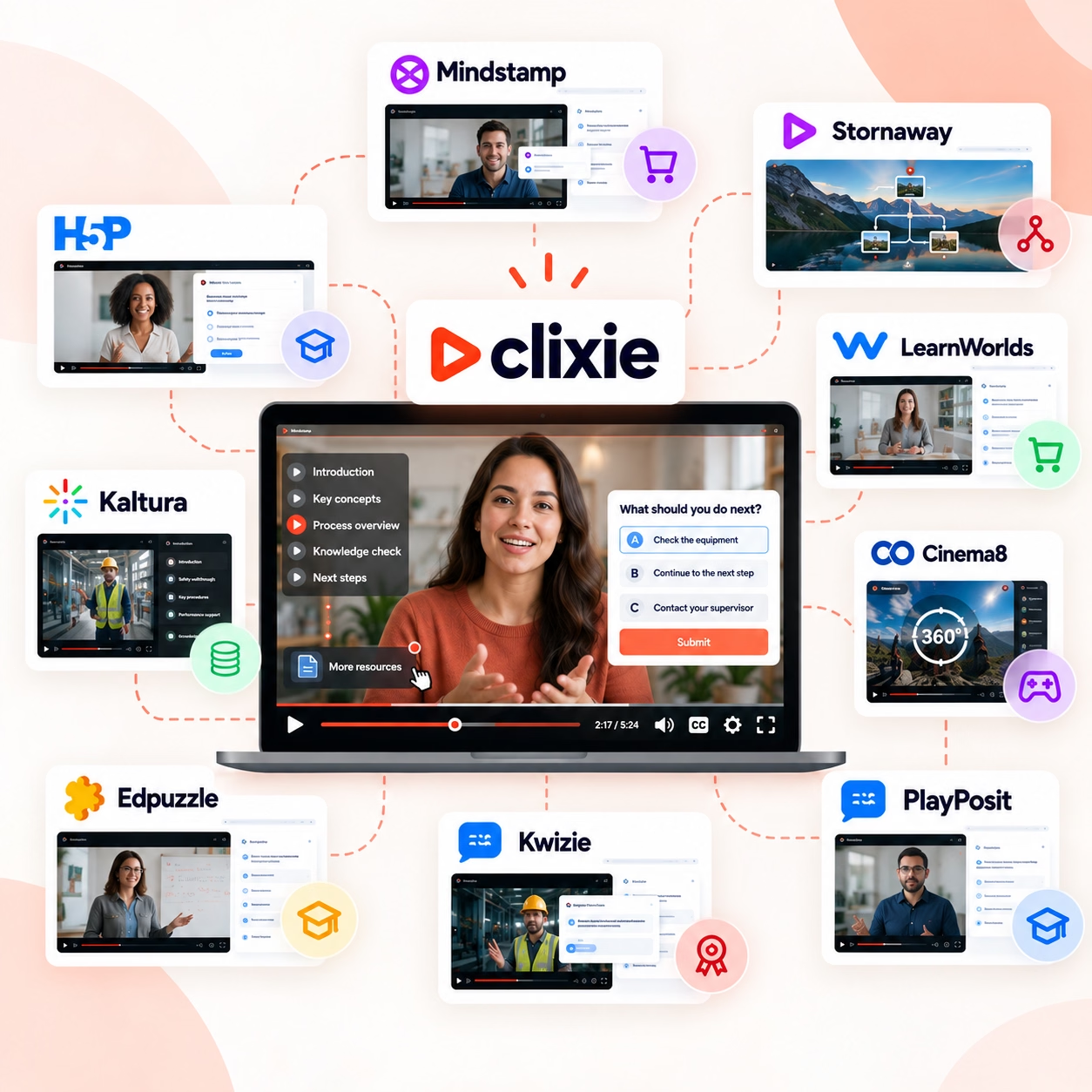
Once the video and audio were generated, the asset was hosted on the Clixie interactive video platform. This allowed the team to add clickable chapters for specific procedures (e.g., "Seat Cleaning," "Tether Manager Attachment").
Furthermore, because Clixie supports interactive training videos, the content was instantly localized. Municipalities with diverse workforces could toggle between English, Spanish, and Portuguese, ensuring that safety protocols were understood by every member of the crew.
Key Outcomes: Speed, Cost, and Compliance
The collaboration between Motmot and Clixie proved that AI video generation for technical workflows delivers tangible business results.
- 72-Hour Turnaround: The project went from concept to final delivery in three days, beating the deadline.
- Cost-Effective Production: By eliminating location scouting, film crews, and manual 3D animation, Motmot saved significantly on production costs.
- Enhanced Technical Clarity: The AI-generated visuals provided a clearer view of internal mechanics than physical cameras ever could.
- Regulatory Compliance: The video served as a valid digital training tool for municipal partners, fully aligned with industry regulations.
Why Utilities Are Switching to Interactive Training
The Motmot case study highlights a broader trend in utility management software and training. As infrastructure ages and the workforce retires, the "knowledge gap" is widening. Utilities need to capture institutional knowledge and transfer it to new hires faster than ever.
Reduced Production Time for Startups
For water technology companies, speed is a competitive advantage. Waiting weeks for a marketing or training asset can stall a pilot program. Generative AI for business allows startups to produce professional-grade content at the speed of software development.
Better Engagement for Field Crews
Old manuals and static PowerPoint slides don't hold attention. Interactive content for municipal decision makers and field crews ensures higher retention rates. When a user has to click to proceed or answer a quiz question about pressure limits, they are actively learning, not just watching.
Scalable Localization
Many heavy industries rely on a multilingual workforce. B2B video production that is locked in a single language limits its utility. AI tools allow for rapid, cost-effective translation and dubbing, ensuring that employee safety training videos are accessible to everyone on the job site.
How to Get Started with AI Video Production
If you are looking to modernize your municipal water systems training or technical marketing, you don't need a Hollywood budget. You need the right tools.
- Audit Your Content: Identify high-value SOPs that are currently text-heavy or difficult to visualize.
- Define Your Standards: Ensure you have your compliance documents (like AWWA standards) ready to feed into the AI for scripting accuracy.
- Choose the Right Platform: Look for a no-code video platform like Clixie that combines creation, interactivity, and analytics in one place.
The Future of Industrial Training
Visualizing complex processes doesn't have to be a headache. Whether you are managing aging water infrastructure or training a new generation of technicians, AI offers a path to create better content, faster.
Motmot used this technology to solve a critical business problem in 72 hours. What could your team achieve with the same tools?
Frequently Asked Questions
How do you explain complex water infrastructure to non-technical audiences?
The best approach is visual simplification. Instead of dense engineering schematics, use AI-generated cross-sections and animations to show "cause and effect." For example, showing a cutaway of a valve closing helps a non-engineer understand why water flow stops, without needing to understand the fluid dynamics equations behind it.
What are the benefits of AI in industrial video production?
The primary benefits are speed, cost, and safety. AI allows you to visualize dangerous or inaccessible environments (like underground pipes or chemical tanks) without putting a film crew at risk. It also drastically reduces the time and cost compared to traditional 3D animation.
How can I visualize underground pipes without 3D modeling?
Generative AI video tools (like Google Veo 3 or Sora) and image generators (like Midjourney) can create realistic visualizations of underground assets based on text descriptions and reference images. This bypasses the need for expensive, time-consuming manual 3D modeling.
What is the fastest way to create technical B2B marketing videos?
An AI-first workflow is currently the fastest method. By using AI for scripting, voiceover, and visual generation, companies can produce technical B2B videos in days rather than weeks. Platforms like Clixie streamline this by bringing these tools into a single ecosystem.
Take Your Content Creation to the Next Level
Start leveraging AI-driven tools to accelerate your workflow and produce high-quality technical marketing videos today. Visit our platform to learn more and get started!
Book a demo to see how Clixie can accelerate your video production
.png)
.png)