Zero-Click Search: The Quiet Shift Reshaping Marketing
With nearly 60% of searches ending without a click, AI Overviews are changing SEO. Here’s what zero-click search means for your strategy and how to adapt.


TL;DR
- The New Reality: Nearly 60% of searches now end without a click, driven by AI summaries and platforms keeping users in their own ecosystems.
- Traffic Does Not Equal Influence: A drop in website visits doesn't mean a drop in brand impact. Being cited by AI builds authority, even if traditional analytics can't track it easily.
- The AI-Proof Strategy: AI can summarize text and standard videos. To survive, brands must pivot to interactive videos and emotional storytelling that require active human participation.
- Next Steps for Leaders: Optimize content for AI extractability (clear structures, FAQs), audit your brand's presence in AI answers, and shift success metrics from pure traffic to engagement.
Have you noticed that your search results look entirely different lately?
Instead of a list of blue links, you're now handed a synthesized, AI-generated answer right at the top of the page. More often than not, you get what you need without ever clicking through to a website.
This isn't an accident. Search engines have evolved into Answer Engines, and this shift is quietly fundamentally changing how digital marketing works.
What Exactly Is a Zero-Click Search?
A zero-click search happens when a user gets the answer to their query directly on the search engine results page (SERP) without needing to visit a third-party website. Traditional examples of this include featured snippets, knowledge panels, and inline map results. However, modern zero-click searches have expanded dramatically due to:
- AI-generated summaries (like Google's AI Overviews and Bing's Copilot)
- Conversational search interfaces (like ChatGPT and Perplexity)
- Voice assistants (Alexa, Siri, Google Assistant) reading answers aloud
- In-app searches on closed-loop platforms (TikTok, Amazon, LinkedIn)
The bottom line? Your content may be seen, cited, and used to inform a customer's decision, but you may never register that interaction as a visit in your analytics platform.
Why Are AI and Zero-Click Searches Accelerating?
Traffic patterns are changing even when consumer demand is not. Three primary forces are driving this structural change in how search delivers information.
How has AI replaced traditional link lists?
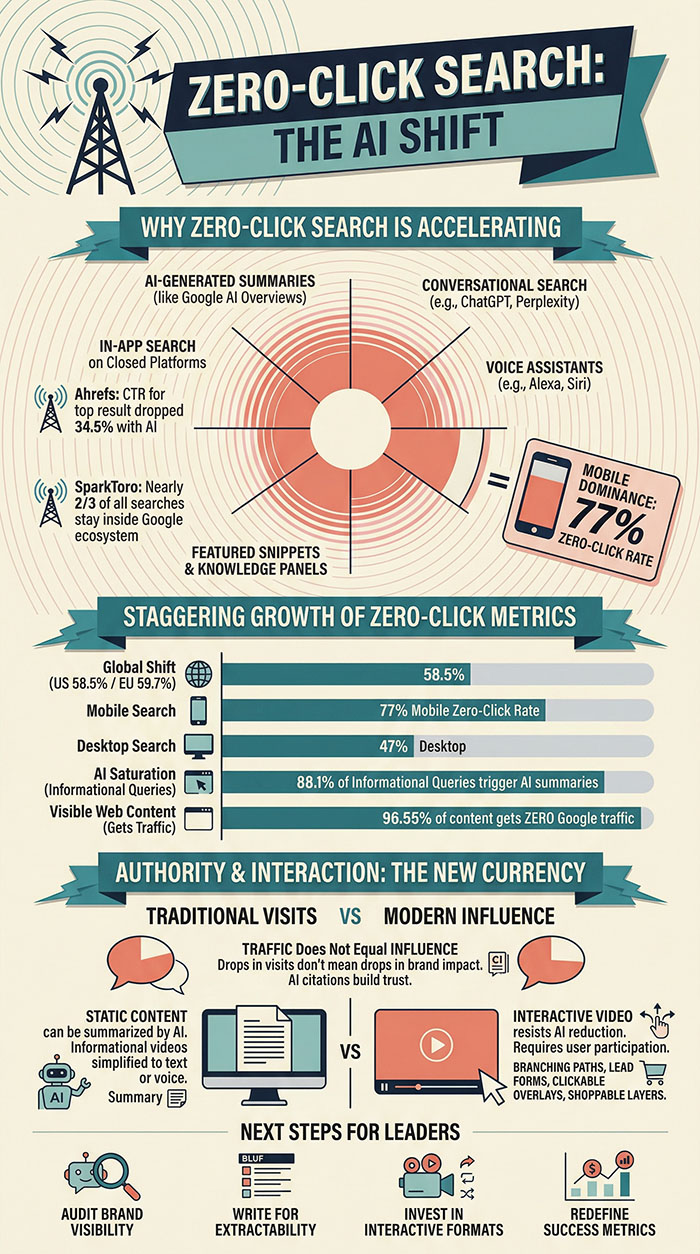
Search engines now synthesize information instead of acting as a directory. When Google introduced AI Overviews, research from Ahrefs found that the average click-through rate (CTR) for the top-ranking result on those keywords dropped from 7.3% to 2.6%. That is a massive 34.5% decline in clicks when an AI-generated summary appears.
Why do platforms want to keep users inside their ecosystems?
Tech giants have strong financial incentives to reduce outbound clicks. According to SparkToro’s 2024 analysis, almost 30% of all clicks now go to platforms Google owns. Furthermore, nearly two-thirds of all searches stay entirely inside the Google ecosystem after a query is made.
Do users actually prefer instant resolution?
Yes. Convenience always wins over exploration. When a search engine provides a satisfactory answer immediately, approximately 37% of searches end the browsing session entirely, according to SparkToro.
What Does This Mean for Business Traffic and Attribution?
The implications of the zero-click shift extend far beyond vanity traffic metrics.
The Staggering Growth of Zero-Click Metrics
Users are finding answers without you. Look at the data:
- The Global Shift: 58.5% of U.S. searches and 59.7% of EU searches result in zero clicks.
- Mobile Dominance: While desktop searches see a 47% zero-click rate, mobile search has skyrocketed to 77%.
- The 96% Invisible: A staggering 96.55% of all web content currently receives absolutely zero traffic from Google.
- AI Saturation: Roughly 88.1% of informational queries—the bread and butter of B2B marketing—now trigger AI-generated summaries.
Why Authority is the New Currency
Being cited by an AI matters more than being visited by a user. If your website is extracted to fuel an AI Overview, users may trust your brand and seek you out later. This influence won't appear in Google Search Console as a referral visit, making attribution murky. The challenge is ensuring your content is clear and authoritative enough (E-E-A-T) that AI wants to cite you.
How Does Zero-Click Search Affect Video Content?
Video marketing is not immune to the AEO shift, but it offers unique protection if utilized correctly.
Can AI summarize informational videos?
Yes. A standard 10-minute explainer or tutorial video can easily be parsed, transcribed, and reduced to a text summary or voice-assistant response by AI. Users can get your insights without ever watching your video.
Why do demonstration and emotional videos survive?
Visual proof and human storytelling resist AI reduction. Product demonstrations, customer testimonials, and narrative-driven content retain their value because they offer visual evidence and an emotional connection that an AI text summary simply cannot replicate.
How do you optimize video for AI extraction?
For video to remain discoverable as a cited source, technical clarity matters:
- Upload accurate transcripts so AI can parse the spoken content.
- Use video chapters to help systems identify specific segments.
- Provide clear, spoken definitions to improve extractability.
Why Is Interactive Video the Ultimate AEO Strategy?
Static content can be summarized by AI. Interactive experiences cannot be compressed.
As search traffic drops, businesses must pivot to formats that require active human participation. Interactive video creates differentiation through:
- Branching paths that let users choose their own journey.
- Embedded forms that capture lead information directly inside the player.
- Clickable overlays that link to products or external pages.
- Shoppable layers that enable direct, frictionless purchases.
When you use interactive video, you shift the focus from passive visits to active outcomes. Users reveal their preferences and take actions that generate valuable first-party data, offsetting the loss of traditional search traffic.
What Should Marketing Leaders Do Now?
Zero-click search isn't eliminating marketing; it's eliminating marketing built solely on traffic. To adapt, take these four steps:
- Audit Brand Visibility: Search your customers' top questions on ChatGPT, Perplexity, and Google. See if your brand appears in the AI summaries.
- Write for Extractability (BLUF): Use clear headings, answer questions immediately in the first sentence, and cite credible sources.
- Invest in Interactive Formats: Shift budget toward interactive video and tools that create engagement AI cannot summarize away.
- Redefine Success Metrics: Track brand mentions, AI citation frequency, and deep engagement metrics instead of just top-of-funnel traffic volume.
Frequently Asked Questions (FAQ)
What is Answer Engine Optimization (AEO)?
Answer Engine Optimization (AEO) is the process of formatting and structuring your content so that AI models (like ChatGPT, Perplexity, or Google's AI Overviews) can easily extract, understand, and cite your brand as the direct answer to a user's question.
Does a drop in search traffic mean my SEO is failing?
Not necessarily. In a zero-click environment, your content may still be actively read and cited by AI. Your brand is building authority and influencing decisions, even if that influence doesn't register as a click in traditional analytics tools.
Is video content affected by AI Overviews?
Yes. Basic informational videos can be easily summarized into text by AI. However, highly visual product demonstrations, emotional storytelling, and interactive videos (which require user choices) cannot be summarized and hold their value exceptionally well.
How can I make my website's content more "AI-friendly"?
To ensure your brand is cited by AI, write using the "Bottom Line Up Front" (BLUF) method. Answer questions directly in 1-2 sentences right after a heading, use formatting like bullet points, implement schema markup, and provide transcripts for all multimedia.
.png)
.png)



.avif)