


AI Video Localization for Training Videos: Complete Workflow, Tools, and Best Practices [2026]
Learn how to localize training videos using AI subtitles, dubbing, and interactive workflows. Compare top tools and see Clixie AI in action.
![AI Video Localization for Training Videos: Tools & Workflow [2026]](https://cdn.prod.website-files.com/646b666669cbb97ed8baef9f/6a09ca5fb300ae34870ad34f_ai-video-localization-training-videos.avif)


AI video localization helps L&D teams translate training videos, subtitles, dubbing, quizzes, branching paths, and LMS packages into multiple languages from one source workflow — without agencies, studio recording, or rebuilding content for each market.
TL;DR
- The critical gap: Most AI video tools localize subtitles and audio — but only platforms that also localize the interactive layer (quizzes, branching paths, hotspot labels, CTAs) deliver a fully localized learning experience.
- Research from MIT and the International Journal of Educational Research shows comprehension improves by up to 30% when training is delivered in a learner's native language rather than a second language.
- Organizations that offer localized learning programs see 21% higher employee retention than those that don't, according to a Rosetta Stone Business survey.
- Traditional studio dubbing costs $160–$430 per minute per language; AI-based localization platforms deliver up to 80% cost savings with turnaround measured in hours, not weeks.
- This guide covers the full 7-step localization workflow, a verified tool comparison, best practices, common mistakes, a platform selection framework, and a complete glossary.
Key Takeaways
- AI video localization is an automated process that transcribes, translates, dubs, and adapts all video elements — including interactive layers — into multiple languages simultaneously.
- Interactive layer localization is the process of translating quiz questions, branching path text, hotspot labels, and calls-to-action within a training video — separate from, and in addition to, subtitle and audio localization.
- eLearning localization is a content strategy that adapts learning experiences to the language, culture, and regional context of each learner audience — not just the words on screen.
- SCORM is a technical standard, maintained by Rustici Software and ADL, that governs how localized training videos communicate completion, progress, and assessment data to a Learning Management System.
- xAPI (Tin Can API) is a learning data standard, documented at ADL Net, that tracks a broader range of learner interactions than SCORM, including per-language engagement events in multilingual deployments.
- AI dubbing is a voice synthesis process that replaces original speaker audio with translated, synthetically generated speech that preserves the original speaker's tone, pacing, and timing.
- Branching video is an interactive video format that routes learners through different content paths based on their choices — requiring localization at the decision-point level, not only at the surface text level.
- Subtitle burn-in is the practice of permanently embedding subtitles into a video file during post-production, making post-production translation impossible without re-rendering the entire video.
- Localization workflow is the end-to-end operational process of adapting content from a source language into target languages, encompassing transcription, translation, voice production, interactive element adaptation, quality review, and LMS packaging.
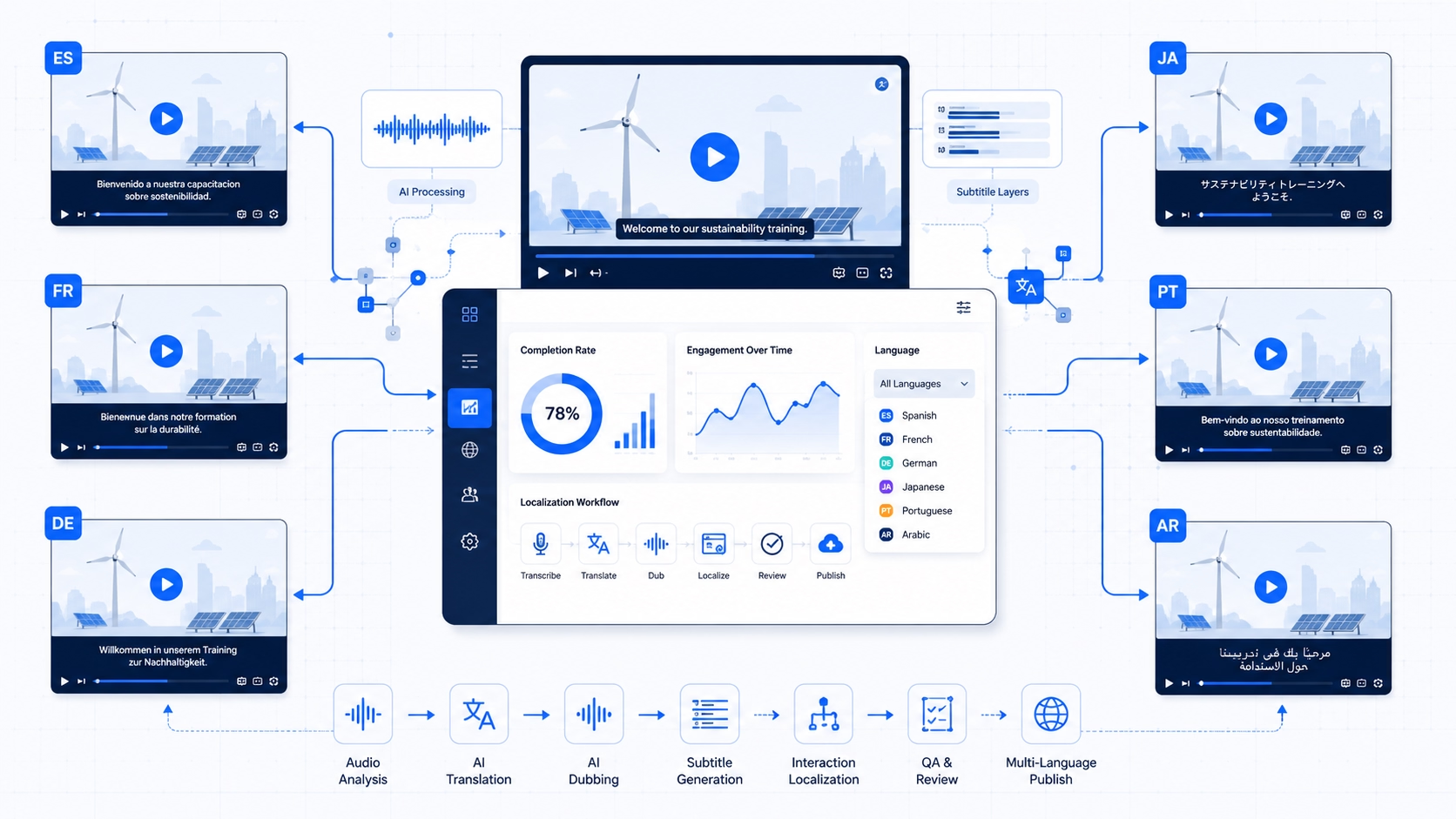
Introduction
Across global Learning and Development teams, a consistent operational gap emerges: training content is centralized in English while workforces become increasingly multilingual. The result is predictable — lower comprehension, weaker knowledge retention, and compliance programs that exist on paper but fail in practice.
Research from MIT and the International Journal of Educational Research, cited by BeTranslated, shows comprehension improves by up to 30% when training materials are delivered in a learner's native language rather than a second language. Organizations that invest in localized learning programs see 21% higher employee retention than those that don't, according to a Rosetta Stone Business survey. These outcomes are not incidental — they are directly tied to whether training reaches learners in a language they process fluently.
The historical barrier was cost and complexity. Traditional video localization ran through translation agencies, voice talent, studio recording sessions, and manual timeline editing — for each target language, for every content update. According to Immersive Fox's 2026 cost analysis, a 5-minute training video localized into five languages through a traditional production workflow costs $22,500–$32,500 or more. Studio dubbing alone runs $160–$430 per minute, per language (Immersive Fox, citing dubly.ai).
AI video localization has changed both constraints. Transcription, translation, voice dubbing, and — critically — interactive element adaptation can now be managed within a single platform workflow, at a fraction of the cost, in a fraction of the time.
The distinction that matters most for L&D teams: interactive layer localization. Most AI video translation tools address the media layer — subtitles and dubbed audio. Very few localize the interactive layer: the quiz questions, branching paths, hotspot labels, and calls-to-action that drive engagement and assessment outcomes in modern training videos. When only the media layer is translated, the localized experience is incomplete. Learners encounter dubbed narration in their native language alongside English quiz questions — a broken training experience that undermines the entire localization investment.
This guide covers what AI video localization involves at the component level, how to evaluate tools, a complete 7-step implementation workflow, best practices, common mistakes, and a decision framework for selecting the right platform by use case. Internal links to related AI-powered corporate learning resources and interactive video for corporate training research are included throughout.
Quick Answer: What Is AI Video Localization for Training Videos?
AI video localization for training videos is an automated workflow that translates all components of a video-based learning asset — spoken audio (via AI dubbing), on-screen text (via subtitle translation), and interactive elements (via interactive layer localization) — into multiple target languages simultaneously, enabling multilingual training delivery without rebuilding content for each market. For training-specific deployments, the workflow must also produce LMS-compatible SCORM or xAPI packages that track completion and assessment data independently per language cohort.
Who This Guide Is For
This guide is written for L&D leaders, training managers, compliance teams, customer education teams, sales enablement leaders, instructional designers, and LMS administrators responsible for delivering video-based training across multilingual workforces.
It is especially relevant for teams managing onboarding, compliance, safety training, product education, or scenario-based learning where quizzes, branching paths, and completion tracking must work correctly in every language.
Why Training Video Localization Matters
Training video localization is the process of adapting video-based learning content into multiple languages so every employee, regardless of geographic location, receives equivalent training quality — including the same interactive elements, assessments, and engagement features available in the source language version.
Global Teams Require Multilingual Training Delivery
The operational case is structural. According to Global Growth Insights, the global eLearning localization service market reached $1.41 billion in 2024 and is projected to grow to $4.1 billion by 2034, at a compound annual growth rate of 11.16%. Research cited by Global-Lingo indicates that nearly 50% of all eLearning content will be delivered in languages other than English by 2026.
For most global organizations, employee onboarding, compliance certification, customer education, and sales enablement now span multiple countries and languages as a standard operating condition — not an edge case. Multilingual training delivery is an operational requirement, not a localization project.
Traditional Localization Is Operationally Unsustainable
The traditional localization chain — export script, engage translation agency, receive certified translation, record studio voiceover, sync audio, re-export — is sequential, expensive, and brittle. Every content update restarts the chain from the beginning.
Immersive Fox's April 2026 cost analysis illustrates the scale of the problem. A traditional full production workflow for a 5-minute training video localized into five languages — including pre-production, production, post-production, and professional dubbing at an average of $300 per minute — totals $22,500–$32,500 or more. Studio dubbing rates run $160–$430 per minute per language (citing dubly.ai). Each language is a separate production engagement.
For a training library of 50 videos across 8 languages, the cost model becomes prohibitive. Beyond cost, turnaround times of 2–6 weeks per update create operational risk. Compliance training with regulatory deadlines and onboarding programs for new regional hires cannot operate on a six-week localization backlog.
Incomplete Localization Breaks the Learner Experience
Research consistently links native-language delivery to stronger engagement, faster onboarding completion, and greater cross-team collaboration. According to Global-Lingo's analysis of multilingual eLearning programs, organizations offering localized learning report measurably higher engagement levels among employees who receive training in their native language compared to those who don't.
For training videos that include interactive elements, incomplete localization creates an additional and often overlooked failure mode. A learner who receives dubbed audio in their native language but encounters quiz questions in English faces a broken assessment experience. Completion data may record a "viewed" status — but knowledge transfer has failed. In compliance contexts, that is an audit liability, not just a training gap.
What Is AI Video Localization? (Core Components Defined)
AI video localization is an automated system that uses machine learning to transcribe, translate, dub, and adapt all elements of a training video — including interactive layers — into multiple target languages simultaneously, replacing a multi-week agency-dependent process with a platform-managed workflow.
The following components make up a complete AI video localization system:
What Is AI Transcription?
AI transcription is the automated conversion of spoken audio in a video into a timestamped text file, which serves as the source document for all downstream translation and synchronization work. Transcription quality is foundational: errors introduced at this stage propagate through every translated language version. Leading AI transcription systems deliver high accuracy on common language pairs; accuracy decreases for less-common pairs, heavily accented audio, and domain-specific technical terminology.
What Is Subtitle Translation?
Subtitle translation is the automated process of converting a source-language transcript into one or more target languages, formatted to match the timing and character constraints of on-screen text display. Neural machine translation systems support instant translation across dozens to hundreds of languages within a single workflow, as documented by Training Industry. Subtitle translation is distinct from dubbing: subtitles display translated text on screen while the original audio plays, whereas dubbing replaces the original audio with a translated voice track.
What Is AI Dubbing?
AI dubbing is the process of replacing original spoken audio with synthetically generated translated speech that preserves the source speaker's pacing, tone, and timing. Modern AI dubbing platforms include lip-sync alignment for on-camera presenters. According to Immersive Fox (citing dubly.ai), traditional studio dubbing runs $160–$430 per minute per language. AI-based localization platforms deliver up to 80% cost savings compared to traditional methods (Immersive Fox, 2026).
What Is Interactive Layer Localization?
Interactive layer localization is the translation and adaptation of non-media elements within a training video — including quiz question text, answer choices, feedback messages, branching path labels, hotspot annotations, chapter markers, and embedded calls-to-action. This is the component most AI video translation tools do not address. Platforms that localize only the media layer (audio and subtitles) leave all interactive elements in the source language, producing an incomplete learning experience for non-English learners. Full interactive layer localization requires a platform that treats interactive elements as separate data objects, editable and translatable independently of the video track.
What Is Multilingual Video Analytics?
Multilingual video analytics is the practice of tracking training engagement metrics — completion rates, quiz scores, drop-off points, and replay behavior — segmented by language and geographic region. Without language-segmented analytics, aggregate completion data obscures per-language performance gaps. A 74% overall completion rate may conceal a 39% completion rate among Spanish-language learners — a gap that aggregate reporting would not surface.
What Is a Multilingual LMS Package?
A multilingual LMS package is a SCORM or xAPI export generated separately for each localized language version of a training video, enabling a Learning Management System to track completion and assessment data independently for each language cohort. This is required for compliance training programs where per-learner, per-language completion records are subject to audit. Platforms that generate a single multilingual video file without language-separated tracking cannot meet this requirement.
What Is Subtitle Burn-In?
Subtitle burn-in is the practice of permanently embedding subtitles into the video file during post-production. Training videos with burned-in subtitles cannot be localized without rebuilding from source files — a common mistake that permanently limits a video's localization potential and should be avoided in any content intended for future multilingual distribution.
AI Video Localization: Pros and Cons
Pros of AI Video Localization
- Cost reduction: AI platforms deliver up to 80% cost savings compared to traditional agency workflows (Immersive Fox, 2026), replacing per-language studio fees with flat per-minute or subscription-based pricing.
- Speed: Turnaround compresses from 2–6 weeks (traditional production) to hours or 1–2 days (AI platform), enabling same-week deployment for compliance updates or new regional cohorts.
- Scalability: Adding a new target language requires no additional production infrastructure — the same platform workflow handles 3 languages or 30 at an equivalent cost-per-minute rate.
- Content consistency: All language versions derive from one source video, eliminating version drift that occurs when regional teams create their own localized adaptations independently.
- Analytics by language: Per-language completion and assessment tracking surfaces engagement gaps that aggregate metrics obscure.
- Update propagation: When source content changes, localized versions can be updated without rebuilding the entire localization workflow from source.
Cons of AI Video Localization
- Human review still required for regulated content: AI translation achieves high accuracy on common language pairs but carries residual error risk. Compliance-sensitive, safety-critical, or legally regulated content requires subject-matter-expert review before publication.
- Performance varies by language pair: Accuracy is strongest for high-resource language pairs (English–Spanish, English–French, English–German). Less common language pairs with limited training data may require more post-editing time.
- Voice nuance limitations: AI voice cloning replicates tone and pacing but may not fully capture speaker authority, regional dialect, or emotional register that subject-matter-expert narrators carry in instructor-led training.
- Interactive layer gap in most tools: Based on publicly documented capabilities reviewed in May 2026, the majority of AI video localization platforms focus on media-layer localization (audio and subtitles) and do not address interactive element translation — a structural limitation for training programs that rely on branching video, quizzes, or embedded assessments.
- Compliance review responsibility remains with the organization: The efficiency of AI translation does not reduce the organization's legal obligation to verify accuracy of regulated content. Workflow speed must not substitute for substantive review.
Key Features to Look for in AI Video Localization Tools
The best AI video localization tool for training combines automatic subtitle generation, multi-language translation, AI dubbing, learning interaction localization, and native LMS compatibility in a single platform — eliminating the manual handoffs between separate transcription, translation, dubbing, and LMS packaging tools.
The following features distinguish a complete multilingual LMS training platform from a general-purpose video translation software or AI subtitle generator:
- Automatic subtitle generation — AI transcription with an in-platform editor for post-review corrections, without requiring file exports or external subtitle tools.
- Multi-language translation depth — Language coverage (65+ for most global workforces; 175+ for near-universal reach) and support for cultural adaptation rather than literal word-for-word translation.
- AI voiceovers and dubbing — Voice cloning fidelity, lip-sync alignment for on-camera presenters, and tone preservation across all language versions.
- Interactive element localization — The ability to translate quiz text, branching labels, hotspot content, feedback messages, and CTAs as distinct data objects, independently of the video track. This is the single most differentiating feature for training-specific use cases — and the most commonly absent from general-purpose platforms.
- LMS and SCORM compatibility — Native SCORM 1.2, SCORM 2004, and xAPI export. Each localized version must generate an independent package with its own completion tracking. Reference: ADL Net xAPI documentation and SCORM.com for standard specifications.
- Collaboration and version control — Multi-reviewer workflow with the ability to update source content and propagate changes to all language versions without rebuilding the localization from scratch.
- Analytics by region and language — Completion rate, quiz score, and drop-off point data segmented by language cohort and geographic region.
- Terminology management — The ability to define approved translations for domain-specific terms across all language versions — critical for technical, medical, or regulatory training content.
How Clixie AI Simplifies Training Video Localization
Clixie AI is an interactive training platform that localizes video content — subtitles, voice dubbing, interactive elements, and LMS packages — into 65+ languages within a single workflow, without requiring translation agencies, studio recording sessions, or separate tools for interactive element management.
Quick Answer: Best AI Video Localization Tool for Interactive Training
For training videos that include quizzes, branching paths, hotspots, and LMS delivery requirements, a platform that localizes the interactive layer alongside subtitles and dubbing provides the only fully integrated multilingual training workflow. Clixie AI localizes all interactive elements — quiz question text, answer choices, feedback messages, branching path labels, and embedded CTAs — as separate data objects, independently of the video track, and exports SCORM and xAPI packages for each language version. Based on publicly documented capabilities reviewed in May 2026, tools such as HeyGen, Rask AI, and Synthesia primarily focus on media-layer localization (audio and subtitles) rather than full interactive-layer localization.
AI-Powered Subtitle Translation
Clixie AI's transcription layer converts uploaded training video audio into a timestamped transcript automatically. Subtitle translation runs across selected target languages from the same interface, with an in-platform subtitle editor that allows inline correction and timing adjustment — no file exports, no external subtitle tools, no agency handoff.
Localized Interactive Video Experiences
Clixie AI localizes the complete training experience: branching logic, quiz question text, answer choices, feedback messages, hotspot labels, chapter markers, and embedded CTAs — all per language, managed from a single platform.
When a compliance video branches into a "supervisor" path and an "employee" path, both paths exist — fully translated — in every target language. When a quiz presents three answer choices, all three choices are localized, along with the correct-answer feedback message and any remediation content that follows.
The most common localization failure in training video programs is not translation error — it is incomplete localization. When the audio is dubbed and the subtitles are translated but the quiz questions remain in English, every non-English learner encounters a broken learning experience at the assessment moment that matters most.
Multilingual Calls-to-Action and Quizzes
Compliance training is the highest-stakes use case. Regulatory language must be accurate in every locale, and assessment questions must test the correct knowledge in the learner's native language. Clixie AI localizes quiz content at the element level, enabling L&D and compliance teams to review and approve translated assessment language before any language version goes live.
Centralized Video Management and Update Propagation
One source video generates multiple localized versions, all managed from a single Clixie AI dashboard. When the source video updates — revised compliance language, updated product demonstration, corrected safety procedure — changes propagate to all language versions without rebuilding the localization workflow from source.
Analytics for Global Training Performance
Per-language completion rates, quiz scores, drop-off points, and engagement data are accessible from the Clixie AI analytics dashboard. This enables L&D teams to identify underperforming language versions, investigate whether the issue is content quality or translation accuracy, and intervene with targeted remediation. For additional context on how this integrates with existing LMS infrastructure, see how Clixie fits into your LMS.
In one documented Clixie AI deployment, a manufacturing customer reduced multilingual compliance rollout time from 18 days to under 48 hours across 11 languages. The deployment replaced a sequential agency-managed production workflow — export, translate, record, sync, re-export, repeat per language — with a single-platform localization process that addressed assessment questions, branching safety scenarios, and voice dubbing simultaneously, generating independent SCORM packages per language for LMS tracking within the same workflow.
Download the free Clixie AI interactive video localization template — a pre-built branching flow, multilingual quiz structure, and localized CTA framework, ready to customize. Get the template →
Step-by-Step Workflow: How to Localize Training Videos with AI
Localizing a training video with AI follows a seven-step workflow: upload, transcribe, translate, dub, localize interactive elements, export to LMS, and measure per-language performance.
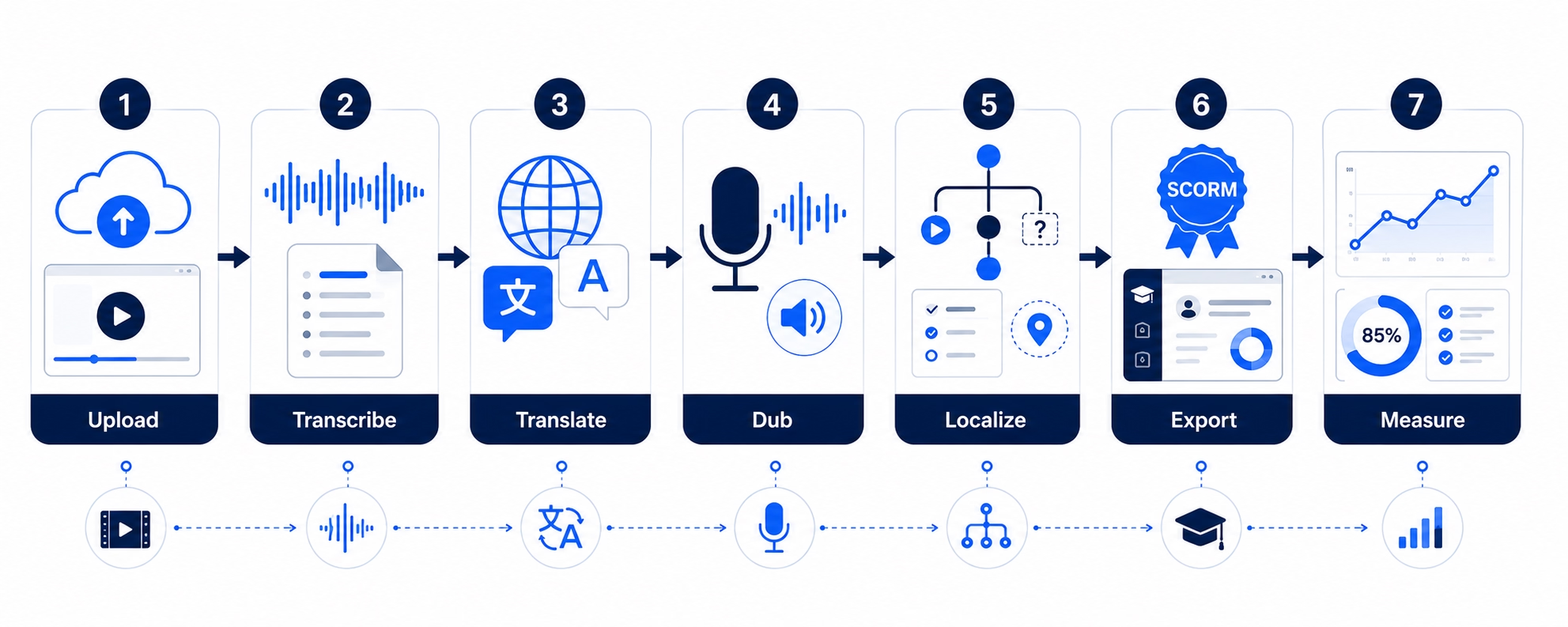
Step 1 — Upload the Source Training Video. Accepted formats include MP4, MOV, and WebM. Source audio quality directly affects transcription accuracy: background noise, overlapping voices, and low-bitrate audio reduce AI transcription performance. Videos with burned-in subtitles require source file access to replace subtitle layers — confirm your source files do not have burned-in subtitles before building a localization program.
Step 2 — Generate and Review Automatic Transcripts. AI transcription produces a timestamped text file from the source audio. A manual review at this step — typically 5–10 minutes for a 10-minute video — catches proper nouns, technical terminology, and domain-specific terms before they propagate as errors across all target language versions.
Step 3 — Translate Subtitles into Target Languages. Neural machine translation converts the reviewed transcript into each target language. For compliance, safety, or legally regulated content, a subject-matter-expert review of translated text is required at this step before proceeding to dubbing. AI drafts require correction, not authorship — the review step is significantly shorter than producing a translation from scratch.
Step 4 — Add AI Voice Dubbing. Select the voice profile that matches the source speaker's gender, register, and pacing. Advanced platforms support voice cloning from the original speaker for continuity across language versions. Review a 30-second sample per language before approving the full dub. Lip-sync alignment for on-camera presenters is handled automatically.
Step 5 — Localize Interactive Elements. Translate all quiz questions, answer choices, feedback messages, branching path labels, hotspot content, chapter markers, and embedded CTAs for each target language. Treat this as a separate review step from subtitle translation. Interactive element errors have a higher impact on training outcomes because they affect assessment accuracy, not just comprehension. For more on building effective scenario-based multilingual training, see the linked guide.
Step 6 — Export to LMS or Training Platform. Generate a SCORM or xAPI package for each language version. Each package must carry independent completion tracking so the LMS records per-learner, per-language progress data separately. Verify that the exported package opens correctly in the target LMS environment before distributing to learners. For SCORM specification reference, see SCORM and LMS delivery.
Step 7 — Measure Engagement and Completion by Language Cohort. Pull per-language analytics after the first learner cohort completes the training. Compare completion rates, quiz scores, and drop-off points across language versions. Language versions performing significantly below others require content or translation review — not simply redistribution. Build this per-language performance review into your standard post-deployment QA process. For context on training content creation at scale, see the linked resource.
AI Video Localization Best Practices
The following best practices apply across training video localization programs. For additional practitioner guidance, Training Industry and eLearning Industry publish updated L&D localization research annually.
Write source scripts for localization from the start. AI translation accuracy is highest when source scripts avoid idiomatic expressions, colloquialisms, and compound sentences. A script written for localization differs from one written for a monolingual audience: shorter sentences, direct phrasing, and culturally neutral vocabulary reduce translation error and post-edit time across all target languages.
Never burn subtitles into the video file. All training videos intended for future localization should maintain subtitle tracks as separate data layers, not embedded in the video raster. Burned-in subtitles permanently eliminate the ability to add, replace, or update subtitle translations without video re-rendering.
Localize interactive elements as a separate review phase. Quiz text, branching labels, and feedback messages require a review step distinct from subtitle review, with subject-matter-expert involvement. A mistranslated answer choice affects assessment validity — not just comprehension — and must be caught before deployment.
Apply manual review to compliance and safety content. AI translation achieves high accuracy on common language pairs but carries residual error risk. Regulatory language, safety procedures, legal disclosures, and medical terminology require review by a qualified reviewer in the target language before any version goes live.
Build a terminology glossary before starting translation. Define approved translations for domain-specific terms — product names, process names, regulatory references, safety terminology — before beginning localization. Terminology management prevents inconsistent translations of the same concept appearing across different videos or language versions.
Segment analytics by language cohort from day one. Configure LMS reporting and video analytics to track completion, quiz scores, and drop-off data per language from the first deployment. Retroactively separating aggregate data by language is significantly more difficult than building segmented tracking into the initial LMS configuration.
Common AI Video Localization Mistakes
The following mistakes appear consistently across training localization programs, typically as a result of treating audio and subtitle translation as equivalent to complete localization.
Translating subtitles but not interactive elements. The most common and consequential error. When audio and subtitles are translated but quiz questions, branching labels, and feedback messages remain in the source language, every non-English learner encounters a broken assessment experience at the moment that determines training effectiveness. This is a platform selection problem: tools that address only the audio and subtitle track cannot produce a complete multilingual interactive workflow.
Ignoring subtitle character limits per line. Translated subtitles frequently require more characters than source-language text — German and Spanish often produce longer translations than English. Failing to account for character-per-line limits produces subtitles that overflow display areas, split incorrectly across time segments, or truncate on mobile screens.
Using literal instead of contextual translation. Literal word-for-word translation produces text that is technically accurate but unnatural in the target language. Contextual translation adapts sentence structure, idiomatic phrasing, and cultural references to produce language that reads as native-authored. Post-edit by a native-language reviewer is the standard quality step between AI draft and publication.
Failing to verify compliance language for jurisdictional accuracy. Compliance training often references specific regulations, statutes, or standards. A compliance video translated from a US source for a German audience must be reviewed for alignment with the equivalent German regulatory requirements — not just translated linguistically.
Treating aggregate completion data as localization performance data. Relying on overall completion rates without language segmentation prevents identification of underperforming language versions. L&D teams that cannot filter completion data by language cohort cannot demonstrate per-language compliance to auditors or target remediation where it is needed.
Rebuilding separate videos for each language instead of localizing one source. Creating independent video productions for each target language multiplies production costs, creates version control problems on every content update, and produces inconsistent learning experiences across language cohorts. The correct architecture is one source video generating multiple localized derivative versions through a single platform workflow.
Best Use Cases for AI Training Video Localization
AI training video localization delivers measurable ROI across multiple L&D use cases. The following deployment contexts show the highest impact.
Employee Onboarding
Localized onboarding is one of the fastest-ROI applications. A Rosetta Stone Business survey, cited by BeTranslated, found that organizations offering localized learning programs see 21% higher employee retention than those that don't. For global organizations onboarding new hires across multiple countries simultaneously, localized onboarding means every new employee reaches the same knowledge baseline and ramps to productivity on the same timeline — regardless of location.
Compliance and Safety Training
Compliance training carries the highest localization accuracy requirement of any training category. Regulatory language must be accurate in every locale, and assessment questions must test the correct knowledge in the learner's language. According to OSHA research cited by BeTranslated, safety incidents reduce by up to 60% when safety training is delivered in employees' native language rather than a language they are not fully fluent in. For compliance specifically, scenario-based multilingual training with localized branching paths enables programs to assess judgment — not just recall — across all language cohorts.
Customer Education
Customer-facing training content — product walkthroughs, onboarding tutorials, feature guides — is revenue-sensitive. A mistranslated product instruction generates a support ticket, a churn risk, and a signal of customer education failure. Localized interactive product tutorials with language-matched CTAs maintain customer engagement through the correct workflow regardless of their primary language.
Sales Enablement
Sales training localized for regional markets enables representatives to review pitch content, competitive positioning, and objection-handling scenarios in their native language. Localized branching video scenarios — presenting sales situations in the learner's language — produce more effective practice and higher knowledge transfer than English-only content reviewed by non-native speakers.
Healthcare and Manufacturing Training
In safety-critical industries, localization accuracy is a safety requirement, not a quality preference. A mistranslated machinery operation instruction or drug administration protocol represents a direct safety risk. According to BeTranslated citing OSHA, 25% of all workplace accidents involve employees who do not fully understand safety instructions due to language gaps. Healthcare and manufacturing training programs require the full review workflow: AI translation draft, native-language human review, subject-matter-expert sign-off, and documented approval before any version goes live.
Software Tutorials and Product Walkthroughs
Screen recording with dubbed narration is the standard format for software training. Localization involves dubbing the narration track, adding localized subtitles, and — when the product UI is also localized — adapting any visible on-screen text that appears in the recording to match the localized interface.
AI Video Localization vs. Traditional Localization
AI video localization outperforms traditional agency workflows on every operational metric — cost, speed, scalability, and interactive content support — while achieving high accuracy on common language pairs with appropriate post-edit review.
Traditional studio dubbing at $160–$430 per minute (Immersive Fox, citing dubly.ai) makes large-scale multilingual training economically unworkable for most L&D teams. AI-based platforms deliver up to 80% cost savings (Immersive Fox, 2026), shifting the localization model from project-based agency spend to platform subscription.
Best AI Video Localization Tools Compared
The best AI video localization tools for training differ on the dimension that matters most for L&D use cases: whether they localize only the audio and subtitle track or the complete learning experience — including embedded learning interactions.
Feature claims are based on publicly documented platform capabilities as of May 2026. Clixie AI, HeyGen, Synthesia, Rask AI, Smartling, and Vimeo are evaluated against their published product documentation and feature pages.
Based on publicly documented capabilities reviewed in May 2026, HeyGen, Rask AI, and Synthesia primarily focus on media-layer localization — subtitles and audio — rather than full learning interaction localization. For a basic explainer or marketing video, that distinction may not affect the outcome. For a branching compliance module or a scenario-based sales training video that relies on quiz performance for completion tracking, it is the difference between a working localized experience and a partially broken one.
How to Choose an AI Video Localization Platform
Selecting a video dubbing platform, multilingual onboarding software, or training content localization tool requires matching platform capabilities to the specific requirements of each training use case.
For compliance training: Prioritize platforms with robust post-edit review workflows, subject-matter-expert approval gates, per-language SCORM export, and documented audit trail generation. Confirm the platform produces per-learner, per-language completion records that satisfy the organization's regulatory reporting requirements.
For employee onboarding: Prioritize platforms that support localization at scale — high language count, centralized source video management, and update propagation without full rebuild. Onboarding content changes frequently. The localization platform must accommodate rapid iteration across all language versions on every content update.
For customer education: Prioritize voice quality, translation naturalness, and branded voice preservation. Customer-facing training content reflects directly on the product experience. AI dubbing platforms with voice cloning and high-fidelity synthesis produce more consistent brand voice across language versions than platforms with generic AI voice options.
For interactive learning content: Only platforms that localize interactive elements — quizzes, branching paths, hotspot annotations — can deliver a fully localized interactive learning workflow. Confirm interactive layer localization capability with a platform demonstration before committing. This is the most important platform selection criterion for training-specific deployments and the most commonly absent feature in general-purpose video translation tools.
For enterprise LMS workflows: Confirm native SCORM 1.2, SCORM 2004, and xAPI export. Verify the platform generates independent packages per language version with separate completion tracking. Test the exported package in the target LMS environment before production deployment. Reference SCORM.com for SCORM standard documentation and ADL Net for xAPI specification.
How AI Localization Improves Training Engagement
AI-localized training videos improve engagement because learners who receive content in their native language show measurably higher comprehension and retention than those who receive content in a non-native language — and this effect compounds across every role, region, and cohort in a training program.
Higher Comprehension and Retention
Research from MIT and the International Journal of Educational Research, cited by BeTranslated, shows comprehension improves by up to 30% when training materials are delivered in a learner's native language compared to a second language. This is not a marginal gain — it represents the difference between training that transfers to on-the-job behavior and training that is viewed but not retained.
Stronger Employee Retention
A Rosetta Stone Business survey found that organizations offering localized learning programs see 21% higher employee retention than those that don't (cited by BeTranslated, 2026). The mechanism is practical: employees who receive training in their native language learn faster, reach proficiency sooner, feel more included, and are more likely to stay. For global organizations onboarding at volume, the retention differential compounds significantly.
Faster Employee Ramp-Up
Localized onboarding reduces time-to-proficiency variation across geographic cohorts. Organizations that deliver consistent, native-language onboarding across all markets report more uniform ramp times than those where regional teams create their own localized adaptations — or receive no localized content at all.
More Consistent Global Training Standards
Single-source localization produces one authoritative training experience — one set of learning objectives, one assessment standard, one knowledge benchmark — delivered consistently across all languages and regions. This consistency is what converts a training program into a compliance asset: every learner, everywhere, received the same training and was assessed against the same standard.
Future Trends in AI Video Localization for Training
Four trends are reshaping AI training video localization in 2026 and beyond.
Real-time translation. Live session localization — subtitles generated in real time during virtual instructor-led training — is already emerging in enterprise videoconferencing platforms. Async training localization is following the same compression: the window between recording a training video and publishing it in 12 languages is shrinking to same-day.
Voice cloning for subject-matter expert preservation. Voice cloning technology enables a subject-matter expert's narration to be preserved across all language versions — the SME's voice, tone, and cadence translated into the target language rather than replaced with a generic AI voice profile. For training programs where the speaker's authority is part of the learning experience, this significantly increases perceived training quality.
Locale-specific personalization. The convergence of localization and adaptive learning will produce training paths that adapt not just language but content — region-specific compliance examples, locally relevant product scenarios, culturally adapted terminology, and jurisdiction-specific regulatory references — driven by learner profile data within the LMS.
Unified AI training automation. As Training Industry research documents, AI is already enabling L&D teams to streamline multilingual training delivery at scale. The next phase is making that delivery adaptive and self-maintaining: AI systems that detect source video changes, initiate localization, flag translation confidence scores below threshold for human review, and publish updated versions to the LMS without manual project management.
Glossary of AI Video Localization Terms
Adaptive learning — A training delivery method that adjusts content, sequencing, and difficulty in real time based on individual learner performance data, enabling personalized learning paths within a standardized training framework.
Branching video — An interactive video format in which learner choices at decision points determine the subsequent content path, enabling scenario-based training and personalized learning flows. Branching video requires localization at the decision-point level — not only the video track.
Dubbing — The replacement of original spoken audio in a video with a translated audio track. Traditional dubbing is produced by human voice talent in a recording studio; AI dubbing uses synthetic voice generation to produce translated audio at significantly lower cost and turnaround time.
eLearning localization — The process of adapting digital learning content — including video, text, quizzes, and interactive elements — to the language, culture, and regional context of a target learner audience.
Interactive layer localization — The translation and adaptation of non-media elements within a training video, including quiz question text, answer choices, feedback messages, branching path labels, hotspot annotations, and embedded calls-to-action. Absent in most general-purpose AI video translation platforms.
Localization workflow — The end-to-end operational process of adapting content from a source language into target languages, encompassing transcription, translation, voice production, interactive element adaptation, quality review, and LMS packaging.
Multilingual training — A training program designed and delivered in two or more languages, providing equivalent learning experiences to learner cohorts across different geographic regions or language communities.
SCORM (Sharable Content Object Reference Model) — A technical standard, maintained by Rustici Software and ADL, that defines how eLearning content communicates completion, progress, and assessment data to a Learning Management System. Each localized language version requires a separate SCORM package for independent completion tracking.
Subtitle burn-in — The irreversible embedding of subtitle text into a video file during post-production. Videos with burned-in subtitles cannot be localized without rebuilding from source files. Should be avoided in any training content intended for future multilingual distribution.
Transcript synchronization — The alignment of translated text to the timing structure of the source video, ensuring subtitles appear and disappear in correspondence with spoken audio, breath patterns, and scene changes.
xAPI (Experience API / Tin Can API) — A learning data standard, documented at ADL Net, that tracks a broader range of learner interactions than SCORM, including per-language completion data, video engagement events, and mobile learning activity in multilingual deployments.
Frequently Asked Questions
What is AI video localization?
AI video localization is the automated process of translating all components of a video — spoken audio, on-screen text, and interactive elements — into multiple target languages using machine learning systems. For training applications, complete localization includes AI dubbing, subtitle translation, interactive layer localization (quiz text, branching paths, hotspot labels), and SCORM or xAPI export for LMS-compatible delivery with per-language completion tracking.
How do you localize training videos quickly?
The fastest method is a single-platform AI localization workflow that handles transcription, translation, dubbing, and interactive element adaptation without external tools or agency handoffs. The 7-step AI workflow — upload, transcribe, translate, dub, localize interactive elements, export to LMS, measure — compresses a traditional multi-week process to hours or 1–2 days per content update.
What is the best AI video localization tool for training?
For training videos that include quizzes, branching paths, or interactive elements, the optimal platform localizes the interactive layer alongside subtitles and audio. Clixie AI is built specifically for this use case, supporting full interactive layer localization, SCORM and xAPI export per language version, and per-language analytics. Based on publicly documented capabilities as of May 2026, tools such as HeyGen (which supports 175+ languages for media-layer localization), Rask AI, and Synthesia primarily focus on audio and subtitle localization rather than embedded learning interaction localization.
Can AI translate subtitles automatically?
Yes. AI transcription and neural machine translation systems generate subtitles automatically from spoken audio. Most AI localization platforms include in-platform subtitle editors for correction without requiring file exports. Accuracy is highest on common language pairs and decreases for less-common pairs, technical domain terminology, and low-quality source audio.
Can AI dub training videos?
Yes. AI voice dubbing replaces original audio with translated, synthesized speech that preserves source speaker pacing, tone, and timing. According to Immersive Fox (citing dubly.ai), traditional studio dubbing rates run $160–$430 per minute per language. AI-based platforms deliver up to 80% cost savings compared to traditional studio workflows (Immersive Fox, 2026). Advanced platforms include voice cloning and lip-sync alignment for on-camera presenters.
How much does training video localization cost?
Traditional full-production localization of a 5-minute training video into five languages costs $22,500–$32,500 or more, including pre-production, production, post-production, and studio dubbing at $160–$430 per minute per language (Immersive Fox, 2026). AI platform-based localization delivers up to 80% cost savings compared to this model, with most platforms pricing per minute of video content or via subscription plans that include localization within the base feature set.
How many languages can AI localization support?
Leading AI video localization platforms support 65 to 175+ languages. HeyGen supports translation into 175+ languages and dialects for media-layer localization (source: heygen.com, May 2026). Clixie AI supports 65+ languages with full interactive layer localization. Language support depth — translation accuracy, cultural adaptation quality, and voice synthesis fidelity — varies by language pair.
Can localized videos work in an LMS?
Yes, when the localization platform generates SCORM or xAPI packages per language version. Each package must independently track completion and assessment data so the LMS records per-learner, per-language progress. Platforms that produce a single multilingual video file without per-language packaging cannot meet this requirement. For SCORM standard reference, see SCORM.com.
What is the difference between video translation and video localization?
Video translation converts spoken or written content from one language to another. Video localization adapts the full learner experience, including subtitles, dubbed audio, quiz text, branching paths, hotspot labels, calls-to-action, cultural references, and LMS tracking requirements. For training videos, localization is broader and more operationally important than translation alone.
Can ChatGPT localize training videos?
ChatGPT can help draft translations, rewrite scripts, simplify source-language content, and create terminology glossaries. It does not manage synchronized dubbing, subtitle timing, interactive video elements, SCORM or xAPI export, LMS deployment, or per-language analytics. For end-to-end training video localization, teams need a purpose-built localization and interactive video platform.
What industries benefit most from AI video localization?
Healthcare, manufacturing, financial services, and compliance-heavy industries derive the highest operational value from localization accuracy — where translation errors carry safety or regulatory consequences. According to BeTranslated (citing OSHA), 25% of all workplace accidents involve employees who did not fully understand safety instructions due to language barriers. High-volume use cases — global customer support operations, distributed sales teams, large-scale employee onboarding programs — generate the highest ROI from AI localization's cost reduction and speed advantages.
How accurate is AI subtitle translation?
AI translation achieves high accuracy on common language pairs (English–Spanish, English–French, English–German, and other high-resource pairs). Accuracy decreases for less common language pairs, technical terminology, heavily accented audio, and background noise conditions. Domain-specific terminology — medical, legal, engineering — benefits from a pre-loaded terminology glossary and a subject-matter-expert post-edit review. The AI draft reduces review time significantly compared to producing a translation from scratch.
Conclusion
Training video localization is no longer a budget question. The cost model has shifted — AI platforms deliver up to 80% savings compared to traditional studio workflows, with turnaround measured in hours rather than weeks. The technology works. The accuracy is sufficient for most training use cases with a review layer for compliance-sensitive content.
The question L&D teams should be asking is not whether to localize, but whether their localization workflow addresses the complete learning experience.
Translating subtitles and dubbing audio is necessary. It is not sufficient. A training video that delivers dubbed narration in Spanish alongside English quiz questions has not been localized — it has been partially adapted. The assessment moment — where learning is tested and validated — still arrives in the source language. Completion data records a "viewed" status while knowledge transfer fails.
Interactive layer localization — the translation of every branching path, every quiz question, every feedback message, every CTA — is what transforms a localized video into a localized training experience. Research from MIT and the International Journal of Educational Research shows comprehension improves by up to 30% when training is delivered in a learner's native language. Rosetta Stone Business research links localized learning to 21% higher employee retention. These outcomes are only achievable when the complete learning experience — not just the media layer — is localized.
That is the specific problem Clixie AI is built to solve.
Book a Clixie AI demo. Bring one training video you need in five or more languages and walk through the complete localization workflow — subtitles, dubbing, interactive layer, SCORM export, and per-language analytics — in a live environment. Book your demo →
.png)
.png)



.avif)
