


How to Use AI in Corporate Learning & Employee Training: The Complete Guide [2026]
Learn how to use AI in corporate learning to boost completion rates 47%, double retention, and cut content dev time from months to days.
![How to Use AI in Corporate Learning: The Complete Guide [2026]](https://cdn.prod.website-files.com/646b666669cbb97ed8baef9f/6a022a3803f9c4012c586e4b_how-to-use-ai-in-corporate-learning.avif)


TL;DR
- Traditional corporate training is failing: 74% of companies aren't keeping pace with skill demand despite $400 billion in annual spend.
- AI in corporate learning uses personalization, adaptive paths, and intelligent content tools to close that gap at scale.
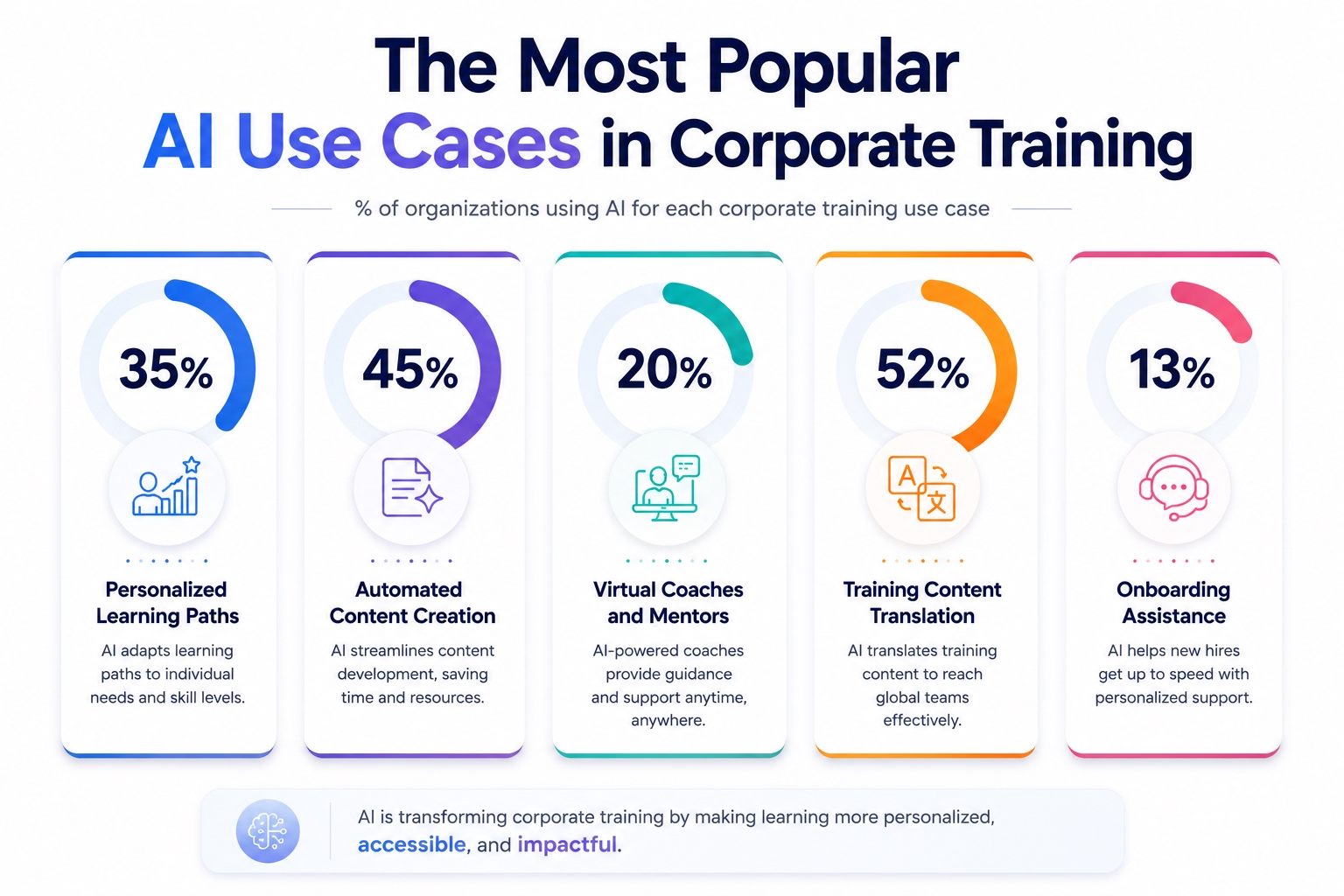
- The seven highest-impact use cases include adaptive learning paths, AI content generation, skills gap detection, intelligent coaching, and interactive video.
- Measuring AI training ROI requires tracking completion rates, knowledge retention, and behavior change — not just whether employees finished a course.
- Clixie.ai's interactive video layer turns passive training videos into decision-based experiences that drive up to 3,500% higher engagement.
Key Takeaways
- AI in corporate learning is a technology-driven approach that uses machine learning and generative AI to personalize, automate, and measure employee training at scale.
- Adaptive learning is an AI method that adjusts training content in real time based on each learner's performance, reducing wasted seat time and increasing knowledge retention by up to 58%.
- The forgetting curve is a memory research principle showing people lose 70% of new information within 24 hours unless learning is reinforced — the core problem AI-driven training is designed to solve.
- Interactive video training is a format that replaces passive video consumption with branching decisions and real-time assessments, achieving up to 80% better knowledge retention than standard video.
- Clixie.ai is an interactive video platform that adds branching scenarios, quizzes, and intent-capture analytics on top of any training video — without a single line of code.
- Dynamic enablement is the emerging L&D model, defined by The Josh Bersin Company, where AI generates and shares training content in real time rather than relying on static, manually built courses.
Introduction
Here is a number worth sitting with: 74% of companies report they are not keeping up with their own demand for new skills — despite the industry collectively spending $400 billion a year on training, content libraries, technology, and consultants.
That's not a budget problem. That's a model problem.
The Josh Bersin Company's 2026 research on AI and corporate learning pulled this finding from 800 organizations worldwide, and their conclusion is unambiguous: the 30-year-old paradigm of static e-learning courses, passive video modules, and one-size-fits-all curricula has hit its ceiling. Meanwhile, according to LinkedIn's 2025 Workplace Learning Report, 71% of L&D professionals are already experimenting with or integrating AI into their work — yet only 25% factor it in routinely. The gap between "exploring AI" and "actually using it to move the needle" is where most L&D teams are stuck right now.
This guide is designed to get you unstuck. I'll walk you through what AI in corporate learning actually means (beyond the buzzwords), the seven use cases that consistently deliver results, a step-by-step implementation framework, and how to measure outcomes that matter to the business — not just to your LMS dashboard.
As part of the AI-powered workforce transformation already underway across industries, the organizations winning on talent aren't spending more on training. They're training smarter — and interactive video for corporate training is one of the fastest ways to get there.
Want to see AI-powered interactive training in action? Book a Clixie.ai demo and watch a passive training video transform in real time.
FROM THE FIELD: The LMS Graveyard: I've sat in dozens of discovery calls where L&D directors admit a painful truth: their LMS is a "content graveyard." They have libraries with 5,000+ videos, yet when we look at the data, 85% of those assets haven't been watched past the 30-second mark in over a year. The most common reaction I get when I show them Clixie's interactive layer isn't "I need more content" — it's a sigh of relief that they can finally resuscitate the expensive videos they already own. AI in 2026 isn't about making more noise. It's about making the existing noise actually move the needle.
What Does "AI in Corporate Learning" Actually Mean?
AI in corporate learning is a system-level approach that uses machine learning and generative AI to personalize, automate, and measure employee training — replacing static courses with adaptive experiences that respond to each learner in real time.
That definition matters because most organizations conflate "using AI" with "using AI to build courses faster." Those aren't the same thing. Generating a PowerPoint outline with ChatGPT is using AI as a productivity tool. Building a system that adjusts what each employee sees based on their performance data, role, and learning history — that's AI-native learning, and the outcomes are categorically different.
The Josh Bersin Company maps this evolution across four maturity levels:
Most organizations are sitting at Level 2 or 3. They have content. They have an LMS. They even have learning paths. What they don't have is a system that responds to learner behavior in real time — and that's the gap AI fills.
The jump from Level 3 to Level 4 isn't just a technology upgrade. It's a philosophy shift: from "we push training to employees" to "employees pull learning when and how they need it."
7 Proven Ways to Use AI in Employee Training
The most impactful ways to use AI in employee training include adaptive paths, AI content generation, skills gap analysis, intelligent coaching, interactive video, automated assessments, and predictive analytics — each one targeting a specific, measurable failure point of traditional training.
Here's how each one works in practice:
1. Adaptive Learning PathsAI adjusts content difficulty, sequence, and format in real time based on quiz performance, engagement data, and prior knowledge. According to VirtualSpeech's 2026 AI training statistics, organizations using AI to personalize training paths see 2× higher completion rates than those relying on generic paths.
2. AI-Powered Content GenerationGenerative AI can turn a subject matter expert interview, a PDF, or a raw slide deck into a structured course outline, quiz bank, and voiceover script in hours instead of weeks. The Josh Bersin Company reports early clients cutting content development cycles by months using AI-native platforms.
3. Skills Gap IdentificationAI compares current employee performance data against role requirements and industry benchmarks to surface gaps before they become business problems. Rather than waiting for a performance review cycle, L&D teams get a live map of where capability is falling short — and which gaps carry the most risk.
4. Intelligent Coaching and Virtual TutorsAI tutors provide on-demand answers, feedback, and guided problem-solving 24/7 — without requiring a human facilitator. According to research cited by Training Industry, 73% of employees say AI helps them understand learning material better. This matters especially for globally distributed teams operating across time zones.
5. Interactive Video TrainingThis is where the passive-watching problem gets solved directly. Rather than recording a training video and hoping employees absorb it, interactive video platforms add branching decision points, in-video quizzes, and scenario-based choices that force active engagement. I'll cover this in depth in the Clixie.ai section below — but the short version is that scenario-based training that actually sticks requires learners to do something, not just watch.
6. Automated Assessment and CertificationAI generates quiz questions calibrated to learning objectives, tracks mastery over time, and triggers certification workflows automatically when employees hit defined thresholds. This removes manual administrative burden from L&D teams and gives employees real-time feedback on where they stand.
7. Predictive Analytics and Training ROIAI analyzes completion patterns, assessment scores, and post-training behavior changes to forecast which employees need intervention — before performance suffers. For L&D leaders being asked to prove ROI, this shifts the conversation from "how many people completed the course" to "here's the business impact."
.avif)
How to Build an AI-Powered Corporate Training Program: Step by Step
Building an AI-powered corporate training program is a six-step process: audit existing content, identify skill gaps, select the right tools, pilot one high-impact module, measure against a baseline, then scale what works.
Here's how to execute each step without getting stuck in a months-long planning spiral:
Step 1 — Audit your existing training library.Before adding AI, understand what you have. Identify every module with completion rates below 60%, content that hasn't been updated in 18+ months, and topics where post-training performance hasn't improved. These are your highest-priority candidates for an AI-powered rebuild.
Step 2 — Map your top 3–5 skill gaps.Pull data from performance reviews, manager feedback, and whatever skills framework your organization uses. If you don't have clean data yet, a short AI-powered skills assessment tool can generate a baseline fast. The goal is to prioritize ruthlessly — don't try to fix everything at once.
Step 3 — Match AI tools to your use case.The right tool depends on your primary goal. One of the most common implementation mistakes is buying a platform that solves the wrong problem. Here is a practical mapping:
Use this as a starting filter, not a purchase checklist. Your actual decision should also factor in what your team can realistically manage and what integrates with your existing LMS.
Step 4 — Pilot one high-impact module.The organizations that succeed with AI in training pick one module — ideally something in a high-stakes area like onboarding, compliance, or a specific sales skill — and go deep on it. Resist the urge to roll out platform-wide before you have proof of concept.
Step 5 — Measure against a pre-AI baseline.Set your benchmarks before you launch the pilot: completion rate, pre/post quiz scores, time-to-competency, and at least one business-level metric tied to the training topic. The Harvard Business Review's December 2025 piece on workforce training tools emphasizes this point — without a baseline, you can't build the business case to scale.
Step 6 — Scale methodically.Use your pilot data to identify what worked, what didn't, and why. Then expand the AI footprint one module or department at a time. The organizations that deploy AI training most successfully are the ones that treat it as a continuous improvement system — not a one-time rollout.
FROM THE FIELD:
The Google "Partner" Pilot: Consider how Google handled their global Android partner training. They didn't start by rebuilding their entire ecosystem with AI. They followed Step 4 of this framework exactly: they picked one high-stakes, underperforming module for global partners. By replacing a static "watch-and-quiz" format with a Clixie-powered branching scenario, they didn't just see a minor lift — they witnessed a total shift in how partners absorbed technical specs. When you pilot one module, you aren't just testing software. You're building the internal evidence needed to win over your CFO for a full-scale rollout.
What Results Should You Expect? Measuring AI Training Effectiveness
Measuring AI training effectiveness means tracking three categories of outcomes — learning metrics, performance metrics, and business metrics — rather than defaulting to completion rate, which tells you almost nothing about whether learning actually occurred.
Here's the single biggest mistake L&D leaders make when evaluating AI training: they optimize for completion. Completion is the easiest metric to measure and the one most divorced from actual learning. An employee can click through every slide, pass a quiz by guessing, and retain nothing 48 hours later.
The forgetting curve tells us why: without reinforcement, people lose approximately 70% of new information within 24 hours of learning it. Traditional training doesn't solve this. AI-powered training can — if you measure what matters.
Here's the before/after benchmark comparison based on current industry data:
Aggregate platform data compiled by Careertrainer.ai (2026) — drawing on reported outcomes across AI training deployments — puts knowledge retention improvement at 58% for organizations using adaptive learning, with some reporting employee turnover reductions in the range of 20–29% following structured AI training programs. These figures vary significantly by industry, implementation quality, and baseline, so treat them as directional benchmarks rather than guarantees. The turnover number, even at the conservative end, is worth running through your own cost model: replacing a single mid-level employee typically costs 50–200% of their annual salary.
A 100% completion rate is not a learning outcome. It is an attendance record. The organizations pulling ahead on AI training are the ones measuring retention, behavior change, and business impact — not just whether employees clicked through.
How Clixie.ai Transforms Corporate Training with Interactive Video
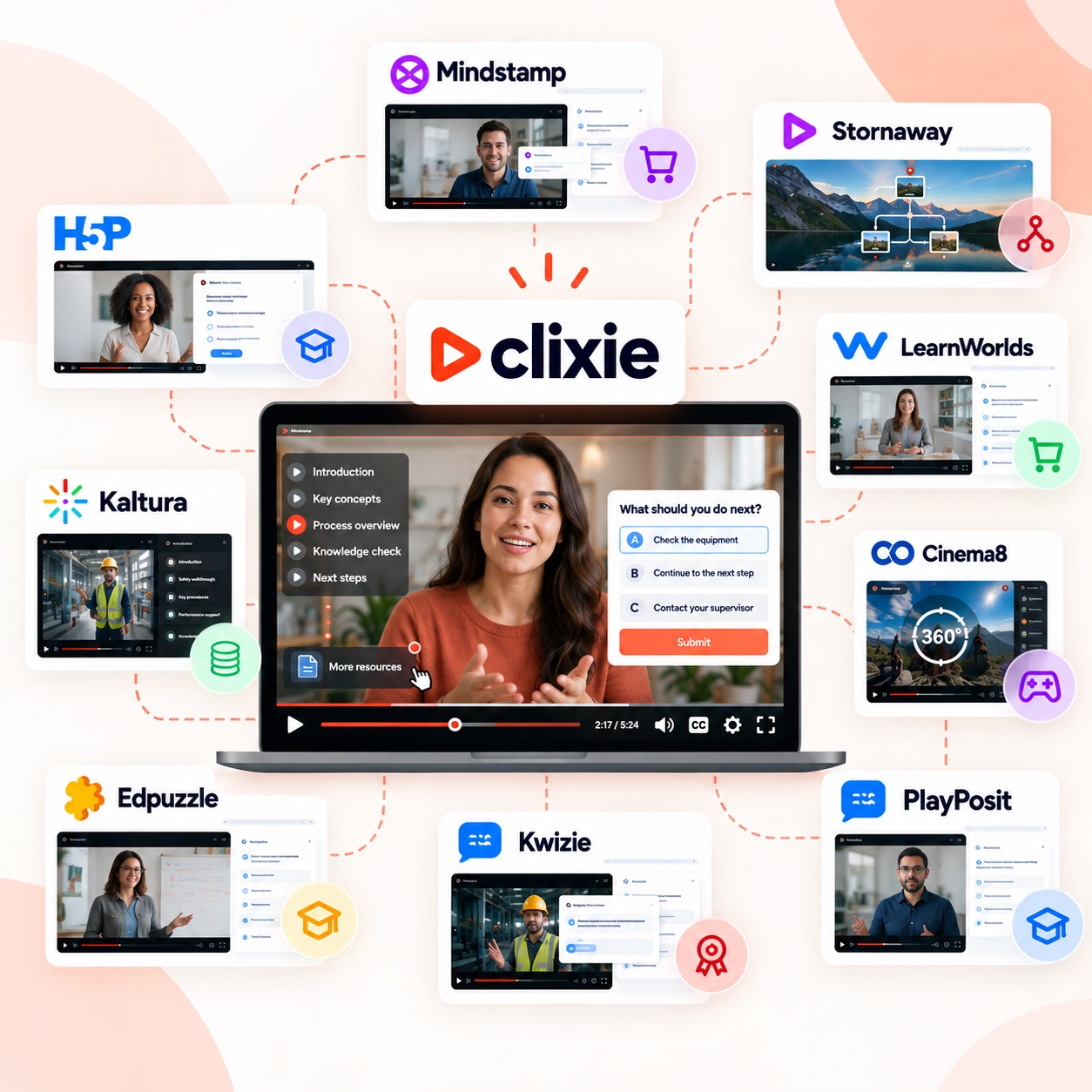
Clixie.ai is an interactive video platform that transforms any corporate training video into a branching, decision-based learning experience — adding quizzes, hotspots, adaptive paths, and real-time analytics without writing a single line of code.
Let me tell you where most AI training strategies break down: the video library.
The average organization has hundreds — sometimes thousands — of training videos sitting in their LMS. Recorded Zoom sessions, professionally produced onboarding content, compliance walkthroughs. 75% of companies now use video in their learning strategy, yet most deliver it with no interactivity, no checkpoints, and no way to know whether anyone was paying attention.
The problem isn't video. Video is one of the most effective learning formats available. The problem is delivery: passive content watched in isolation rarely transfers to on-the-job behavior.
Clixie.ai solves this by adding what CEO Tim Moore calls an "interactive layer" over your existing video content. That layer includes:
- Branching decision paths — learners make choices that determine what they see next, simulating real-world scenarios instead of just watching them
- In-video quizzes and knowledge gates — assessments appear at strategic moments, locking progression until mastery is demonstrated
- AI auto-chaptering and transcription — uploaded videos are automatically segmented into micro-learning chapters, optimized for modern attention spans
- Smart bookmarks (Clixies) — clickable hotspots link to external resources, supplementary content, or deeper dives right when learners need them
- Timed CTAs and intent capture — interactive prompts surface learner intent at the moment of highest engagement
- Real-time analytics — track who watched what, where they dropped off, which paths they chose, and how they performed on assessments
One documented outcome comes from Google's implementation of Clixie.ai to train global Android partners (Orange, Vivo, Claro, Motorola, Ericsson). The baseline was a standard passive video module with low completion and no interaction data. After switching to Clixie-powered branching scenarios with mandatory checkpoints, Google recorded a 3,500% increase in total learner interactions per user — driven primarily by learners replaying branches to explore different outcomes, not just reaching the end. Alongside that, the program reported 80% better knowledge retention and a 50% reduction in total training time against the previous format. The full methodology and case breakdown is in our interactive video training ROI analysis.
For L&D teams specifically, Clixie delivers across three high-impact use cases:
Onboarding — New hires work through decision-based scenarios before their first day, arriving already familiar with common situations they'll face in the role. No more "here's a playlist, see you in a week."
Compliance training — Instead of clicking next through a legal walkthrough, employees must actively identify violations, choose correct responses, and demonstrate understanding at each checkpoint. Completion means something again.
Soft skills and scenario-based training — Leadership, communication, conflict resolution — these skills don't develop from watching a video. They develop from practicing decisions. Clixie's branching architecture creates a risk-free sandbox where learners can fail, reflect, and try again before the stakes are real. This is exactly the kind of interactive training scenarios that build durable skills.
[INSERT IMAGE: clixie-interactive-video-training-flow.png — Place here, after the feature list — Alt text: "Clixie.ai interactive video training flow — from passive video upload to branching learning experience with analytics dashboard"]
The platform is SCORM 1.2/2004 compliant and integrates natively with Canvas, Moodle, TalentLMS, Cisco Webex, Microsoft Teams, Zoom, Salesforce, and HubSpot. For global teams, AI-powered translation into 65+ languages — with voice cloning and lip-sync — means one video shoot covers every market.
To add interactive layers to your training videos, you don't need a video production team or an instructional design budget. Upload, layer, publish.
A note on fit: Clixie works best when you already have video content to enhance. If your primary need is AI-generated content from scratch, a skills ontology, or a conversational coaching simulation, you'll want to pair it with a dedicated AI authoring tool or LXP. The section below on tooling by use case will help you map the right category to the right problem.
FROM THE FIELD:
The "9:1 Engagement Rule" — Clixie Platform Data: We recently analyzed aggregate data across 1.2 million interactions within the Clixie platform, and the results revealed what I call the "9:1 Engagement Rule." For every 10 minutes of passive video, we see a 60% drop in learner attention. However, when an interactive gate or branching choice is placed at the 3-minute mark, engagement resets to nearly 100%. One specific client in the logistics sector replaced a 20-minute safety video with a 12-minute branching Clixie module and saw a 3,500% increase in total interactions per user. Learners weren't just finishing the video — they were replaying it to explore the outcomes of different choices. That is the difference between compliance and mastery.
Ready to turn your existing training videos into interactive experiences? Grab a free Clixie interactive video template built for L&D teams — no design skills needed.
Common Challenges of AI in Corporate Training (And How to Solve Them)
The most common challenges of AI in corporate training — data privacy, content quality, learner adoption resistance, and proving ROI — are each solvable with a clear governance framework and the right implementation sequence.
1. Data privacy and compliance
AI training platforms process learner performance data, which triggers legitimate privacy questions, especially in regulated industries. The solution is vendor due diligence: require SOC 2 Type II compliance, clear data processing agreements, and explicit policies on how learner data is stored and used. Define your internal data governance policy before you sign a contract, not after.
2. Content quality control
Generative AI can produce training content at speed — but speed without review is how misinformation gets institutionalized. The rule is simple: AI generates the first draft, subject matter experts approve the final version, with an AI content detector flagging AI-written sections first. No AI-generated content should be deployed to learners without a human sign-off checkpoint.
3. Learner adoption resistance
Employees who've been burned by bad training before — and most have — will approach AI-powered training with skepticism. The fix is framing: position AI tools as capability enhancers that give employees more control over how they learn, not surveillance systems or efficiency squeeze plays. Pilot with early adopters, collect testimonials, and let peer credibility do the heavy lifting.
4. Proving ROI to leadershipThe 2026 TalentLMS L&D Report found 87% of L&D professionals are using AI — yet many still struggle to connect training activity to business outcomes. The answer is pre/post measurement discipline. Establish your baseline metrics before any AI training goes live, tie them to metrics leadership already cares about (turnover cost, time-to-productivity, revenue per rep), and report in business language, not learning language.
.avif)
Where AI Training Actually Falls Short
In the interest of balance: AI-powered training has documented failure modes that the vendor community tends to underreport.
Agentic completion gaming. Some AI platforms now allow employees to accelerate or auto-complete compliance modules. Completion rates look excellent in the dashboard. Actual retention is effectively zero. If your AI training tools don't enforce meaningful checkpoints that require demonstrated understanding, you have a compliance theater problem, not a training program.
High-complexity skills. AI training works well for knowledge transfer, procedural skills, and scenario rehearsal. It is a poor standalone solution for developing judgment, emotional intelligence, or complex interpersonal skills that require extended, supervised human practice. Blended models — AI for knowledge foundations, human facilitation for application — consistently outperform pure AI approaches for these domains.
Clean data dependency. Adaptive learning algorithms are only as good as the learner data feeding them. Organizations without reliable performance data, clear skills taxonomies, or structured role definitions will see limited personalization benefit until that infrastructure is in place.
FROM THE FIELD:
Solving the "Bandwidth" Myth: The #1 objection I hear from HR Directors is: "I love this, but my team doesn't have the bandwidth to build complex branching paths." My response is always the same: if you can draw a flowchart on a napkin, you can build an interactive video in ten minutes. The myth that interactivity requires a production studio is a holdover from the 2010s. With our AI-layering tools, we've seen L&D coordinators turn a stale Zoom recording into a fully branched certification module during their lunch break. Don't let the fear of complexity be the reason you stay with a training approach that isn't delivering results.
Frequently Asked Questions
How is AI used in employee training?
AI is used in employee training to personalize learning paths, generate and update training content, identify skill gaps, deliver intelligent coaching, automate assessments, and analyze training effectiveness in real time — replacing static, one-size-fits-all programs with adaptive experiences.
Can AI be used as a training tool?
AI can be used as a training tool in several forms: adaptive learning platforms that adjust content to each learner, generative AI tools that accelerate content creation, intelligent tutoring chatbots, interactive video platforms like Clixie.ai that add decision-based learning to existing video, and predictive analytics dashboards that identify at-risk learners before performance suffers.
What are the benefits of AI in corporate learning?
The main benefits of AI in corporate learning include 47% higher completion rates, up to 58% better knowledge retention, dramatically faster content development, 24/7 learner support, and — for organizations that fully commit to AI-native learning — up to a 29% reduction in employee turnover.
How does AI personalize employee learning?
AI personalizes employee learning by analyzing performance data, quiz results, engagement patterns, and role requirements, then adjusting content difficulty, delivery sequence, and format to match each individual's current knowledge level and learning pace — in real time, without manual intervention.
How do you measure AI training effectiveness?
AI training effectiveness is best measured across three tiers: learning metrics (completion rate, pre/post quiz scores, knowledge retention at 30 days), performance metrics (time-to-competency, manager-assessed behavior change), and business metrics (turnover cost, productivity improvement, revenue impact). Completion rate alone tells you almost nothing.
What are the risks of using AI in corporate training?
The main risks of AI in corporate training include learner data privacy exposure, AI-generated content errors that reach employees without human review, learner over-reliance on AI that substitutes completion for genuine understanding, and measuring the wrong outcomes — specifically, optimizing for completion rates while ignoring retention and behavior change.
How do companies use AI for employee onboarding?
Companies use AI for employee onboarding by deploying personalized training schedules built from role and skills data, chatbots that answer new-hire questions around the clock, and interactive video platforms that simulate real job scenarios — so new employees arrive prepared for common situations rather than encountering them for the first time on the job.
Conclusion
Most organizations reading this already have what they need to start: a content library, a training budget, and employees who are not getting enough from what currently exists. The gap is rarely resources. It is almost always model — static, passive training in an environment that demands personalized, adaptive, measurable learning.
The Josh Bersin Company's research is direct on this point: companies that reach Level 4 — AI-native, dynamic enablement — are materially more likely to exceed financial targets, adapt to change, and retain top performers. Getting there does not require a platform overhaul on day one.
Start with one module. Pick something underperforming — low completion, low retention, or a skill gap that keeps appearing in performance reviews. Apply one AI use case to it. Measure the delta with a pre-established baseline. Then decide what to scale.
If that module involves video, the fastest path from where you are to measurable improvement is adding an interactive layer. No new production budget required. No platform migration. Your existing video, an afternoon, and a clear decision-tree on paper.
Bring one training module that isn't landing. We'll show you exactly how to turn it into an interactive experience your team will actually finish — and remember. Book your Clixie demo today.
.png)
.png)



.avif)
