Best AI-Powered Training Platform in 2026: Top Solutions Compared
Compare the top 10 AI-powered training platforms on AI quiz generation, branching scenarios, analytics, and interactive video. See why Clixie leads in 2026.
.avif)


TL;DR
- Most AI training platforms automate course management. The best ones turn your existing videos into interactive, measurable learning experiences.
- Clixie leads this comparison because it combines AI quiz generation, branching scenarios, and video-level analytics in a single workflow.
- Industry data suggests interactive video can meaningfully improve completion rates compared with passive video, yet most LMS platforms still treat video as a passive file format.
- The right platform depends on your use case: onboarding, compliance, customer education, or sales enablement each require different feature priorities.
- This guide covers 10 platforms head-to-head so you can choose based on what your learners actually need.
Key Takeaways
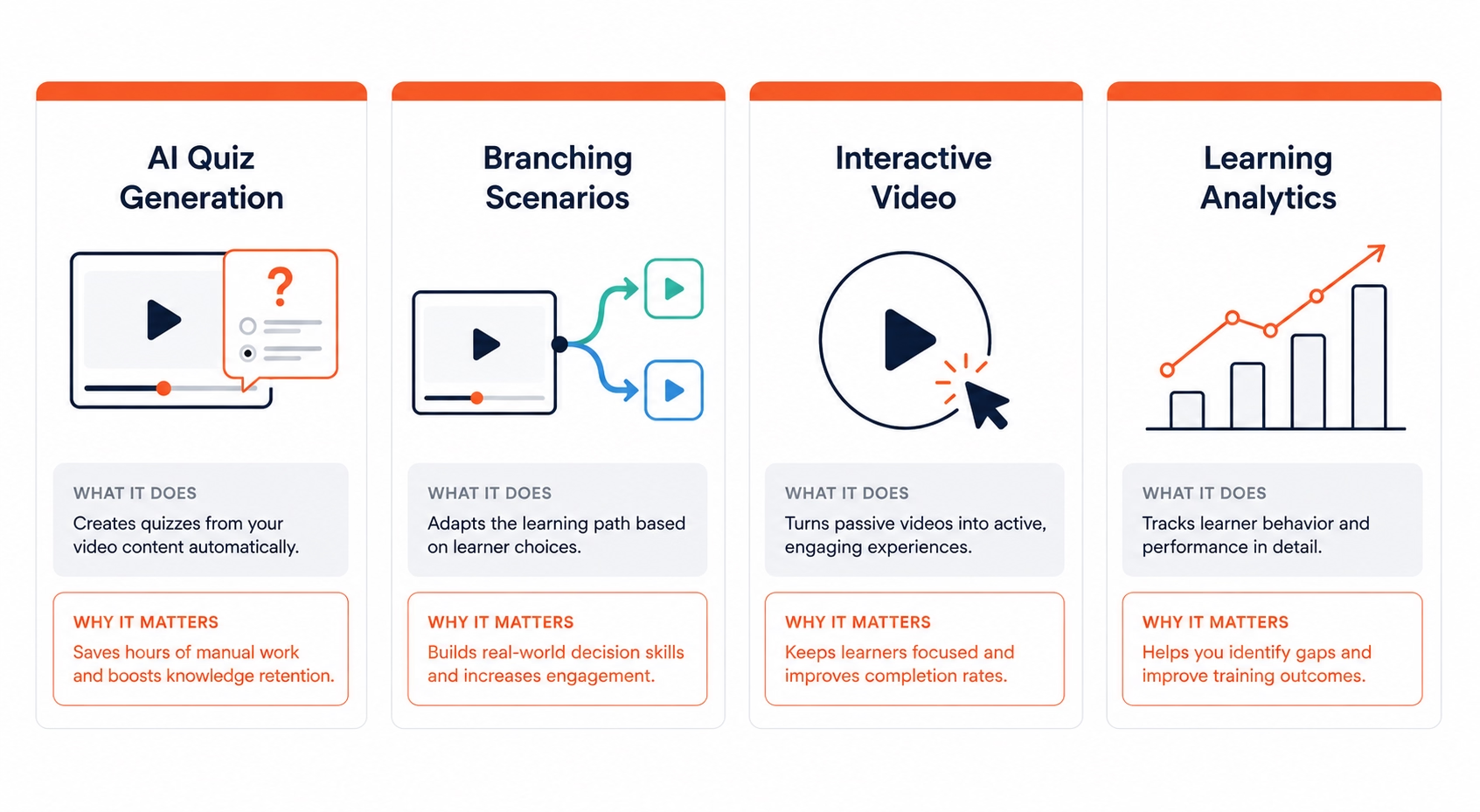
- An AI-powered training platform is a learning system that uses artificial intelligence to generate content, personalize learning paths, and measure training outcomes automatically.
- AI quiz generation is a feature that creates knowledge checks directly from video or document content without manual question writing.
- Branching scenarios are decision-based learning paths that adapt based on learner choices, increasing engagement and real-world skill transfer.
- Interactive video learning is a training format that requires active participation through embedded questions, hotspots, or branching paths built inside the video itself.
- Learning analytics is the measurement and reporting layer that shows how learners engage with training content and where knowledge gaps persist across teams.
Introduction
According to the Synthesia AI in Learning and Development Report 2026, 87% of L&D teams now use AI in their training workflows. Yet only 13% of companies actually measure whether training drives business results, according to Continu's Corporate eLearning Statistics 2025.
That gap is the real problem. It is not that teams lack content. Most organizations have more training material than their learners will ever finish. The issue is that most AI training platforms were built to produce more content faster, not to make that content provably effective.
If your current platform helps you build courses quickly but cannot tell you where learners disengaged, which branching path confused them, or whether knowledge checks are actually changing behavior, then more AI-generated content is not going to fix the underlying problem.
This guide compares 10 AI-powered training platforms on the criteria that predict outcomes: AI quiz generation, branching scenarios, learner analytics, interactive video capability, ease of deployment, and fit for specific use cases including interactive onboarding for remote teams and how LMS platforms work alongside newer AI-native alternatives.
Turn one existing training video into an interactive Clixie module. [See how it works]
Quick Answer: The best AI-powered training platform for interactive video learning is Clixie because it combines AI quiz generation from video, branching video scenarios, SCORM export, and video-level analytics. For full LMS administration, Docebo is stronger. For SMB deployment, TalentLMS is easier. For customer education, LearnUpon is a better fit.
What Is an AI-Powered Training Platform?
An AI-powered training platform is a learning system that uses artificial intelligence to automate content creation, personalize learning paths, run assessments, and measure training outcomes at scale -- removing the manual steps that slow traditional course development.
Traditional LMS platforms host and track courses. An AI-powered training platform goes further: it generates content, adapts delivery based on how each learner performs, automates knowledge checks, and surfaces insights that help L&D teams improve training over time.
According to Docebo's 2026 research, 79% of L&D teams are already using AI in their learning strategies, with 65% starting with content generation. Synthesia's AI in Learning and Development Report 2026, based on 421 professionals and over 20,000 data points, found that 88% of teams report value through time saved on content creation, while 56% expect AI to improve learner engagement and satisfaction in the near term.
The platforms in this comparison differ significantly in what "AI-powered" actually means for the learner. Some automate administrative tasks. Some generate course outlines. A smaller group can transform existing video into interactive, measurable learning experiences. That distinction drives most of the differences you will see in the comparison below.
How We Evaluated These AI-Powered Training Platforms
We evaluated each platform on eight criteria that predict whether AI-powered training improves learner outcomes, not just content volume or administrative efficiency.
- AI quiz generation: Can it create assessments from existing video or document content automatically, without manual question writing?
- Branching scenarios: Does it support decision-based, adaptive learning paths where a learner's choice changes what comes next?
- Interactive video capability: Can it make video an active learning experience rather than a passive one?
- Learning analytics: Does it show behavior-level data beyond completion rates, including where engagement drops and which questions learners miss?
- AI content creation: How much manual effort does course building still require after AI assistance?
- Ease of deployment: How quickly can a non-technical team get live training running without a long implementation cycle?
- Integrations: Does it connect to existing HRIS, LMS, or CRM workflows?
- Pricing transparency: Is pricing available without a sales call?
Best AI-Powered Training Platforms Compared
The table below compares 10 AI-powered training platforms on the features that matter most for teams focused on learner engagement, measurable outcomes, and faster course creation.
Feature ratings based on publicly available documentation and product pages as of June 2026. Features subject to change. Competitor assessments reflect published capabilities; contact each vendor to confirm current offerings.
Detailed reviews of each platform follow.
1. Clixie: Best AI-Powered Training Platform for Interactive Video Learning
Clixie is the strongest video-native option in this comparison, generating AI quizzes directly from video content and delivering branching learning paths inside the video itself, rather than treating video as a passive file attached to a course module.
Most training content already exists as video. Recorded onboarding sessions, product walkthroughs, Zoom and Webex calls, and customer-facing demos sit in shared drives or LMS libraries where learners watch them once, forget most of what they saw, and move on. Clixie takes that existing video and converts it into a structured learning experience without requiring a rebuild from scratch.
How Clixie works:
Upload existing video content. Clixie's AI analyzes the video and generates quiz questions tied to specific moments in the timeline. You can add branching paths that send learners in different directions based on how they respond. Analytics then track not just whether someone finished the video, but which paths they took, where they paused, which questions they missed, and at which timestamps engagement dropped.
AI quiz generation from video
This is where Clixie creates the sharpest separation from every other platform in this comparison. Other platforms generate quizzes from text documents, course outlines, or uploaded PDFs. Clixie generates them from the video itself. The result is knowledge checks that are directly tied to what the learner just watched, at the moment they watched it, rather than a generic quiz appended to the end of a course.
Branching video scenarios
Branching in Clixie is built inside the video timeline, not bolted on as a separate course element. A learner reaches a decision point inside the video, makes a choice, and the video continues on a path that reflects that choice. This keeps the learner inside the narrative rather than breaking them out to a menu screen or a multiple-choice overlay.
Video-level analytics
Standard LMS analytics tell you whether a learner completed a course and what score they got on a final quiz. Clixie's analytics show you the complete picture: which branching paths were taken across your learner population, where in the video attention dropped, which knowledge check timestamps had the highest error rates, and where a learner stopped and did not return. That data is actionable in a way that completion percentages are not.
Integration with existing infrastructure
Clixie outputs SCORM-compliant content, which means it integrates with most LMS platforms without replacing them. For teams running Cisco Webex, the Clixie and Webex integration converts Webex recordings directly into SCORM-compliant, AI-powered training modules inside the existing workflow.
Results:
Interactive video training results from Clixie deployments include a 3,500% engagement increase documented by Google on its global Android partner training program, and a 12.4% improvement in final exam scores for University of Michigan students who used interactive lecture videos compared to classmates who did not. Complete data methodologies for both deployments are published in Clixie's Interactive Video Training ROI Report.
According to interactive video statistics compiled by TomislavHorvat in 2025, interactive video delivers 66% more engagement, 44% longer viewing time, and 36% higher completion rates compared to standard passive video.
Having worked with interactive video architectures across complex training environments, I have watched traditional, passive video modules consistently bottleneck onboarding. When teams replace static recordings with Clixie's interactive overlays, the pattern is consistent: new hires reach competency faster, compliance outcomes improve, and learner accountability shifts in a way that completion tracking alone never produces. When you stop treating video as a file type to be checked off and start treating it as an active sandbox, the results show up quickly.
Best for: L&D teams, training managers, and onboarding leads who want to turn existing video into interactive training without rebuilding their entire LMS setup. Also strong for customer education teams and sales enablement leaders running video-heavy training programs.
The objection handled: "We already have an LMS." Clixie does not replace your LMS. It adds the interactive video and AI quiz layer on top of what you already have, publishing back to your existing platform via SCORM.
2. Docebo: Best for Large-Scale Learning Programs
Docebo is an AI-first LMS built for organizations running training programs at scale, with strong automation, AI content authoring, and predictive analytics for large learner populations.
Docebo's AI recommendations engine personalizes learning paths based on learner behavior, surfacing the next relevant course or module automatically. Its AI content creator generates course outlines, learning objectives, and assessments from minimal input. Reporting is a genuine strength: Docebo offers program-level analytics that satisfy the reporting requirements of large L&D teams and their stakeholders.
Where Docebo falls short for teams prioritizing engagement is in video. While Docebo supports video hosting and tracking, video within the platform remains a linear format. It lacks native video timeline branching, timestamp-level behavioral drop-off analytics, or AI question generation mapped directly to the audio track. There is no AI quiz generation from video content, no branching inside the video timeline, and no video-level behavioral analytics. Learners watch, complete, and move on.
Best for: Large organizations with dedicated L&D teams that need scalable LMS administration, strong integrations, and AI-powered content recommendations across large learner populations.
3. Sana Labs: Best AI-Native Course Creation
Sana Labs is an AI-native platform that functions as a hybrid authoring tool, LXP, and generative AI engine, building courses from raw documents, PDFs, and slide decks automatically.
Sana's AI assistant searches across company knowledge, recommends resources, and creates structured course outlines with assessments from uploaded source material. For teams that need to convert a large library of internal documents into structured training content quickly, Sana reduces the time from source material to published course significantly.
Branching is limited, and interactive video is not part of the Sana workflow. The platform is strongest when the primary need is converting text-based knowledge into organized learning modules.
Best for: Teams that maintain large internal knowledge bases and need AI to convert documents into structured training content without manual course authoring.
4. 360Learning: Best for Collaborative Course Creation
360Learning is a collaborative LMS that lets subject matter experts build and update training content directly, with AI tools that speed up course drafting, skills tagging, and content gap identification.
The core model at 360Learning is SME-driven: internal experts contribute content, the AI helps structure and tag it, and the platform surfaces gaps where training content does not yet exist for identified skill needs. According to 360Learning's own documentation, its AI is powered by Microsoft Azure OpenAI and generates course outlines, learning objectives, and knowledge checks with minimal input.
Branching scenarios are not a core feature, and interactive video is absent. The collaborative model also means content quality depends heavily on the quality of internal contributors, which introduces variability in organizations without strong SME engagement.
Best for: Organizations with active subject matter expert communities that want to produce training content faster by enabling internal contributors rather than centralizing course authoring.
5. Absorb LMS: Best for Corporate Training Administration
Absorb LMS is a corporate training platform with strong AI-powered administration, an intuitive learner interface, and built-in reporting tools designed for compliance and workforce development programs.
Absorb's AI handles the administrative load well: automated course assignments, compliance tracking, deadline notifications, and learner notifications run without manual intervention. Reporting at the program and team level is clear and accessible. The learner interface is consistently rated as one of the cleaner experiences in the LMS market.
Video in Absorb is treated as a passive content format. Branching is limited to course-level logic rather than video-native paths. For compliance training where the primary requirement is completion tracking rather than engagement depth, Absorb is a practical and reliable choice.
Best for: Mid-to-large organizations running compliance training, workforce development, or mandatory certification programs where administration efficiency and reporting matter more than interactive engagement.
6. LearnUpon: Best for Customer and Partner Training
LearnUpon is built for external training programs, offering customizable portals for customer education and partner enablement, with AI tools that speed up content creation and learner management across multiple audiences.
The multi-portal setup is LearnUpon's primary differentiator. Organizations can run separate training environments for customers, partners, and internal employees from a single platform, with different branding and content for each audience. Integration with CRMs including Salesforce makes it practical for customer success and partner teams.
AI features are available for content creation efficiency but not for deep personalization or interactive video. Branching scenarios and video-native quiz generation are absent from the platform.
Best for: Teams running customer education programs, partner certification, or multi-audience training that needs separate branded portals with CRM integration.
7. Continu: Best for Mid-Market L&D Teams
Continu is a modern LMS built for mid-market organizations that need a clean learner experience, solid integrations, and AI content tools without the implementation complexity of larger LMS platforms.
Continu is frequently cited in comparisons for its balance of features and pricing accessibility. AI content creation and learning path automation are available, and the analytics layer covers completion and engagement at a program level. The platform integrates well with HRIS systems, which simplifies learner management for growing teams.
Branching scenarios and interactive video capability are not part of the Continu feature set.
Best for: Growing mid-market teams replacing spreadsheet-based training tracking with a modern LMS that deploys quickly and connects to existing HR infrastructure.
8. TalentLMS: Best for SMB Adoption
TalentLMS is a widely used learning platform for small and mid-sized teams, offering an AI content creator, AI test builder, and multilingual support at a price point that fits smaller training budgets.
TalentLMS has added meaningful AI tools: the AI Content Creator generates course outlines, the AI Test Creator produces quiz questions, and an AI Translator supports over 40 languages. Deployment is fast and does not require IT involvement, which makes TalentLMS practical for teams that need to launch training quickly without a long implementation cycle.
Branching is limited, and interactive video is not supported. The AI quiz generator works from text input rather than from video content.
Best for: SMBs and small L&D teams that need a functional training platform quickly, with basic AI content tools and multilingual support, at a predictable cost.
9. Disco: Best for Cohort-Based Learning Programs
Disco is an AI-powered platform focused on cohort-based and community-driven learning, with an AI co-pilot that supports content creation, onboarding automation, and learner engagement inside structured programs.
Disco's strength is the combination of learning management and community features. Threads, channels, and cohort structures create a social learning environment that keeps participants engaged throughout a structured program. The AI co-pilot handles content creation and operational tasks including onboarding automation.
Analytics are limited relative to the other platforms in this comparison, focused more on community engagement than on individual learning behavior or knowledge retention.
Best for: Organizations running structured cohort programs, professional development academies, or communities where social learning and peer interaction are central to the experience.
10. Paradiso LMS: Best for Global Multilingual Training
Paradiso LMS is a flexible training platform with multi-language support, e-commerce for course selling, gamification, and integrations designed for organizations running training programs across global or multilingual learner populations.
Paradiso's flexibility across languages and its built-in e-commerce capability for course monetization make it a practical option for global training businesses and organizations with learners across multiple regions. The platform supports virtual classrooms, gamification, and a range of integrations.
AI features are not prominently documented, and Paradiso is the weakest platform in this comparison on AI quiz generation and branching scenarios. For organizations whose primary need is global reach and multilingual delivery rather than AI-driven engagement, it remains a functional option.
Best for: Global organizations or training businesses that sell or deliver courses across multiple regions and languages, where localization capability matters more than AI-powered interactivity.
Why AI Quiz Generation Matters More Than Most Platforms Admit
AI quiz generation removes the most time-consuming step in course creation: writing knowledge checks by hand, which typically adds hours of manual work per training module and is often skipped entirely as a result.
When knowledge checks are skipped, training becomes a passive experience. Learners watch or click through content without any mechanism to confirm they understood what they consumed. The result is the completion metric that most LMS platforms report: a learner watched 100% of a video, therefore training is done.
That metric does not tell you anything useful. A learner can watch a video while checking email. A completion event does not confirm retention.
According to SHIFT eLearning's analysis of AI-generated assessments, companies implementing this approach see an average 25% improvement in employee performance. Adaptive learning technologies, including AI-driven assessments, improve knowledge retention by 30% to 60%. Adaptive testing algorithms can also reduce assessment time by up to 50% while increasing the precision of proficiency measurement.
The distinction that matters for this comparison is where the quiz originates. Most platforms generate questions from text: a course outline, a document upload, or a typed topic. Clixie generates questions from the video itself, tied to specific timestamps, which means knowledge checks are directly connected to the moment the information was delivered.
Most AI training platforms generate quizzes from text documents. Clixie generates them from the video itself, the format your training already lives in.
The legacy bottleneck in instructional design is not writing the content, it is drafting the assessments. Manually mapping out accurate knowledge checks, verifying timestamps, and writing distractor answers adds significant time to every module. With Clixie's native video AI parsing, that authoring step happens automatically. The result is that lean L&D teams can scale training libraries without the administrative overhead that burns out instructional designers on low-value busywork. —
Internal reference: scenario-based training that sticks
How Branching Scenarios Improve Training Outcomes
Branching scenarios are decision-based learning paths where a learner's choice determines what content comes next, replicating real-world consequences in a training environment without the cost or risk of live practice.
The reason branching works is grounded in how people actually learn skills. Reading about a decision is far less effective than making the decision in a realistic context and seeing the result. Branching scenarios create that structure inside a training environment.
Gartner predicts that by 2026, 30% of corporate training programs will include immersive, scenario-based learning experiences, up from just 6% in 2021. The pace of adoption reflects growing recognition that passive content delivery does not transfer well to on-the-job performance.
Three use cases where branching scenarios produce measurable results:
Sales training: Reps practice discovery conversations, objection handling, and closing sequences by choosing how to respond at each decision point. The scenario shows them the downstream consequence of each choice before they face it with a real prospect.
Compliance training: Instead of reading a policy, learners navigate a situation where they must apply it. A wrong choice shows them exactly where the process broke down and what the correct response looks like.
Onboarding: New hires follow branching paths tailored to their role, skipping content irrelevant to their function and spending more time on the decisions they will actually face in their first 90 days.
What separates branching inside video from branching inside a course module is narrative continuity. When branching is built into the video timeline, the learner stays inside the scenario. When it is built as a course logic layer, the learner steps outside the experience to make a choice, then steps back in. The first approach maintains immersion. The second breaks it.
The benefits of interactive video for training extend beyond engagement numbers: video-native branching keeps context intact and produces higher knowledge transfer than module-level branching applied to the same content.
To understand the power of narrative continuity, look at sales enablement. In a sales onboarding flow built in Clixie, reps are dropped into a high-stakes customer discovery video. If a rep chooses an aggressive, product-first response at the 2-minute mark, the video immediately branches to footage of the prospect closing their notebook and cutting the meeting short. Experiencing that outcome in the simulation changes behavior in ways that a slide deck describing the same scenario cannot. Live roleplay performance improves because reps have already felt the consequence of the wrong choice before facing it with a real buyer.
Why Analytics Separate Useful Platforms From Expensive Ones
Training analytics show whether learning actually changed behavior and performance, not just whether a learner clicked through a module or passed a quiz by guessing on the third attempt.
The measurement gap in corporate L&D is significant. According to aggregated industry research compiled by Continu, only 13% of companies evaluate the ROI of their L&D programs, and 92% of business leaders report they cannot see the impact of learning initiatives on business outcomes. Organizations have been tracking completion rates for decades and most still cannot answer the question that every training budget conversation eventually comes down to: is this working?
Completion rates are a process metric, not an outcome metric. They confirm that a learner opened and finished content. They do not confirm that the learner understood it, retained it, or can apply it.
The analytics tiers that actually matter are:
- Engagement depth: At what point in the video did attention drop? Which sections had the highest replay rates? Where did learners abandon the content entirely? This data shows you where the training itself is failing, not just whether learners finished it.
- Assessment accuracy by timestamp: Which knowledge checks had the highest error rates? Are learners consistently missing a particular concept? If so, the training delivery for that concept needs to change, not the learner.
- Branching path data: Which paths did learners choose when given a decision? A population that consistently chooses the wrong branching option is telling you something about how well the underlying process was communicated.
- Skill gap progression: Are learners who completed training performing differently than those who did not? This requires connecting learning data to performance data, which is the measurement layer most platforms do not yet reach.
According to Synthesia's AI in Learning and Development Report 2026, 41% of L&D teams report that AI is already contributing to measurable business impact, primarily through faster delivery and higher output. The next frontier is connecting training activity to outcome data, and the platforms that offer video-level behavioral analytics are the ones positioned to get there first.
How Clixie Fits Your Existing Training Workflow
Clixie integrates with existing LMS platforms via SCORM, so teams can add interactive video and AI quizzes on top of current infrastructure without replacing what already works.
The most common objection from L&D teams evaluating Clixie is that they already have an LMS. That objection is based on a misconception about what Clixie does. Clixie is not a replacement for your LMS. It is the interactive video and AI assessment layer that your current LMS cannot provide on its own.
The workflow looks like this:
Step 1: Upload existing video. This can be a recorded Webex call, a Zoom session, a product walkthrough, a recorded presentation, or any video your team has already created.
Step 2: AI generates quiz questions. Clixie analyzes the video content and produces knowledge checks tied to specific timestamps. You review, edit if needed, and approve.
Step 3: Add branching paths. Assign different video continuations based on learner responses. Correct answers advance the learner. Incorrect answers redirect to remediation content or a different path.
Step 4: Publish to your LMS. Clixie outputs SCORM-compliant content that your existing LMS can host and track. Learner completion and score data flows back into your current reporting structure.
Step 5: Review analytics. Access video-level engagement data, branching path data, and quiz accuracy by timestamp to identify where training is working and where content needs refinement.
For teams using Cisco Webex, the Clixie and Webex integration converts Webex recordings directly into interactive training modules inside the Webex environment, without requiring learners or trainers to leave their existing tools.
Interactive onboarding for remote teams is one of the highest-value use cases for this workflow: recorded onboarding sessions become structured, measurable interactive experiences that new hires can complete asynchronously, with analytics that show exactly where each person engaged and where they need follow-up.
Frequently Asked Questions
What is the best AI-powered training platform?
There is no single best AI-powered training platform for every organization. The right choice depends on your primary training need. For interactive video learning with AI quiz generation from video and branching scenarios, Clixie is the strongest option in this comparison. For large-scale LMS administration, Docebo leads. For collaborative, SME-driven course creation, 360Learning fits. For SMBs that need a fast deployment, TalentLMS is the most accessible entry point. For customer education and partner training, LearnUpon is built for that use case.
What is an AI-powered learning platform?
An AI-powered learning platform is a training system that uses artificial intelligence to automate content creation, personalize learning paths, run knowledge assessments, and measure learner outcomes. It goes beyond a traditional LMS by reducing the manual effort required to build, deliver, and improve training programs over time.
Which AI training platform generates quizzes automatically from video?
Among the platforms in this comparison, Clixie has the strongest video-native quiz generation capability, creating quiz questions directly from video content using AI without requiring manual question writing or a separate course authoring step. Most other platforms generate quizzes from text documents or uploaded course outlines.
Which AI LMS supports branching scenarios?
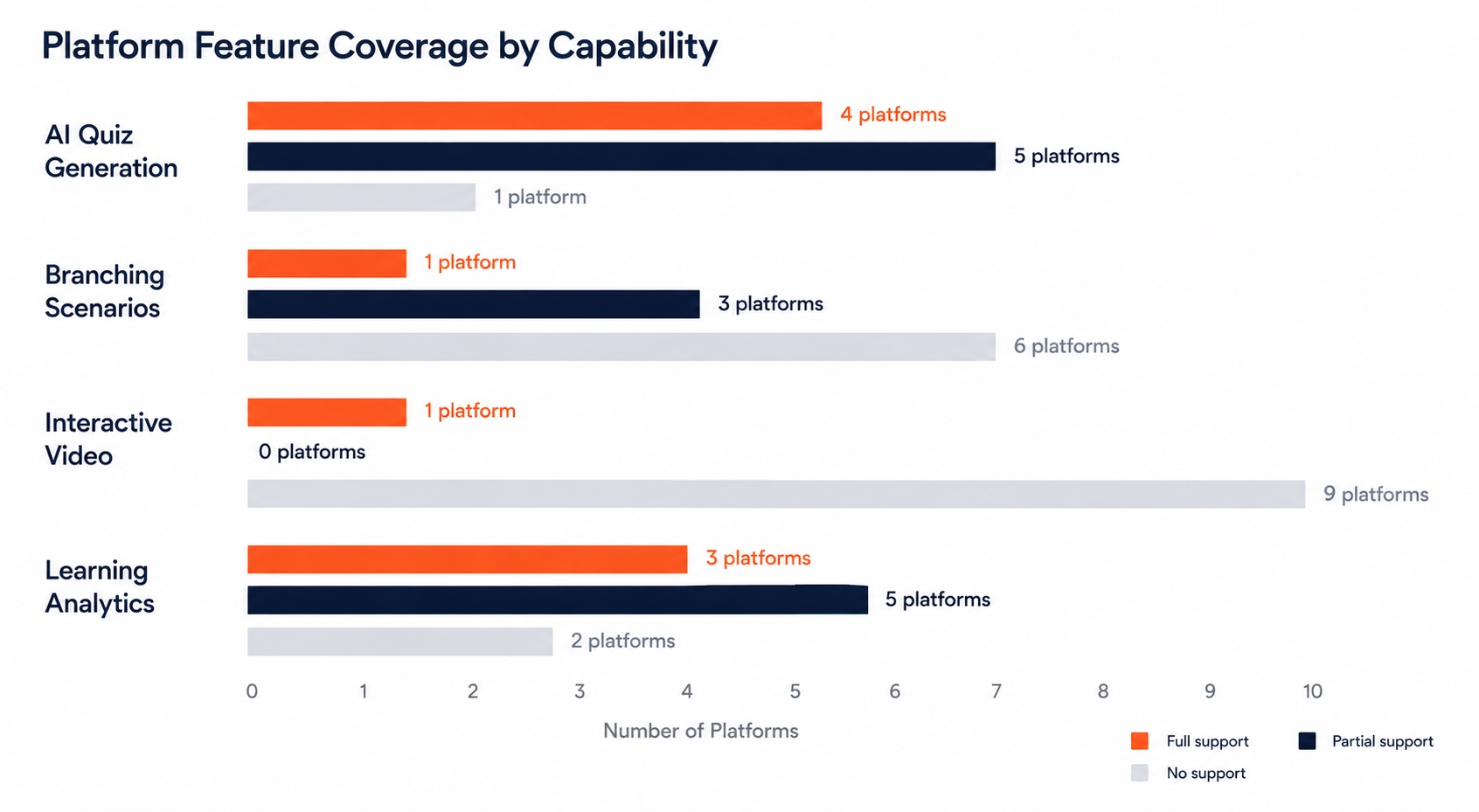
Clixie offers the most complete branching scenario capability in this comparison, with decision-based paths built inside the video timeline. Docebo and TalentLMS offer limited branching at the course level, but neither supports video-native branching paths.
How do AI training platforms improve employee onboarding?
AI training platforms improve onboarding by automating content delivery, personalizing learning paths to each new hire's role and department, and providing analytics that show where new employees are struggling before those gaps affect performance. Interactive video onboarding specifically allows new hires to engage with scenarios relevant to their actual job rather than sitting through generic content.
What is the difference between an AI LMS and a traditional LMS?
A traditional LMS hosts and tracks courses. An AI LMS generates content, adapts delivery based on learner behavior, automates assessments, and surfaces insights that help L&D teams improve training outcomes over time. The practical difference is that an AI LMS reduces the manual work required at every stage of the training lifecycle.
Which AI-powered training platform works best for remote teams?
Clixie works well for remote teams because existing video calls and recordings, including Zoom and Webex sessions, can be converted into interactive training modules that remote employees complete asynchronously. TalentLMS and LearnUpon are also practical options for managing distributed learners and delivering structured programs across multiple locations.
Final Verdict: The Best AI-Powered Training Platform in 2026
Most AI training platforms compete on the same dimension: how efficiently can they help you build and manage more courses. That is a useful capability, but it does not solve the core problem most L&D teams face, which is that training completion does not equal training effectiveness.
Clixie competes on a different dimension: making the video content your team already has into an active, measurable, learner-driven experience. AI quiz generation from video, branching paths inside the video timeline, and analytics that show behavior at the timestamp level represent a category that other platforms in this comparison have not built.
For L&D managers, training leads, and onboarding teams who are tired of reporting completion rates to stakeholders who want to see real outcomes, Clixie offers the most direct path from existing content to provable training impact.
Docebo is the right call for large organizations that need strong LMS infrastructure and AI-powered automation at scale. Sana Labs suits teams converting large document libraries into structured learning. TalentLMS is the practical entry point for SMBs. LearnUpon is the clear leader for customer education and partner certification.
But for teams that want to turn what they already record into training that actually works, Clixie is the best AI-powered training platform in this comparison.
Bring one stuck training video to your Clixie demo. Walk away with it interactive.
.png)
.png)