Interactive Video Training ROI: What 3,500% Engagement Growth Actually Looks Like [2026 Data]
Google saw 3,500% engagement growth. University of Michigan: 12.4% higher exam scores. See how Cisco Webex + Clixie AI produces measurable training ROI.
![Interactive Video Training ROI: 3,500% Growth? Here's the Data [2026]](https://cdn.prod.website-files.com/646b666669cbb97ed8baef9f/6a01d5207d1197b386d42bb4_interactive-video-training-roi.avif)


TL;DR
- Google deployed Clixie AI on Cisco Webex for Android partner training and recorded a 3,500% increase in learner engagement — confirmed in writing, not a rounding error.
- University of Michigan students who watched Clixie interactive lecture videos scored 12.4% higher on their final exams than classmates who did not — a full grade and a quarter.
- Blocks University onboarded customers using Clixie and saw 42% more course completions, 20% higher exam scores, and 31% fewer support calls — three separate ROI signals from one platform switch.
- The driver behind every one of these results is the same: interactive video turns passive viewers into active learners and generates behavioral data at every decision point.
Key Takeaways
- Interactive video training ROI is the measurable return — in engagement rates, exam scores, completion rates, and support cost reduction — produced when learners interact with video content rather than passively consume it.
- Branching scenario video is an active learning format where a learner's in-video decision determines which content plays next, generating behavioral data at every interaction point.
- The Cisco Webex + Clixie AI integration is a joint solution that converts Webex recordings into SCORM-compliant, AI-powered interactive training modules without requiring learners or trainers to leave the Webex environment.
- Google documented a 3,500% engagement increase after implementing Clixie AI interactivity on its global Android partner training program.
- The Kirkpatrick Model is the four-level training evaluation framework — reaction, learning, behavior, results — that interactive video analytics fulfill automatically at every learner interaction.
Introduction
Here is the number that should concern every L&D leader right now: 40% of employees who leave within their first year cite poor training as the primary reason for their departure — at a cost of over $40,000 per employee.
That is not a retention problem. It is a training problem disguised as a retention problem.
The instinctive response is to create more video content. Record more sessions in Webex. Upload more modules to the LMS. The problem is that more passive video does not fix passive learning. It just creates more content that employees watch once, retain partially, and file away without data to prove any of it worked.
I know what training engagement actually means in practice — and passive video does not produce it. The organisations in this article reached the same conclusion. Then they ran an experiment. They replaced passive video delivery with AI-powered interactive video built on Cisco Webex and Clixie AI. The results are below, in exact numbers, from the source.
Ready to run the same experiment in your organisation? Request a Clixie AI demo or log in and see what the data looks like on day one.
Why Corporate Training Is Failing — And Why the Cost Is Accelerating
Corporate training failure is a measurable condition where learners complete a programme without retaining knowledge or changing behaviour — and the financial consequences compound every quarter it goes unaddressed.
The scale of what is coming makes this more urgent than it has ever been. The World Economic Forum's Reskilling Revolution is targeting one billion people with better education and skills by 2030 — a workforce transformation of a scale not seen since industrialisation. The Future of Jobs Report 2025 puts the number more precisely: 39% of workers' existing skill sets will be transformed or become outdated by 2030. Organisations are not prepared for this. US corporate training spend has already climbed to $102.8 billion annually, and the return on that investment is still largely unmeasured.
Tim Moore, CEO and Co-Founder of Clixie AI, framed the core problem clearly in a joint webinar with Cisco for the UK Public Sector:
"When you have a video, it's a passive experience — so you don't know how well they're learning. Most people only look at their Webex recordings when they're trying to clear space on their hard drive."
The analogy he uses to explain what interactive video fixes has stayed with me. Passive video, Moore says, is like watching television:
"If you're watching TV, you get to lean back, reach for the popcorn, play with your phone — you're not penalised, the content is still running. In a video game, you have to pay attention because you might miss something critical to your outcomes. We're not video games — but that's the difference."
40% of people who leave their job within the first year cite poor training as the primary reason — at a cost of over $40,000 per employee. Most organisations respond by recording more passive video. That is the wrong answer." — Tim Moore, CEO, Clixie AI
This is how outdated training quietly drains budget at scale — not in a single catastrophic moment but in a steady bleed of turnover, underperformance, and support costs that never gets attributed to the training programme that failed to stick.
What the Research Says About Interactive Video and Learning Outcomes
Interactive video training ROI is the measurable return — in exam scores, completion rates, engagement, and support cost reduction — produced when learners make decisions inside video content rather than passively observe it.
The research on why this works is consistent and peer-reviewed. A published study on active learning strategies in safety training found that active learners retained 93.5% of information vs. 79% for passive learners — measured one full month after training, not immediately after. The forgetting curve does not flatten on its own. Interaction is what flattens it.
The test score gap is equally clear. Active learning produces an average test score of 70% vs. 45% with passive formats — a 54% difference in demonstrated knowledge. Meanwhile, 90% of L&D professionals confirm that video improves learner engagement and knowledge retention — but only when that video demands something from the learner.
The data problem is the hidden cost that rarely appears in a training budget: passive video generates no behavioral insight. An L&D manager reviewing completion data from a standard Webex recording can tell a CFO that 87% of the team watched the video. They cannot tell the CFO which concepts those learners misunderstood, where they disengaged, or whether any of it changed how they perform on the job. Interactive video generates that data automatically, at every click, every branching decision, every quiz attempt.
The proven benefits of interactive video in training are not theoretical. The four case studies below quantify them in real organisations, across five distinct sectors, with outcomes measured in the metrics that matter to finance, operations, and leadership teams.
builds greater trust, and greater trust driv4 Case Studies: Interactive Video Training ROI in the Real World
These are not industry benchmarks or modelled projections. Each result below comes directly from organizations that deployed Clixie AI on Cisco Webex and measured what happened next.
Summary table of interactive video training ROI case studies from Google, University of Michigan, Blocks University, and Utah Department of Agriculture using Clixie AI and Cisco Webex — 2026"
Case Study 1 — Google: 3,500% Engagement Increase on Android Training
Google has a training problem that most organisations would envy — and still could not solve without the right technology. The company needed to train global partners, including major telecoms operators, device manufacturers, and resellers, on how to use and sell Android and Android mobile solutions. The content was good. The engagement data was zero.
"They would create video content, send it to their partners and customers, and then hear nothing," Moore explained. "They didn't know if it was good or bad."
The switch to Clixie AI introduced mandatory interactive checkpoints that prevented passive playback, adaptive branching paths that routed learners to relevant content based on their responses, and a real-time analytics dashboard that gave the Google training team, for the first time, a clear picture of what was working.
The result: a 3,500% increase in learner engagement.
Moore's first reaction when the data came in was disbelief: "I honestly thought it was a typo when they sent it to me. But it's not. That's how much of a difference it makes when you take things from zero to interactive."
One detail worth noting for L&D teams evaluating platforms: learners never saw the word Clixie. The entire experience was white-labelled to Google's branding. Better brand consistency produces higher trust, and higher trust produces higher engagement. Google is now five years in and on its second three-year contract.

Case Study 2 — University of Michigan: 12.4% Higher Exam Scores
The University of Michigan used Clixie AI to build a lecture review experience for students preparing for their final exams. Twelve separate lecture recordings were combined into a single navigable "story" — Clixie's term for a structured, chaptered learning sequence.
The AI automatically segmented each lecture into chapters of under three minutes, aligning with microlearning research on attention spans. At the end of each chapter, learners had to complete a quiz — pulled directly from Canvas, the university's learning management system — before the next chapter unlocked. Students who failed a checkpoint were looped back to that segment to try again.
The outcome was measured against a natural control group: the same exam, the same curriculum, one cohort had Clixie and one did not.
Students who used the Clixie interactive review scored 12.4% higher on their final exam — what Moore described as "a full grade and a quarter higher."
The student experience data reinforced the result: 92% said they would much rather learn from interactive video than standard video. The quiz pass rate across the programme was 85%, approximately 15% above baseline. The measurement here is clean, comparable, and repeatable — the kind of data a provost or a CFO can act on.

Case Study 3 — Blox University: 42%, 20%, and 31%
Blox University built its entire customer onboarding learning experience inside Clixie AI. The goal was to get new customers productive on their software platform faster, with less hand-holding from the support team.
Three things happened that the platform had not produced before:
- Course completion increased by 42%. Learners who started the onboarding programme now finished it — because the interactive format kept them engaged rather than giving them an easy exit.
- Exam scores increased by 20%. Customers who completed the programme demonstrated meaningfully higher knowledge than those who had gone through the previous passive format.
- Support calls decreased by 31%. This is the result that matters most to leadership teams — and the one that is hardest to attribute to a training programme without behavioral data. With Clixie's analytics, the connection was direct and traceable.
To put that into context, Blox University is the educational arm for a major software provider serving the fast-paced media and publishing industry. Their software is incredibly robust, which historically meant new customers felt overwhelmed by standard, dense tutorial videos. The 31% drop in support calls wasn't just a volume metric—it represented a massive shift in ticket quality. Instead of their success team spending hours answering basic "how do I set up this feature" questions, the interactive onboarding handled the foundational knowledge. This freed their team to focus on high-level, strategic account expansion.
Moore's framing of the support call reduction is worth quoting directly: "That is an absolutely demonstrable return on your investment. Happier customers through better engagement equals more money for you."
This is what scenario-based training that sticks actually looks like in practice — not a slide deck claim but a support ticket reduction you can put in front of a CFO.

Case Study 4 — Utah Department of Agriculture and Food: Government Certification at Scale
The Utah Department of Agriculture and Food needed to certify pesticide applicators statewide — people who spray chemical compounds on commercial and residential properties and must demonstrate precise procedural knowledge before being licensed to do so.
There were no existing Webex recordings. No prior video content. Clixie AI built the training content from scratch using AI avatars and structured interactive modules, then layered in the certification assessment logic — learners progressing only when they demonstrated correct knowledge, with full tracking for compliance records.
Moore notes that government certification is Clixie's fastest-growing use case at the state and local level — and frames the stakes clearly: licensing is one of the most important services government provides to constituents, and the consequence of a knowledge gap is not a failed exam but a public safety incident.
The white-glove content creation service matters here. Organisations that have no existing video assets, or whose recordings are too informal to deploy as training, can hand the brief to Clixie and receive a polished, deployable, interactive certification programme. No studio. No production team. No reshoots when regulations change.

How Cisco Webex + Clixie AI Produces These Results
The Cisco Webex and Clixie AI integration is a joint training solution that converts any Webex recording into an AI-powered interactive learning module — without requiring learners or instructional designers to leave the Webex environment.
The mechanics are straightforward. The outcomes are not accidental.
Step 1 — Record. Any Webex meeting, training session, customer call, or product demonstration becomes the raw material. No additional production required.
Step 2 — AI automation. On upload, Clixie's AI immediately generates chapters (each under three minutes), a searchable and navigable transcript, translation into up to 50 languages — including regional dialects like Mexican Spanish vs. Castilian Spanish — and quiz checkpoint suggestions based on the content.
Step 3 — Add interactivity. Branching paths, visual markers, hotspots, native assessments, and timed CTAs are added through a natural language AI agent. Moore's description of this is the clearest argument against the "too complex to implement" objection: "You can simply type: 'please create an interactive bookmark at this time with this URL for this audience' — and the AI does the work for you." No video editor. No coding.
Step 4 — Deploy. The finished module is SCORM 1.2 and xAPI compliant, white-labelled to the organisation's branding, and deployable directly through Canvas, Teams, Zoom, or Webex. Learner progress, quiz scores, branching decisions, and completion status flow directly into the LMS record.
Step 5 — Analyse. The analytics dashboard shows engagement heatmaps, branching path accuracy, quiz attempt rates, and where learners drop off. The AI agent extends this: teams can log in and ask "compare last year's cohort data with this year's — show me where I have problems" in plain language and get an immediate answer.
The data reveals is one of the most useful frameworks for interpreting engagement analytics: "A lot of clicks on something means either extreme interest or extreme challenge. Having the data is like having a crystal ball."
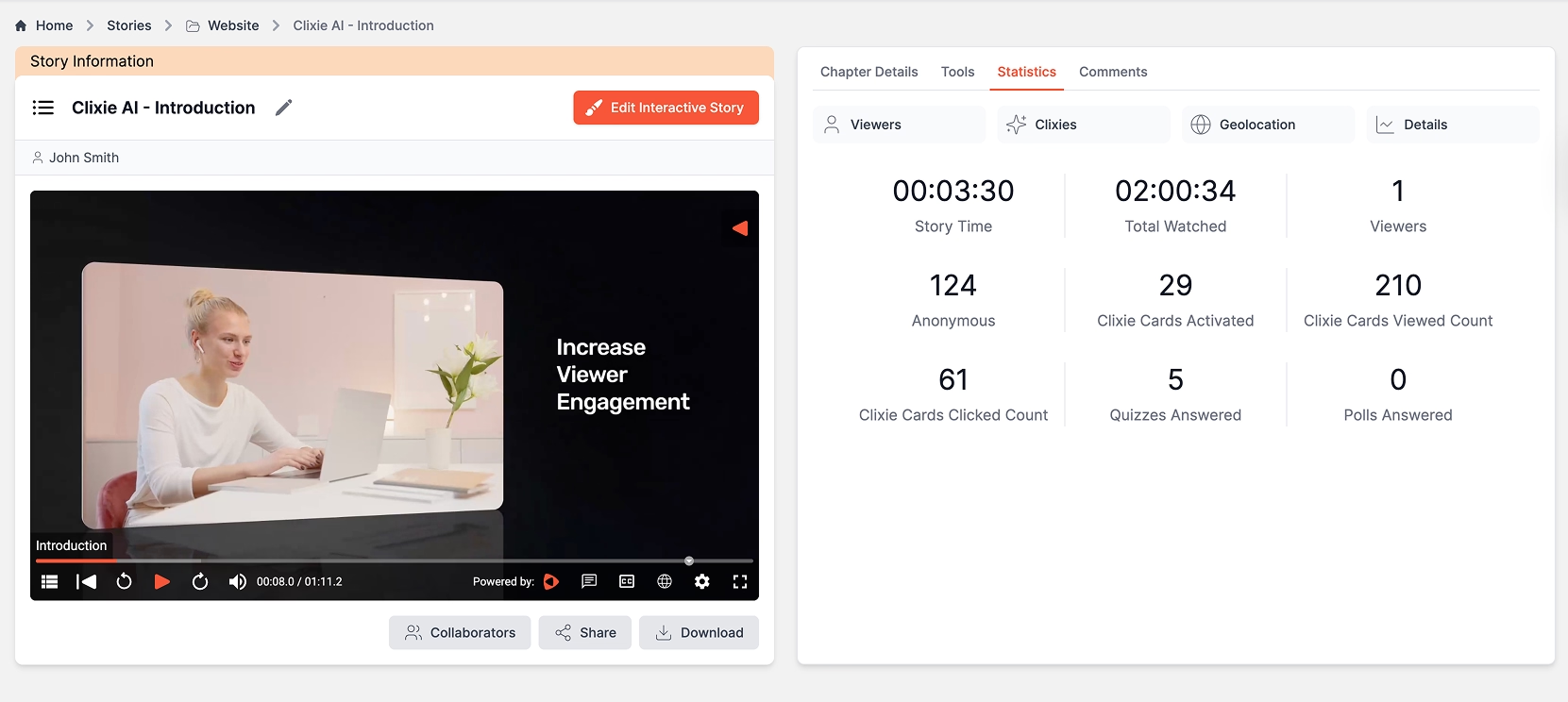
When I sit down with L&D directors to review their first 30 days of Clixie data, the "aha" moment is almost always the same. It is not the overall completion rate that shocks them—it is the "Incorrect Path Selection" clustering. Standard eLearning simply tells you a learner failed the post-video assessment. Our dashboard shows them that 70% of their new hires confidently clicked on the exact same incorrect action during a simulated scenario mid-video. That data point shifts the conversation instantly. It stops being "the employees aren't paying attention" and becomes "our curriculum is actively misleading them on this specific operational step, and we know exactly where to fix it."
For a deeper technical breakdown of the partnership, see how the Cisco Webex integration works end-to-end.
How to Replicate These Results in Your Organisation
Replicating interactive video training ROI requires three operational changes: replacing passive video delivery with branching content, connecting learner responses to your LMS data layer, and using analytics to close the gap between what was taught and what was retained.
Here is the five-step starting point for any L&D team:
- Audit your existing video library. Identify which Webex recordings or training videos are currently passive — no questions, no branching, no data. These are the highest-ROI targets for conversion.
- Upload and let the AI run first. Chapters, transcription, translation, and quiz suggestions are generated automatically. Most teams have a deployable interactive draft within an hour of upload.
- Add branching at decision-critical moments. Compliance choices, skills scenarios, and knowledge checkpoints are the highest-value insertion points. The AI agent handles placement via natural language instructions.
- Connect to your LMS via SCORM or xAPI. Every learner interaction — branching choice, quiz score, completion status, hotspot click — flows into your existing LMS record. No separate data warehouse required.
- Interrogate your analytics. Measure your video retention rate before and after switching formats. Compare cohorts. Ask the analytics agent where learners are struggling. Use that data to refine the next module — and to build the business case for expanding the programme.
For a full breakdown of the platforms delivering these outcomes across different L&D use cases and budget levels, the comparison guide is worth bookmarking before you evaluate vendors.
FAQ
What is the ROI of interactive video training?
Interactive video training ROI is the measurable return generated when learners interact with video content rather than passively watch it — quantified in engagement rates, exam score lifts, course completion improvements, and downstream metrics like support call reduction. Real-world results documented by Clixie AI include a 3,500% engagement increase at Google, a 12.4% exam score improvement at the University of Michigan, and a 31% reduction in support calls at Blocks University.
How do you measure the effectiveness of video training?
Measuring video training effectiveness requires tracking four levels of the Kirkpatrick Model: learner reaction (satisfaction and engagement data), learning (quiz scores and branching path accuracy), behaviour (on-the-job performance changes post-training), and results (business metrics like support ticket volume or sales conversion rates). Interactive video platforms like Clixie AI generate Kirkpatrick Level 1 and 2 data automatically through every in-video interaction, and export that data in SCORM or xAPI format for your LMS.
What is a good completion rate for online training?
The average completion rate for non-interactive online training video is approximately 60% — with 35% of learners who pause never returning to the content. Interactive video programmes with mandatory checkpoint questions and branching paths routinely achieve completion rates of 85–94%. Blocks University recorded a 42% increase in course completion after switching from passive to interactive video delivery.
How does interactive video improve learning outcomes?
Interactive video improves learning outcomes by requiring learners to actively respond to content — through questions, branching decisions, and hotspot interactions — rather than passively consuming it. Peer-reviewed research confirms that active learners retain 93.5% of information versus 79% for passive learners, measured one month after training. The act of making a decision inside a video, and receiving immediate feedback on that decision, encodes the underlying concept more durably than watching the same content play through.
How does Cisco Webex support corporate training programmes?
Cisco Webex supports corporate training as the recording and collaboration infrastructure that generates training content at the point of delivery. Through the native Clixie AI integration — available directly from the Webex App Hub — Webex recordings are converted into interactive, SCORM-compliant training modules automatically. L&D teams do not need to export recordings or use a separate platform. The entire workflow, from recording through analytics, runs inside the Webex environment.
Conclusion
The numbers in this article are not forecasts. They are documented outcomes from organisations that made one structural change to their training delivery: they stopped accepting zero data from passive video and started generating behavioral evidence from every learner interaction.
3,500%. That is what happened when Google stopped sending training videos into silence and started measuring what its partners actually understood. 12.4%. That is the exam score gap between Michigan students who learned actively and those who did not. 31%. That is how many support calls disappeared when Blocks University's customers finished their onboarding knowing what they were doing.
The infrastructure to produce these results is available today, embedded inside the Cisco Webex environment most organisations already use, deployable in under an hour on content that already exists. The only variable is whether your current training programme generates data — or just completion certificates.
Start your 7-day free trial — no credit card required. Upload your first Webex recording, let the AI build the interactivity, and see your learner data populate in real time. Start Free Trial →
.png)
.png)



.avif)