Best Compliance Training Platform in 2026: Ranked for Interactive Video, SCORM, and Audit Readiness
Click-through modules average 67% completion. Interactive compliance platforms hit 95%. Compare 8 platforms ranked for SCORM, branching, and audit trails.


North American organizations paid $4.6 billion in compliance penalties in 2024, according to Continu's 2026 compliance training software analysis. (The $4.6 billion figure is cited by Continu from industry compliance reporting; for individual violation amounts, OSHA publishes its official penalty schedule annually.) Penalty data doesn't always isolate training failure as the sole cause, but weak training records make compliance defense harder during audits, investigations, and litigation. The question every L&D leader should be asking is more specific: can your platform prove employees understood the material, not just that they clicked through it?
Most compliance training platforms stop at completion tracking. The best ones go further, forcing decision-making, capturing comprehension data, and giving L&D teams the audit-ready evidence regulators actually want to see.
Key Takeaways
- Dedicated compliance platforms report 95% completion vs. 67% with manual tracking, per Continu's 2026 compliance training analysis.
- Zahan's 2026 training completion benchmarks, which synthesize data from the ATD 2025 State of the Industry and LinkedIn's 2026 Workplace Learning Report, show self-paced compliance training averages 35% real completion, while branching formats exceed 89%.
- OSHA willful or repeat violations can reach $165,514 per citation, while GDPR cumulative fines have exceeded €7.1 billion.
- If you already have an LMS, you likely don't need a new compliance platform, you need an interactive video layer that makes your existing setup Level 3–4 capable.
- If your team already has compliance videos and an LMS, see Clixie’s interactive compliance training software for the product workflow behind the comparison.
What Separates Effective Compliance Training From a Checkbox Exercise?
Effective compliance training pushes completion above 94% and produces audit evidence that documents comprehension, not just attendance, according to Zahan's 2026 training completion rate benchmarks. That said, not all platforms are built equally. Five capabilities separate those that produce defensible audit evidence from those that just check a box.
Branching scenarios place employees in realistic decision points, a harassment situation, a data handling dilemma, a safety protocol choice, and route them based on their answers. This isn't optional for high-stakes compliance: it's the mechanism by which training shifts from passive to defensible. Remediation loops send employees who answer incorrectly back through targeted content, creating an evidence chain that shows not just completion but correction.
SCORM 1.2 and xAPI export matter because most organizations already have an LMS. The compliance video platform you choose needs to output packages that your existing system can ingest, assign, and track, not replace your LMS entirely. Automated recertification handles the operational burden of annual or role-specific renewal, triggering re-enrollment before certifications lapse. And audit-ready reporting means exportable records by employee name, completion date, content version, and score, the exact format regulators and legal counsel want to see.
95% of organizations offer mandatory and compliance training, according to ATD's 2025 State of the Industry report, one of the three most common content areas alongside new-employee orientation and manager training. The question isn't whether to use a platform. It's whether your platform handles all five of those capabilities or just the first one.
The Compliance Video Maturity Model: Which Level Is Your Training At?
Most compliance training evaluation frameworks focus on platform features. This one focuses on what the training actually produces, a 4-level scale that maps directly to completion rates, audit defensibility, and regulatory risk.
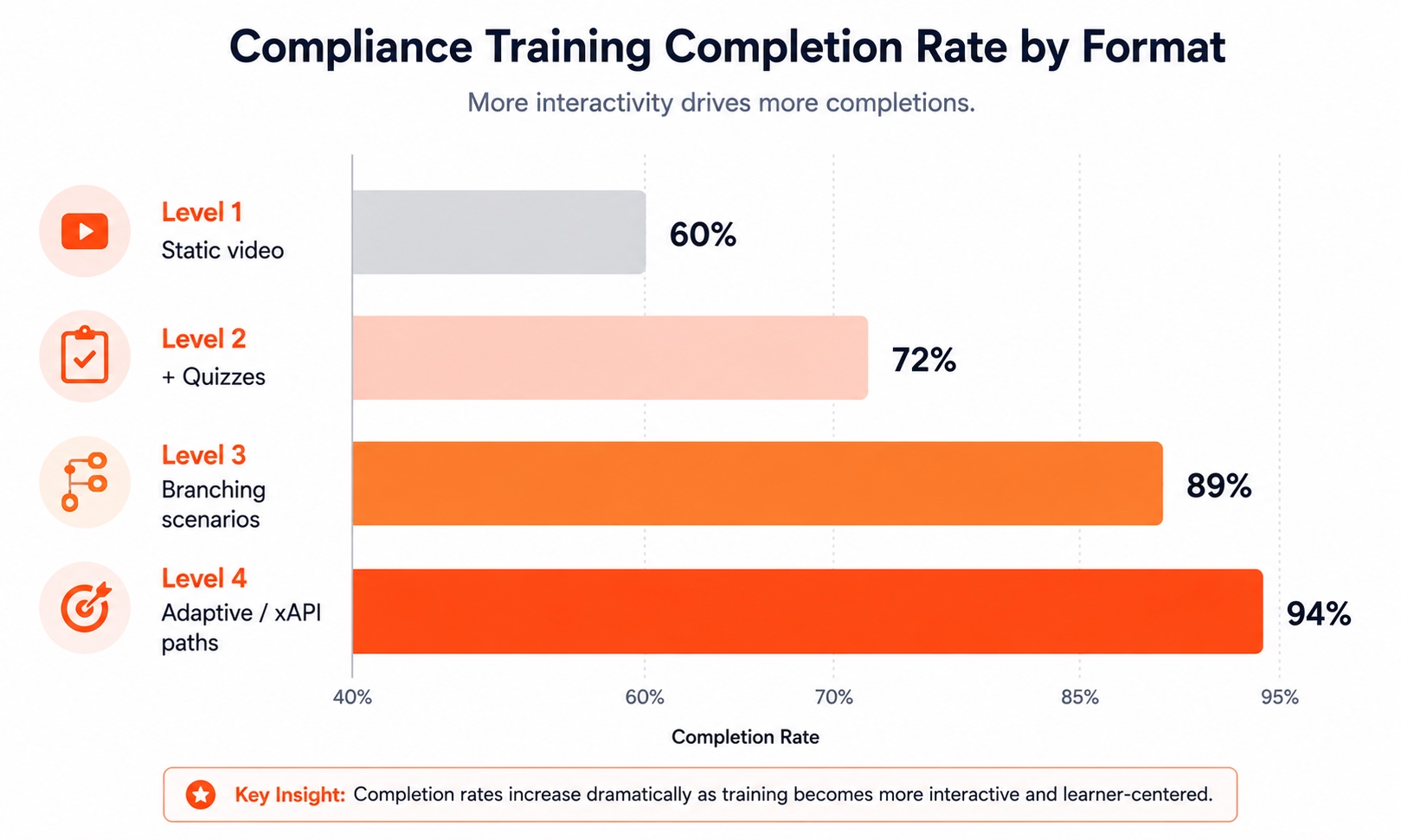
Level 1, Static video (play-to-complete). The employee presses play and watches. Completion is tracked when the video ends. There's no evidence of comprehension, no branching, no remediation. Average completion for non-interactive compliance video sits at 60%, per LMS Insights data via Research.com, and that's completion in name only.
Level 2, Video with embedded quizzes. By contrast, Level 2 adds questions during or after the video, but the path through the content is the same regardless of whether the employee answers correctly. Completion rates improve, but incorrect answers aren't remediated, they're just recorded.
Level 3, Branching scenarios with remediation paths. At this level, the employee faces a realistic scenario and chooses a response. Wrong choices route to corrective content before the learner can proceed. This is where completion rates cross 89% consistently, per Zahan's benchmarks, and where audit documentation becomes substantively defensible.
Level 4, Adaptive paths with xAPI analytics. Training adjusts based on prior performance. Learners who've previously demonstrated mastery move through faster; those who've failed remediation receive additional exposure. xAPI data captures the full interaction record, every decision point, every branch taken, every retry, in a format that integrates with any LRS or enterprise analytics stack.
Based on publicly available product documentation reviewed for this article, most full-suite compliance platforms emphasize assignment, completion tracking, quizzes, certifications, and reporting. Native video branching with remediation is less commonly documented and often requires an authoring layer or a dedicated interactive video tool, like Clixie, added on top of an existing setup.
The Compliance Video Maturity Model defines four levels of compliance training quality: Level 1 (static video, 60% completion), Level 2 (video with quizzes, 72%), Level 3 (branching scenarios with remediation, 89%), and Level 4 (adaptive xAPI paths, 94%). Most full-suite compliance platforms operate at Level 2. Reaching Level 3–4 requires native interactive video authoring or an interactive video layer integrated with the existing LMS.
The 8 Best Compliance Training Platforms in 2026
How we ranked these platforms: Each platform was evaluated across seven weighted criteria using publicly available product documentation, vendor websites, and G2/Capterra user reviews current as of June 2026. Scores are editorial assessments, not vendor-provided data.
Platform capability notes are based on publicly available product documentation as of June 2026. Features and pricing may change; verify directly with each vendor before purchasing.
Scores are editorial assessments (1–10) based on publicly available product documentation as of June 2026. Weighted criteria: audit reporting and SCORM/xAPI support 20% each; branching and remediation 20%; certification automation 15%; integrations 10%; deployment ease 10%; cost transparency 5% (not scored per-platform due to limited public pricing data). Verify capabilities directly with each vendor before purchasing.
The table above shows scores across all criteria. Platforms are listed below in order of interactive video capability (the dimension most relevant to the compliance training gap this article addresses (branching, remediation, and SCORM export). Organizations prioritizing audit reporting depth or certification automation should rank Docebo and Absorb LMS higher for their specific requirements; both outscore Clixie on those dimensions.
Each entry uses the Compliance Video Maturity Model level as a practical benchmark.
1. Clixie, Best for Adding Branching and SCORM to Existing Compliance Videos
Best for: L&D teams that already have an LMS and a video library, and need to upgrade their compliance training to Level 3–4 without replacing anything.
Compliance features:
- No-code branching scenarios layered onto any existing hosted video
- SCORM 1.2 and SCORM 2004 export for delivery through any LMS
- xAPI (Tin Can) output for granular, per-decision learner tracking in an LRS
- Embedded quizzes and remediation loops triggered by incorrect responses
- Native integrations with Canvas LMS, Salesforce, HubSpot, Cisco Webex, and Microsoft Teams
SCORM / xAPI: Full export for both standards, packages deploy directly into any SCORM-compatible LMS.
Maturity level: 3–4 (branching with remediation + xAPI analytics)
Limitation: Clixie is not an LMS, it doesn't handle course enrollment, certification management, or compliance reporting natively. It functions as the interactive video layer that integrates with the platform doing those things. Organizations without an existing LMS should pair Clixie with one of the full-suite platforms below.
See how Clixie adds branching to your existing compliance videos →
.avif)
2. 360Learning, Best for Collaborative Compliance Authoring
Best for: Organizations that want to build compliance courses using internal subject matter experts rather than an instructional design team.
Compliance features:
- Collaborative course authoring that routes content to relevant internal experts
- AI-powered quiz generation from existing compliance text or video
- Custom learner paths with mandatory training enforcement and automated reminders
- SCORM import for deploying off-the-shelf compliance content
- Strong completion tracking and basic audit reporting
SCORM / xAPI: SCORM import; xAPI output is limited per publicly available documentation.
Maturity level: 2 (video with AI-generated quizzes; no native branching documented)
Limitation: Interactive video branching isn't a native feature. Quizzes sit outside the video rather than embedded within it, meaning completion and comprehension data remain separate.
3. Continu, Best for Large-Scale HR Integration
Best for: Large enterprises running compliance training inside an existing HRIS or talent management stack (Workday, SAP, BambooHR).
Compliance features:
- Deep HR system integration for automatic enrollment on hire or role change
- Automated recertification with expiry notifications and manager escalation
- Comprehensive audit trail by employee, completion date, and content version
- Off-the-shelf compliance content library covering OSHA, GDPR, harassment, and DEI
- Real-time dashboards for compliance gap identification
SCORM / xAPI: SCORM import and delivery; xAPI output limited per public documentation.
Maturity level: 2 (course delivery with quizzes; native video branching not documented in current product pages)
Limitation: No native interactive video branching. Audit data is strong, but the training experience itself doesn't force decision-making.
4. Docebo, Best for Large Organizations Needing Deep LMS Functionality
Best for: Global enterprises with complex compliance requirements across multiple regions, languages, and regulatory frameworks.
Compliance features:
- Automated compliance assignment by role, region, and certification status
- Multi-language support with localized content delivery
- Detailed audit logs exportable for legal and regulatory review
- AI-powered content recommendations to surface relevant compliance material
- Integration with most enterprise HCM platforms
SCORM / xAPI: Full SCORM 1.2/2004 and xAPI support per vendor documentation.
Maturity level: 2 (strong delivery and tracking; interactive video authoring requires additional tools per public documentation)
Limitation: Implementation is heavy and pricing reflects that. Docebo is built for large organizations with dedicated L&D operations, smaller teams will find it over-engineered.
5. SafetyCulture (formerly iAuditor), Best for Frontline and Safety-Regulated Industries
Best for: Manufacturing, construction, healthcare, and logistics organizations where OSHA compliance, safety protocols, and frontline worker training are the primary use case.
Compliance features:
- Mobile-first delivery designed for deskless and field-based workers
- Digital checklists, safety audits, and inspection tools alongside training content
- Real-time compliance gap visibility for frontline managers
- Automated training triggers linked to safety incident reports
- Strong OSHA, workplace health, and industry-specific safety content library
SCORM / xAPI: Basic SCORM support; xAPI limited.
Maturity level: 2 (structured safety modules with checks; limited branching)
Limitation: Less suited to knowledge-worker compliance scenarios, GDPR, DEI, financial regulations, and data privacy aren't the platform's focus.
6. Absorb LMS, Best for Complex Certification Management
Best for: Organizations in heavily regulated industries (healthcare, finance, pharma) where multi-level certification hierarchies and automated renewal tracking are non-negotiable.
Compliance features:
- Granular certification management with configurable expiry windows and auto-renewal triggers
- Compliance report templates exportable for regulatory submission
- eCommerce for selling compliance training to external partners or clients
- Precise learner segmentation by department, location, and role
- SSO and API integrations for large tech stacks
SCORM / xAPI: Full SCORM 1.2/2004 and xAPI support.
Maturity level: 2 (strong delivery and certification management; interactive video authoring requires third-party integration)
Limitation: Pricing is higher-tier. Per public documentation, Absorb does not include native content authoring; interactive compliance video requires a separate authoring tool.
7. TalentLMS, Best for SMBs Needing a Cost-Effective Compliance LMS
Best for: Small and mid-size organizations that need a straightforward, affordable compliance LMS without enterprise complexity.
Compliance features:
- Intuitive course builder with SCORM import for compliance content
- Automated assignment and completion tracking by team or role
- Certification issuance with expiry reminders
- Branch accounts for delivering compliance training across subsidiaries or client organizations
- Mobile app for on-the-go compliance training access
SCORM / xAPI: SCORM 1.2/2004 import and delivery; basic xAPI.
Maturity level: 2 (SCORM-based delivery; interactive video authoring capability limited per public documentation)
Limitation: Branching and interactive video capability is basic compared to enterprise platforms. Organizations that need Level 3 training will need to pair TalentLMS with an interactive video layer like Clixie for SCORM-ready interactive training.
8. iSpring Suite, Best for Converting Existing Content to SCORM Fast
Best for: Teams that have PowerPoint-based compliance training and need to convert it to SCORM-deliverable courses quickly, without rebuilding from scratch.
Compliance features:
- One-click SCORM export from PowerPoint presentations
- Branching scenario builder built into the PowerPoint interface
- Quiz and survey tools with pass/fail scoring for compliance gates
- Video integration for adding recorded training to SCORM packages
- Detailed tracking of learner responses in any SCORM-compatible LMS
SCORM / xAPI: SCORM 1.2/2004 and xAPI output.
Maturity level: 3 (branching capability via PowerPoint; limited video-native interactivity)
Limitation: iSpring is a desktop authoring tool, not a platform. It needs an LMS for delivery, tracking, and enrollment, it doesn't handle those functions itself.
The best compliance training platforms for 2026 range from full-suite LMS/compliance systems (360Learning, Continu, Docebo, Absorb) to specialized tools (SafetyCulture for frontline safety, iSpring for SCORM conversion) and interactive video layers (Clixie). Clixie is the only platform in this comparison that functions as a Level 3–4 interactive video layer on top of any existing LMS, adding branching scenarios and xAPI tracking without replacing compliance management infrastructure already in place.
Full Platform vs. Interactive Video Layer: Which Do You Actually Need?
So which approach actually fits your situation? Branching scenario training delivers 9% higher knowledge retention, 14% better procedural knowledge, and 20% greater self-efficacy than conventional instruction methods, per Sitzmann's (2011) meta-analysis of 65 studies published in Personnel Psychology. The question isn't whether you need interactivity, it's whether you need to replace your whole compliance stack to get it.
Three questions narrow the decision:
1. Do you already have a working LMS with audit trail capability?If yes, a full compliance platform is probably redundant. What you're missing is Level 3 interactivity, and that can be layered onto your existing LMS via an interactive video tool like Clixie without displacing your compliance management infrastructure. If no, start with a full-suite platform from the list above.
2. Is your compliance failure mode "people didn't finish" or "people finished but don't know the content"?The first problem is an enforcement and reminder problem, most LMSes solve this natively with automated nudges and manager escalation. The second problem is a training design problem that only branching scenarios and remediation loops actually fix.
3. Do you need SCORM packages for an existing LMS?If yes, both approaches work, but an interactive video layer that exports SCORM is often faster to deploy than migrating to a new full-suite platform. Clixie's SCORM export generates packages directly from interactive video that any SCORM-compatible LMS can ingest, assign, and track.

Organizations with an existing LMS typically don't need a full compliance platform replacement to reach Level 3 training quality. An interactive video layer that exports SCORM 1.2/2004 and xAPI, like Clixie, can add branching scenarios, remediation loops, and granular learner tracking to any existing video library and deliver the output through the LMS already in place. This approach is faster to deploy and avoids displacing compliance management infrastructure already working.
What to Look for in Compliance Training Software: The 8-Point Buyer Checklist
The regulatory stakes make this decision consequential. OSHA willful and repeat violations can reach $165,514 per citation. GDPR cumulative penalties have crossed €7.1 billion, with €1.2 billion issued in 2025 alone, per DLA Piper's 2026 GDPR Fines and Data Breach Survey. Documented, comprehension-evidencing training is the strongest legal defense organizations have, but only if the platform can actually produce it. With that in mind, here is what to verify before committing.
Before signing any contract, verify the platform delivers on all eight of the following:
- Completion tracking by employee, date, and content version, not just aggregate counts. Regulators want individual records.
- Branching scenarios or decision-point quizzes, not just post-video assessments. Comprehension evidence requires in-experience checks.
- Remediation loops, incorrect responses must route to corrective content before progression, not just be recorded.
- SCORM 1.2 or SCORM 2004 output, your LMS almost certainly requires one of these standards for ingest and tracking.
- xAPI (Tin Can) output, the granular interaction record that captures every decision point, retry, and branch taken.
- Automated recertification triggers, manually managing annual renewals at scale is a compliance risk in itself.
- Exportable audit report, a downloadable record in a format legal counsel and regulators can review without platform access.
- Content versioning, the platform must track which version of the course an employee completed, since regulatory content changes over time.
What most compliance platform demos won't show you is whether the platform proves comprehension, not just completion. Ask the vendor to show you what an audit export looks like after a learner fails a branching scenario and completes remediation. That record is the difference between a defensible training program and a liability.
How Do You Add Interactive Branching to Existing Compliance Videos?
Organizations don't need to re-record their compliance video library to reach Level 3 interactivity. According to Zahan's 2026 training completion rate benchmarks, the format gap between static compliance video (60% completion) and branching formats (89%+) is achievable by layering interactivity onto existing video, with no new recording required.
The workflow in Clixie takes four steps:
- Step 1, Connect or upload your existing compliance video. Clixie connects to YouTube, Vimeo, Wistia, or any direct video URL. You don't move the file, you reference it.
- Step 2, Add decision points at key moments. Pause points with scenario questions appear at the timestamps you define. "Your colleague asks you to approve an expense that looks unusual. What do you do?" Learners choose from 2–4 response options.
- Step 3, Configure branching and remediation. Correct answers advance the learner. Incorrect answers route to a short remediation clip or slide before returning to the decision point. The loop continues until the correct response is selected, and the interaction record captures every attempt.
- Step 4, Export SCORM or embed in your LMS. Clixie generates a SCORM 1.2 or SCORM 2004 package in one click. Drop it into your LMS the same way you'd add any SCORM course. The LMS tracks completion; Clixie's xAPI output captures the full decision-point interaction data for your audit record.
A well-scoped module, where the source video, scenario questions, and remediation paths are already defined, can go from upload to deployed SCORM package in a single working session. More complex regulatory modules with multiple branching paths and remediation clips require additional review before publishing. See the full interactive compliance training workflow for a step-by-step walkthrough, or explore Clixie's SCORM and xAPI integrations for technical details.
Frequently Asked Questions
What is the best compliance training platform for enterprises?
For enterprises needing full audit trails and automated recertification across complex HR systems, 360Learning, Continu, and Docebo are the strongest full-suite options in 2026. For enterprises that already have an LMS and need to upgrade compliance video quality to Level 3–4, Clixie adds branching scenarios and SCORM/xAPI export without replacing existing infrastructure. The right answer depends on whether the gap is compliance management (full platform) or training interactivity (video layer).
Which compliance training platform supports SCORM and xAPI tracking?
Clixie exports SCORM 1.2, SCORM 2004, and xAPI from any interactive video, with xAPI capturing per-decision interaction records for each learner. Among full-suite platforms, Docebo and Absorb LMS offer the most complete SCORM and xAPI support. TalentLMS and 360Learning support SCORM import and delivery; their xAPI output is more limited. iSpring Suite exports both SCORM and xAPI but requires a separate LMS for delivery and enrollment.
How do I add branching scenarios to existing compliance training videos?
Platforms like Clixie let you layer branching decision points, quizzes, and remediation paths onto any existing hosted video without re-recording. Upload or connect your video, define decision points at key timestamps, configure correct and incorrect response paths, and export a SCORM or xAPI package for your LMS. A well-scoped module can be ready to deploy in a single working session once source video and scenario content are defined. The full process is covered in the interactive compliance training guide.
What completion rate should I expect from interactive compliance training?
Interactive compliance training with branching scenarios consistently exceeds 89–94% completion, versus an average of 35% for self-paced modules without enforcement mechanisms, per Zahan's 2026 training completion rate benchmarks. The gap closes significantly in regulated industries where enforcement is strict, healthcare and financial services average 20–22% self-paced completion even without interactivity. Adding branching and remediation moves those numbers into the 89–94% range regardless of industry.
Which Compliance Training Platform Is Right for Your Team?
The right compliance training platform depends on one question: does your training gap come from weak enforcement, or weak comprehension? OSHA willful violations can reach $165,514 per citation, and GDPR cumulative fines have crossed €7.1 billion: the stakes reward getting this right. In practice, most organizations need different tools depending on where they currently stand.
If you have no LMS, start with a full-suite platform (360Learning, Continu, or Docebo). If you have an LMS but your compliance video completion is below 80%, the gap is almost certainly training design; that's where an interactive video layer closes the distance.
As a result, three things stand out from this comparison:
- Completion tracking isn't compliance evidence. Regulators and legal counsel want proof of comprehension. Only Level 3–4 training, branching scenarios, remediation loops, decision-point records, produces that.
- Most full-suite platforms are strong at Level 2. 360Learning, Continu, and Docebo handle enrollment, reminders, and audit trails well. Based on their public documentation, native interactive video branching is not a core feature of any of them.
- If you already have an LMS, you don't need to replace it. An interactive video layer that exports SCORM and xAPI is faster to deploy, cheaper to implement, and preserves the compliance management infrastructure already working.
See how Clixie adds branching to your existing compliance videos →
Already using an LMS and want to add SCORM-ready interactive compliance video? Clixie integrates with Canvas, Salesforce, HubSpot, Cisco Webex, and any SCORM-compatible platform.
.png)
.png)