How to Make Your Videos Searchable (YouTube, TikTok & Beyond)
Learn how to make your videos searchable on YouTube, TikTok, and AI search engines. Step-by-step guide covering metadata, engagement, and interactive video.


TL;DR
- Video searchability comes down to three pillars: metadata optimization (titles, descriptions, keywords), engagement signals (watch time, CTR, comments), and interactivity (clickable elements that keep viewers active, not passive).
- YouTube rewards watch time and engagement above keyword density. Optimize your titles, descriptions, transcripts, and thumbnails, then use interactive elements to boost the metrics that actually matter.
- TikTok is a search engine now. 41% of Americans have used TikTok to search, and the platform processes over 140 billion searches per year. Keywords must appear in your captions, on-screen text, spoken audio, and hashtags.
- Interactive video generates 66% more engagement and 10X higher click-through rates than passive video. It is the single biggest lever most creators and brands are ignoring.
- Clixie.AI lets you turn any video into an interactive experience with quizzes, hotspots, branching, and chapters, then measure exactly how viewers engage. No code required.
Over 25% of Google search results now include a video snippet, according to VdoCipher's 2026 video SEO research. Meanwhile, TikTok processes more than 140 billion searches per year, with search query volume growing 140% year-over-year, according to data aggregated by ALM Corp. Video isn't just content anymore. It's a search surface.
Yet most videos remain invisible. Creators upload, cross their fingers, and wonder why the views never come. The problem isn't the content itself. It's that the video was never made searchable in the first place: no keyword strategy, no metadata optimization, no engagement hooks, and no interactivity to keep viewers locked in.
This post breaks down exactly how to make your videos searchable on YouTube, TikTok, and across the new wave of AI-powered search engines like ChatGPT, Perplexity, and Google AI Overviews. More importantly, it introduces the concept many creators are overlooking: interactive video as the ultimate searchability multiplier, and how Clixie.AI makes it easy to build, publish, and measure interactive video content without writing a single line of code.
What Is Interactive Video? A Complete Guide for Marketers
How to Make Your Videos Searchable (The Core Framework)
Making a video searchable means optimizing it so that platforms, search engines, and AI models can find, understand, and surface it to the right audience. This goes beyond just uploading and hoping for the best. It requires deliberate work across three pillars: metadata, engagement, and interactivity.
Pillar 1: Metadata Optimization
Metadata is everything search algorithms read about your video: the title, description, tags, captions, transcripts, file name, and structured data. Think of metadata as the language you speak to algorithms. According to SproutVideo, 72.8% of first-page search results include structured data, yet only 18% of organizations actually use it. That gap is your opportunity.
Pillar 2: Engagement Signals
Platforms like YouTube and TikTok don't just look at what your video says. They look at what viewers do. Click-through rate, average watch time, comments, likes, shares, and completion rate are all engagement signals that determine whether your video gets promoted or buried. According to Sprout Social's Q2 2025 Pulse Survey, YouTube's algorithm now weighs engagement signals like CTR, average view duration, and retention more heavily than keywords alone.
Pillar 3: Interactivity
This is where most creators leave massive value on the table. Interactive video generates 66% more engagement and 44% longer viewing time than passive video, according to research compiled by THM SEO Agency. The click-through rate of interactive video is 10X higher than passive video. Interactive elements (quizzes, hotspots, branching paths, clickable CTAs) transform viewers from passive watchers into active participants, and that behavioral shift sends exactly the signals search algorithms reward.
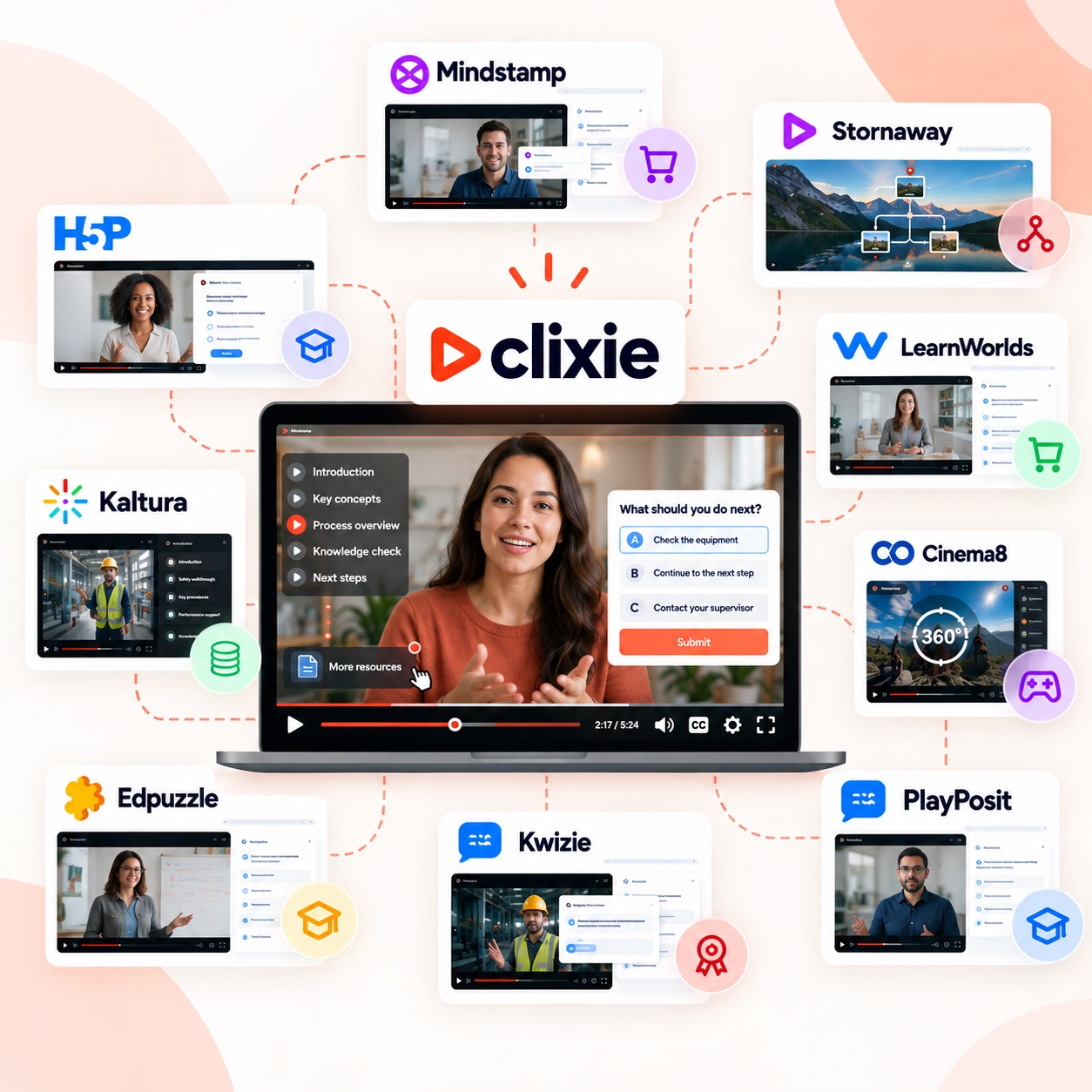
Clixie.AI is the tool that makes this third pillar accessible. It's a no-code platform that lets you upload any video and layer on interactive elements (buttons, hotspots, quizzes, chapters, branching logic) in minutes. It then tracks viewer engagement at a granular level through its analytics dashboard, giving you the data to prove what's working and what isn't.
Key Takeaway
The three pillars of video searchability are metadata, engagement signals, and interactivity. Most creators focus only on the first two and miss the biggest lever: interactive video, which generates 66% more engagement and 10X higher click-through rates than passive video.
How to Make Your YouTube Video Searchable
To make a YouTube video searchable, optimize your title, description, tags, and transcript with relevant keywords, then focus on driving the engagement signals (watch time, CTR, comments) that YouTube's algorithm uses to rank and recommend content. Adding interactive elements takes this a step further by boosting those engagement metrics.
Keyword Research and Metadata
YouTube is the world's second-largest search engine, with over 2.7 billion monthly active users, according to Meltwater. Every video you upload needs to be optimized for the terms your audience is actually searching for.
Here's what to optimize:
- Title: Keep it under 75 characters. Place your primary keyword near the front. Make the value proposition clear ("How to…", "X Ways to…", "Complete Guide to…"). According to Sprout Social, titles that highlight value and match search intent earn more clicks.
- Description: Use all 5,000 characters available. Front-load the most important information and keywords. Include timestamps, relevant links, and calls to action.
- Tags: Use focused, descriptive tags. Don't go overboard. Irrelevant tags can actually hurt rankings.
- Transcripts and Captions: Uploading a transcript makes your video fully machine-readable. Every spoken word becomes searchable text. According to SEO Sherpa, captions can boost video viewing time by 38%, which is a major signal for YouTube's algorithm.
- File Name: Before uploading, rename your video file to include your target keyword (e.g., "how-to-make-videos-searchable.mp4" instead of "final_v3.mp4").
Engagement Signals That YouTube Rewards
YouTube's algorithm has moved well beyond keyword matching. According to Semrush's YouTube SEO guide, the platform uses machine learning to recommend videos and evaluate how well they satisfy viewers. The signals that matter most:
Interactive video directly improves several of these metrics. When viewers can click, answer questions, or choose their own path through content, they stay longer and engage deeper.
Schema Markup for Google Visibility
If your videos live on your own website (not just on YouTube), adding VideoObject schema markup in JSON-LD format helps Google understand and display your video in search results, video carousels, and Google Discover. According to SproutVideo, 72.8% of first-page results use structured data, but only 18% of organizations implement it. This is low-hanging fruit.
Required properties include the video name, description, thumbnail URL, upload date, and duration. Optional but recommended properties include transcript, content URL, and interaction statistics.
Using Clixie.AI to Make Videos Interactive
Here's where the strategy shifts from standard SEO to competitive advantage. Clixie.AI lets you take any video and add interactive elements: clickable hotspots, in-video quizzes, chapter navigation, branching logic, buttons, and badges. You don't need a developer. The platform's AI engine even suggests the best interactive elements based on your content.
Once your interactive video is published (embeddable on any website, shareable via link, or posted to social media), Clixie's "Data-at-a-Glance" analytics dashboard shows you exactly how viewers interact. You can see where they click, where they drop off, how they score on quizzes, and which paths they take through branching content.
This data isn't just useful for improving your content. It's a signal to search engines and AI models that your content is engaging and valuable. More engagement = better rankings = more visibility.
How to Make Your TikTok Videos Searchable
To make a TikTok video searchable, place relevant keywords in your caption, on-screen text, spoken audio, and hashtags. TikTok's algorithm reads all four layers to determine what your video is about and who should see it.
TikTok is no longer just a scrolling platform. According to data cited by Sprout Social, Gen Z consumers search on social media before Google. Adobe research found that 41% of Americans have used TikTok as a search engine. And according to ALM Corp, demand for TikTok SEO services in the U.S. rose 116% in a single year.
Keywords in Every Layer
TikTok's search algorithm scans multiple content layers simultaneously. Here's where to place your keywords:
- Caption (most heavily weighted): Write captions that describe your video the way a user would search for it. Instead of "This saved my skin," try "My morning skincare routine for sensitive skin," as EmbedSocial recommends.
- On-screen text: Text overlays that appear in your video are indexed by TikTok's system. Use them to reinforce your primary keyword.
- Spoken audio: TikTok transcribes your voiceover. According to Rise at Seven, what you say in the first 5 seconds of a video has a higher impact on search rankings than written text. Say your keyword clearly and naturally.
- Hashtags (3-5 relevant): Mix broad and niche. Avoid generic tags like #fyp or #viral. Instead, use specific, keyword-rich hashtags that match search intent.
- File name: Name your video file with keywords before uploading (e.g., "tiktok-seo-tips-2026.mp4").
Share a specific TikTok where keyword optimization led to search traffic, including the keywords you targeted.
Hashtag Strategy That Works in 2026
Hashtags are still a discovery mechanism, but they've evolved. The old approach of stacking 15 generic tags is counterproductive. According to SEO Sherpa's TikTok guide, the smart strategy is:
- Use 3-5 hashtags maximum. Quality over quantity.
- Mix 2-3 trending hashtags with 1-2 niche ones. This balances broad reach with targeted relevance.
- Use TikTok's search bar autocomplete to discover what users are actually searching for. Type your topic and see what suggestions appear.
- Use TikTok's Creator Search Insights (in the Creator Center) to spot rising search terms before trends peak.
Content Format and Engagement Signals
TikTok's search algorithm also rewards engagement. Videos with high watch-through rates, shares, and comments rank higher in search results. According to Rise at Seven, 63% of all successful TikTok videos get their point across right away. Hook early, deliver value fast, and encourage interaction.
Here's the underused play: take your best-performing TikTok content and repurpose it as interactive video using Clixie.AI. Embed the interactive version on your website, in email campaigns, or in training modules. You get the reach of TikTok's algorithm and the deep engagement and analytics of interactive video.
How to Repurpose Short-Form Video Content for Maximum ROI
How to Make Your TikTok Account Searchable
To make your TikTok account searchable, ensure your account is set to public, enable all discoverability settings, and optimize your bio with relevant keywords.
Many creators unknowingly restrict their own visibility through privacy settings. According to BIGVU's guide on TikTok privacy settings, the Discoverability settings (found under Profile > Settings and Privacy > Privacy > Discoverability) control whether your videos appear in search results, on the For You Page, and in suggested content. For any growth-focused account, these should be fully open.
Here's the full checklist:
- Set your account to Public. A private account means your videos won't appear on the For You Page for non-followers and won't surface in most search results. Go to Settings and Privacy > Privacy > Private Account and toggle it off.
- Enable "Suggest your account to others." This lets TikTok recommend your profile based on phone contacts, email, and social connections.
- Keep comments open. Comments are engagement signals that tell the algorithm your content is worth amplifying. Use TikTok's keyword filter to catch spam automatically.
- Optimize your bio. Use your primary keywords to describe your brand or niche (e.g., "Interactive video tips for marketers" rather than just "Video creator"). Include a clear call to action.
- Enable Stitch and Duet. These features let other creators build on your content, which expands your reach and sends engagement signals back to your original video.
- Add a link in bio. Direct traffic to your website, a landing page, or an interactive video experience built with Clixie.AI.
Walk through your own TikTok account settings and any specific changes that improved your discoverability.
Beyond YouTube and TikTok: Making Videos Searchable for AI Search Engines
AI search engines like ChatGPT, Perplexity, and Google AI Overviews don't watch your videos. They read your metadata, transcripts, and structured data to determine whether your content answers a user's question. To get cited by AI, your video content needs to be machine-readable, well-structured, and backed by engagement data.
According to VdoCipher's 2026 research, LLMs interpret titles, descriptions, captions, schema metadata, and transcripts to understand what a video covers. If your video's transcript clearly and directly answers a common question, and your page uses VideoObject schema markup, you have a strong chance of being referenced in AI-generated answers.
Here's how to optimize for AI search specifically:
- Structure your videos around questions. Create content that answers "what," "how," and "why" queries directly. AI search pulls concise, direct answers.
- Keep transcripts public and crawlable. Don't hide them behind paywalls or require login.
- Use descriptive headings around video embeds. If your video lives on a blog, add contextual headings like "In this video, [Name] explains how to optimize TikTok videos for search."
- Add VideoObject schema markup with all required and recommended properties.
- Make longer, detailed videos. AI models prefer in-depth, well-structured sources they can trust. A 10-minute clear explanation often outperforms 2 minutes of surface-level content.
Interactive video built with Clixie.AI adds another layer here. The engagement data from Clixie's analytics (completion rates, quiz scores, click patterns, path choices) provides quantifiable proof that your content is valuable. While AI models don't directly read this data today, the behavioral signals it creates (longer time on page, lower bounce rates, higher return visits) all contribute to the authority signals that search engines and AI models use to rank and cite content.
Why Interactive Video Is the Searchability Multiplier
Interactive video is the most underused lever for improving video searchability because it directly boosts the engagement metrics that every platform's algorithm rewards. It transforms passive viewers into active participants, and platforms notice.
The numbers are hard to ignore. According to research compiled by THM SEO Agency:
According to Wistia's 2025 State of Video Report, interactive features placed at the end of longer videos boost conversion rates up to 65%. And yet, only 20% of marketers currently use interactive video, with 68% believing its importance will grow.
Clixie.AI is the platform that closes this gap. Here's what it offers:
- No-code authoring: Upload your video and add interactive elements (buttons, hotspots, quizzes, clickable areas, chapters, branching paths) through a drag-and-drop interface. Clixie's AI engine even suggests the best interactivity based on your content.
- Conditional branching: Direct viewers to different sections based on their choices. This is powerful for training, product demos, and storytelling.
- In-video quizzes and badges: Test comprehension, gamify the experience, and collect data on what viewers actually learned.
- Chapters and bookmarks: Let viewers navigate to exactly what they need, which improves satisfaction and reduces drop-off.
- Analytics dashboard: Track individual and aggregate engagement: where viewers click, how they score, which paths they take, where they drop off. This is data you can't get from YouTube or TikTok analytics alone.
- Publish anywhere: Embed on your website, share via link, post to social media, or export as a SCORM package for LMS platforms.
- 65+ language support: AI-powered transcription and translation make your interactive content globally accessible.
Clixie.AI is trusted by over 500 companies, including the University of Michigan and UC Davis, and their platform analytics show that interactive video boosts learner retention by 50%.
NeuCup's First Experience with Clixie.AI
NeuCupe is using Clixie.AI to build an interactive marketing video for NeuCup was a complete game-changer for our digital strategy. We were looking for a way to make our product showcases more engaging, and Clixie provided the perfect bridge between passive viewing and active participation. Instead of just hoping viewers would scroll down to click a link in the description, we were able to embed our brand's story and our storefront directly into the viewing experience itself.
The Interactive Workflow
The workflow was surprisingly intuitive and didn't require any heavy technical lifting. We started by simply uploading our standard, polished NeuCup promotional video into the Clixie dashboard. From there, we used the platform's tools to layer interactive elements over the timeline. We placed clickable hotspots over the NeuCup when specific features were mentioned, allowing users to instantly pull up sizing charts, material specifications, and direct "Add to Cart" buttons without ever leaving the video player. The drag-and-drop interface meant our marketing team could build and map out the entire interactive journey in a single afternoon.
Results vs. Standard Videos
The results we saw compared to our traditional, linear videos were phenomenal. Because viewers could click and explore the content on their own terms, our average watch time increased by 40%, signaling that the interactive elements held their attention much longer. More importantly, the frictionless path to purchase embedded within the video drove a 3x higher click-through rate directly to our product pages. Our audience wasn't just watching our marketing campaign; they were actively engaging with the NeuCup, turning a standard video view into a highly qualified conversion.
FAQ
Q: Do captions and transcripts really help video searchability?
A: Yes. Captions make every spoken word machine-readable, which helps both search engines and AI models understand your content. According to SEO Sherpa, adding captions can boost video viewing time by 38%, which is a significant ranking signal on YouTube.
Q: How long does it take for video SEO to show results?
A: On TikTok, search rankings can appear within 24-72 hours for low-competition keywords and 1-4 weeks for competitive ones. On YouTube, results typically take longer, often 2-8 weeks. Video schema markup takes an average of 14-30 days to generate rich snippets in Google.
Q: Can interactive videos be embedded on any platform?
A: Yes. Clixie.AI generates embed codes that work on any website, and interactive videos can also be shared via direct link or exported as SCORM packages for LMS platforms like Canvas, Moodle, and TalentLMS. The platform also integrates with Zoom, Microsoft Teams, and Webex.
Q: What is video schema markup and do I need it?
A: Video schema markup (VideoObject in JSON-LD format) is structured data you add to your website's HTML to help search engines understand your video content. It enables rich results in Google. Given that 72.8% of first-page results use structured data but only 18% of organizations implement it, adding schema is a significant competitive advantage.
Q: How does Clixie.AI differ from other interactive video tools?
A: Clixie.AI combines AI-powered authoring (it suggests the best interactive elements for your content), no-code simplicity, granular analytics, SCORM compliance, and 65+ language support in a single platform. It's designed for both marketers and L&D professionals, and it's trusted by 500+ companies.
Q: Does making a video interactive hurt its SEO?
A: The opposite. Interactive elements increase watch time, engagement, and completion rates, all of which are positive signals for search algorithms. The key is to ensure your interactive video is embedded on a page with proper metadata and schema markup.
Conclusion
Making your videos searchable isn't one action. It's a system. Optimize your metadata (titles, descriptions, keywords, schema), drive engagement signals (watch time, CTR, comments), and add interactivity to turn passive viewers into active participants.
Here are the key action items:
- Audit your existing videos for metadata gaps: missing keywords in titles, empty descriptions, no captions or transcripts.
- Set up your TikTok account for maximum discoverability: public account, all discoverability settings enabled, keyword-optimized bio.
- Add VideoObject schema markup to any videos embedded on your website.
- Start building interactive video content with Clixie.AI. Upload a video, add quizzes or hotspots, publish, and watch the engagement data roll in. The platform offers a free 14-day trial.
- Structure your video content around questions so AI search engines can cite you.
The brands and creators who win in video search over the next 12 months won't just be the ones with the best production quality. They'll be the ones whose videos are optimized, interactive, and measurable. Clixie.AI gives you the tools to be all three.
Ready to make your videos interactive and searchable?
.png)
.png)