


The End of "One Size Fits All": Hyper-Personalization, AI Agents, and the Interactive Revolution of 2026
Is 2025 the end of "one size fits all"? Discover how AI Agents, Interactive Video, and predictive data are redefining customer trust and ROI.



The Shift from Segments to Signals
The year 2025 marks the definitive end of broad demographic targeting. For decades, businesses operated on the law of averages, grouping customers into "segments" and treating every 30-year-old urban male roughly the same. Today, that approach is not just inefficient; it is obsolete.
We have entered the era of hyper-personalization: the ability to treat every single user as an individual, in real-time, at scale.
This shift is driven by a crisis of engagement. Digital noise has reached an all-time high, and consumers have developed a "filter" against generic content. They no longer see mass marketing; they ignore it. Success in this new landscape is defined by "signals"—the ability to capture a user's intent in the moment and reshape the entire digital experience to match it instantly.
A New Standard of Intelligence
The question is no longer "How do we reach our audience?" but "How do we understand this specific person right now?" This shift is powered by a convergence of three transformative technologies:
- Generative AI that can write unique messages and code custom interfaces for every reader.
- Interactive Media that adapts to viewer choices, turning passive spectators into active participants.
- "Listening" Engines (AI Agents) that predict needs before a problem arises, shifting service from reactive to anticipatory.
Resilience Through Relevance
Businesses that once focused on mass efficiency are now pivoting to mass intimacy. From e-commerce storefronts that rearrange themselves based on browsing history to technical support queues that know why you’re calling before you speak, 2025 is the year where the interface adapts to the user—not the other way around. In this new era, data isn't just a metric; it is the fuel for empathy.
Chapter 1: Key Forces Shaping Hyper-Personalization in 2025
1. The Rise of "Phygital" Experiences
The line between "online" and "offline" has dissolved completely. In 2025, hyper-personalization means carrying context across boundaries. The modern consumer expects a "contextual carryover": if they look at a running shoe on your mobile app, the in-store staff should theoretically know their size, preference, and that they abandoned the cart yesterday, the moment they walk in.
- Contextual Continuity: Data follows the user, preventing the "let me explain my problem again" frustration that kills loyalty.
- Unified Profiles: A single source of truth that combines digital clicks, physical foot traffic, and historical support tickets.
- The Outcome: A seamless journey where the brand feels like one cohesive entity, not a collection of disconnected departments (Sales vs. Support vs. Retail).
- The lesson: Customers don't see channels; they only see one relationship.
2. From Chatbots to "AI Agents"
The clunky, script-reading chatbots of 2022 are gone. They have been replaced by autonomous AI Agents capable of complex reasoning and execution. For many teams, adopting an AI agent builder is the practical step that makes these autonomous capabilities repeatable across support workflows without having to rebuild everything from scratch. These agents don't just answer FAQs; they perform tasks. They can process refunds, update subscriptions, modify shipping addresses, and troubleshoot technical issues by "reading" the manuals themselves in real-time.
- Emotional Intelligence: Modern agents analyze sentiment in real-time, a capability often integrated through an AI app builder. If a customer types in all caps or uses frustrated language, the Agent detects the emotion and adjusts its tone to be more empathetic or immediately escalates to a human.
- Action-Oriented: Agents that do things. Instead of sending a link to a "How to Reset Password" article, the Agent asks, "Would you like me to reset it for you now?" and executes the API call.
- 24/7 Tier-2 Resolution: Solving complex technical problems at 3 AM without human intervention.
- The outcome: Support becomes a value driver and a loyalty builder, not just a cost center.
3. Anticipatory Service & Predictive Care
The highest form of personalization is fixing a problem before the customer knows it exists. By analyzing usage patterns, IoT signals, and behavioral data, companies can now predict churn or technical failure with frightening accuracy.
- Proactive Outreach: "We noticed your WiFi signal is weak in the evenings. Here is a firmware update that fixes it," sent before the user even calls support.
- Predictive Shopping: Suggesting repurchases based on actual consumption rates (e.g., "You usually run out of coffee beans every 18 days"), rather than just calendar averages. This kind of pattern-based replenishment is especially valuable for ecommerce brands that rely on recurring orders, such as sellers offering private-label coffee beans through automated online storefronts.
- The Outcome: Trust is built through foresight. The brand moves from a vendor to a partner.
4. The Privacy Paradox: Trust as the New Currency
With great data comes great responsibility. As hyper-personalization grows, so does the user's awareness of their digital footprint. In 2025, the most successful brands are those that treat privacy not as a compliance hurdle, but as a premium feature.
- Zero-Party Data: Moving away from "creepy" third-party tracking (cookies) to explicit data—asking the user, "What are you looking for today?" and personalizing based on that direct answer.
- Transparent AI: telling users clearly when they are speaking to an AI and explaining why a specific recommendation was made.
- The Outcome: Customers willingly share data, but only with brands they trust to use it for their benefit, not just for ads.
Chapter 2: The Interactive Video Revolution
Why Passive Viewing is Dead and the Future is "Lean-Forward"
If 2025 was the year of Generative Video (creating footage from text), 2026 is the year of Interactive Video (turning footage into an engine for action).
[Travel Agency Interactive Video Placement]
For a century, video has been a "lean-back" medium. Whether it was cinema, TV, or YouTube, the viewer's role was static: sit back, watch, and absorb. But in an attention economy defined by TikTok swipes and second-screen distractions, passive video is losing its power. Completion rates are dropping, and retention is struggling.
The solution is the shift to “Lean-Forward” media. For instance, industries with high-intent buyers—like automotive—are increasingly blending interactive content with paid acquisition strategies, with many marketers getting started with automotive PPC on Google to drive targeted traffic into personalized, engagement-driven experiences.
The Neuroscience of Interaction
Human brains are wired for agency. When we physically interact with content—clicking, touching, choosing—our brain releases dopamine, the neurotransmitter associated with reward and motivation. Tools that support this shift toward two-way engagement, especially in learning and corporate environments, rely heavily on interactive content to keep participants actively involved.
- The "Ikea Effect" in Media: Just as we value furniture more when we build it ourselves, we value information more when we navigate it ourselves.
- Retention Spikes: Studies consistently show that interactive video generates 3x to 4x higher engagement times than linear video. When a user has to click to reveal the next step, they are cognitively "checking in" with the content, preventing the zoning-out effect common in passive watching.
Three Pillars of the Interactive Shift
1. Non-Linear Storytelling (Branching) Why should a CEO and a Junior Developer watch the same 10-minute product demo? In 2025, video is modular.
- The Mechanic: At the start of a video, the viewer is asked: "Who are you?" (e.g., "I'm in Marketing" vs. "I'm in IT").
- The Result: The video branches. The Marketer sees a benefit-focused pitch; the IT pro sees a security/compliance deep dive. One video asset serves multiple personas perfectly.
2. The Data Goldmine (Intent Tracking) Standard video analytics are shallow. They tell you how many people watched, but not what they cared about. Interactive video changes the metrics game entirely.
- The Old Way: "User X dropped off at 2:00." (Why? We don't know).
- The New Way: "User X clicked on the 'Pricing' hotspot but ignored the 'Features' hotspot."
- This is Intent Data. It tells sales teams exactly what a prospect is interested in before they ever pick up the phone.
3. Shoppability and Direct Action The "friction gap" is the time between seeing a product in a video and finding it on a website to buy it. Every second of that gap loses sales.
- The Solution: Shoppable layers allow users to click a jacket in the video and add it to a cart without leaving the stream.
- The Application: In corporate training, this means clicking a "Download PDF" button inside the safety video. In support, it means clicking "Schedule a Tech Visit" right inside the troubleshooting tutorial.
Summary: In 2025, video is no longer just a file type. It is an application. It is a web page. It is a storefront.
Chapter 3: Innovators Defining the 2026 Marketplace
Across industries, certain companies are setting the standard for what this new era looks like in action. They prove that creativity and intelligence can coexist, and that growth is strongest when the experience is tailored to the individual.
Clixie AI: Turning Every Video into a Two-Way Conversation
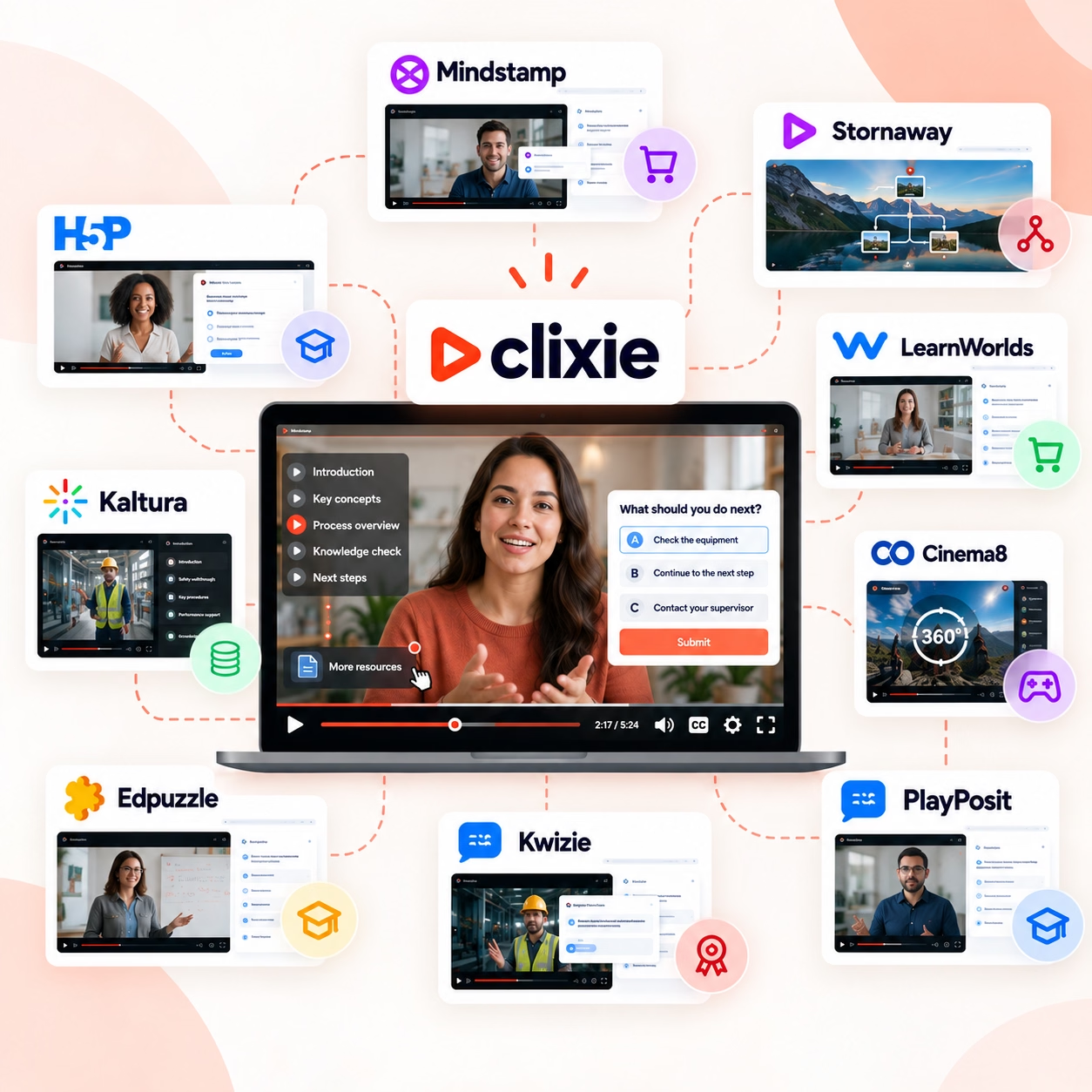
Overview Clixie AI is an interactive video platform that transforms passive viewing into active engagement. Used by educators, marketers, and corporate trainers, it allows teams to embed quizzes, hotspots, and "choose-your-own-adventure" branching directly into video content—without writing a single line of code. Key Solutions
- No-Code Interactivity: A drag-and-drop editor that sits on top of existing video files.
- Interactive "Bookmarking": Allows viewers to jump to the exact content they need, rather than scrubbing through a timeline.
- Deep Analytics: Tracks specific clicks and decision paths, providing granular intent data. Use Case in Action A software company uses Clixie for onboarding. Instead of a boring 30-minute webinar, new hires get an interactive mission. They choose their department, and the video adapts, showing only relevant tools. If they get a quiz question wrong, the video automatically loops back to re-explain that specific concept. Why It Matters in 2025 As attention spans shorten, "press play and hope" is no longer a viable strategy. Clixie AI proves that video can be a two-way street.
Intercom: The First AI Customer Service Agent
Overview Intercom has evolved from a messaging platform into a complete AI-first customer service ecosystem. Their flagship "Fin" AI agent is designed to resolve support tickets instantly, using the latest LLMs to understand complex queries and provide accurate, safe answers based on a company's own support content. For companies looking to leverage this technology without breaking the bank, finding a reliable Intercom discount can make upgrading to this AI-first ecosystem more cost-effective.
Key Solutions
- Fin AI Agent: An autonomous bot that resolves up to 50% of support questions instantly with human-like accuracy.
- Unified Help Desk: Integrates email, chat, and social tickets into one view.
- Safeguards: Strict controls ensure the AI only answers based on approved company documentation. Use Case in Action A SaaS company deploys Fin to handle weekend support. When a user asks, "How do I integrate with Slack?", Fin doesn't just paste a link. It summarizes the steps, asks which version of Slack they use, and offers to troubleshoot if the integration fails—all in conversational English. Why It Matters in 2025 Customers demand instant answers, but they hate robotic responses. Intercom bridges this gap with an AI that feels human and frees up real agents for high-value strategy.
Bloomreach: The Engine of E-Commerce Personalization
Overview Bloomreach is a commerce experience cloud that combines customer data, AI search, and marketing automation. It powers the "shopping experience of the future" by understanding not just what customers click, but why they click. Key Solutions
- Loomi AI: A specialized e-commerce AI trained on 13+ years of commerce data to optimize search results.
- Contextual Search: Understands long-tail queries (e.g., "red dress for a summer wedding under $100") better than standard keyword matchers.
- 1:1 Marketing: Sends emails and SMS based on real-time website behavior, not just static segments. Use Case in Action A fashion retailer uses Bloomreach to personalize their homepage. Visitor A, who loves hiking, sees waterproof boots and rain jackets. Visitor B, who just bought a suit, sees ties and dress shoes. Both visit the same URL, but see completely different stores. Why It Matters in 2025 In a crowded digital market, generic storefronts fail. Bloomreach allows retailers to build a site that rearranges itself for every visitor.
Gladly: Treating Customers as People, Not Tickets
Overview Gladly is a customer service platform built around a radical concept: "No Tickets." Instead of assigning case numbers, Gladly centers the experience around a lifelong conversation thread. Whether a customer emails, texts, or calls, the agent sees one continuous history. Key Solutions
- People-Centric View: A single timeline for every interaction across all channels.
- Hero AI: Helper tools that draft responses and summarize long histories for agents in seconds.
- Seamless Switching: Move a chat to a voice call without losing context. Use Case in Action A luxury luggage brand uses Gladly. A customer tweets about a broken wheel. Later, they call the hotline. The agent picks up and says, "Hi Sarah, is this about the wheel you tweeted about?"—instantly creating a "wow" moment of recognition. Why It Matters in 2025 Hyper-personalization fails if your support team treats a loyal customer like a stranger. Gladly proves that technology can make business feel more human, not less.
Clixie AI: Personalized Video at Scale
Overview Clixie AI is the leader in "Data-Driven Video." They allow brands to generate millions of cinematic-quality videos where every frame is personalized for the specific viewer—from seeing their name on a billboard to having a narrator discuss their specific usage stats. Key Solutions
- Cinematic Rendering: Hollywood-quality personalization, not just text overlays.
- Real-Time Generation: Videos are rendered the moment the user clicks "play."
- Scalability: Capable of generating millions of unique videos in hours. Use Case in Action A bank sends a "Year in Review" video to every client. The video doesn't just say "Hi Customer." It says, "Hi John, you saved $400 on dining this year!" while showing a specialized graph of John's actual spending. It ends with a customized offer based on his credit score. Why It Matters in 2025 Static email text is easy to ignore; a video addressed specifically to you is not. Clixie exemplifies the trend by combining the emotional power of video with the precision of CRM data.
The Road Ahead
The coming years will belong to those who can balance data depth with human empathy. Hyper-personalization is no longer just a marketing tactic; it is the operational standard for trust.
The companies shaping 2025 aren’t simply "using AI." They are integrating it into the fabric of the customer journey to remove friction, anticipate needs, and recognize individuals in a crowded world. As AI agents, interactive video, and predictive models converge, the brands that win will be the ones that make every customer feel like the only customer.
The technology is ready. The question is: are you?
.png)
.png)



.avif)
