Interactive Product Demos: The Fastest Way to Reduce Sales Calls and Increase Conversions
Learn how interactive product demos qualify buyers, shorten sales cycles, and reduce unqualified calls — without adding headcount. Built for growth teams.



TL;DR
- 67% of B2B buyers now prefer buying without a sales rep involved — your demo process needs to match that expectation.
- An interactive product demo lets prospects explore your product on their own, before they ever book a call.
- Self-guided demos filter unqualified discovery calls, shorten sales cycles, and improve product-qualified lead conversion.
- The best-performing demos are ungated, above the fold, and under 13 steps — format is as important as content.
- Clixie.ai adds branching video to the mix, turning a static product tour into a personalized qualification layer that generates first-party buying signals.
Who this is for: Growth leaders, VP Marketing, Product Marketing Managers, and Sales Enablement Leads at B2B software companies running sales-assisted or product-led growth. If your demo process still depends on a rep explaining product basics on every discovery call, this article is for you.
Key Takeaways
- An interactive product demo is a self-guided digital experience that allows buyers to explore product value without a live sales call.
- Demo automation is a sales infrastructure strategy that replaces repetitive discovery calls with scalable, self-serve buyer education.
- Product-qualified leads (PQLs) are prospects who have engaged with a product experience — interactive demos are the primary mechanism for generating them at scale.
- Buyer self-service preference is the documented shift in B2B purchasing behavior toward independent research and rep-free product evaluation.
- Branching interactive video is a demo format that presents personalized decision paths within a video experience, adapting to each viewer's role or use case.
- The Demo Compression Loop is a five-stage revenue framework: self-guided exploration, behavioral qualification, high-context sales call, personalized follow-up, accelerated close. It converts faster by removing unnecessary rep-dependent steps from the funnel.
- No-code demo builder is a category of software that enables non-technical teams to create interactive, self-guided product demos without engineering resources.
Most demo calls don't fail because your product isn't good enough. They fail before the call even starts.
The buyer shows up unprepared. The rep spends 20 minutes covering context that a good demo could have addressed in five. Both sides leave uncertain about fit. A follow-up gets scheduled. The deal cools.
This isn't a messaging problem or a rep performance problem. It's a structural problem: the structure is the demo process itself.
According to Gartner's March 2026 survey of 646 B2B buyers, 67% now prefer a buying experience with no sales rep involved. Yet most revenue teams still route every prospect through a live discovery call before they've seen the product do anything meaningful.
The real problem isn't low demo volume. It's that sales teams spend expensive human time explaining information buyers could have explored asynchronously. That's a fixable inefficiency — and the fix is an interactive product demo.
This article covers what interactive product demos are, why the current demo process is breaking under its own weight, how self-guided experiences compress the sales cycle, how to build one without a developer, how Clixie.ai operationalizes the full system as a revenue engine, and how to handle the SDR-replacement question with honest math.
If you want to understand how interactive elements work at a technical level, that's a useful starting point. But if you've already accepted that passive content is no longer enough and you're ready to build something that converts, keep reading.
See how interactive product demos reduce sales friction → Book a demo strategy session
What Is an Interactive Product Demo?
An interactive product demo is a self-guided digital experience that lets prospects explore your product's key features and workflows at their own pace, without accessing a live environment or scheduling a call with a rep.
That definition covers a wide range of formats. At one end, you have click-through product tours: screenshot-based walkthroughs where buyers advance through a linear sequence of annotated screens. At the other end, you have full sandbox demos — cloned live environments where buyers interact with a working product replica. In between sits a growing format that Clixie.ai is built around: branching interactive video demos, where buyers watch, choose, and navigate a personalized path through the experience based on their role, objective, or challenge.
Here's the distinction that matters for complex B2B products: most click-through demos simulate software interaction. Branching video demos simulate decision-making.
Consider a concrete example. A Head of Marketing selects "See campaign analytics" and enters a flow built around attribution, pipeline visibility, and conversion lift. A Customer Success Lead selects "Reduce onboarding friction" and enters an entirely different branch — activation checkpoints, onboarding flows, and handoff logic. Same product. Same demo asset. Two entirely different experiences, delivered without a rep.
When teams migrate to Clixie.ai from standard screenshot-based demo platforms, they typically arrive with the same frustration: the click-through tour looked polished, but buyers still left without understanding the business value behind the product. The operational reason is straightforward. Screenshot tools simulate interface interaction. Clixie.ai simulates the decision-making process behind the purchase itself.
In a traditional click-through demo, the buyer clicks highlighted fields, advances through static screens, and follows a sequence designed to imitate product usage. The experience shows where features live, but rarely explains why those features matter in the context of a real operational problem. Branching video changes the structure entirely. A VP of Growth sees attribution and pipeline visibility. A CS leader sees onboarding compression and activation workflows. An operations lead sees integrations, automation logic, and process orchestration. The buyer receives a personalized, asynchronous sales narrative that reacts to their role and intent, without a live rep guiding the experience.
One more distinction worth drawing early: an interactive product demo is not a free trial. A free trial still requires account creation, setup time, onboarding effort, and workflow commitment before the value becomes visible. A well-built interactive demo removes that friction entirely — buyers see what matters before they ever need to commit to accessing the product.
Why Traditional Demo Processes Are Breaking
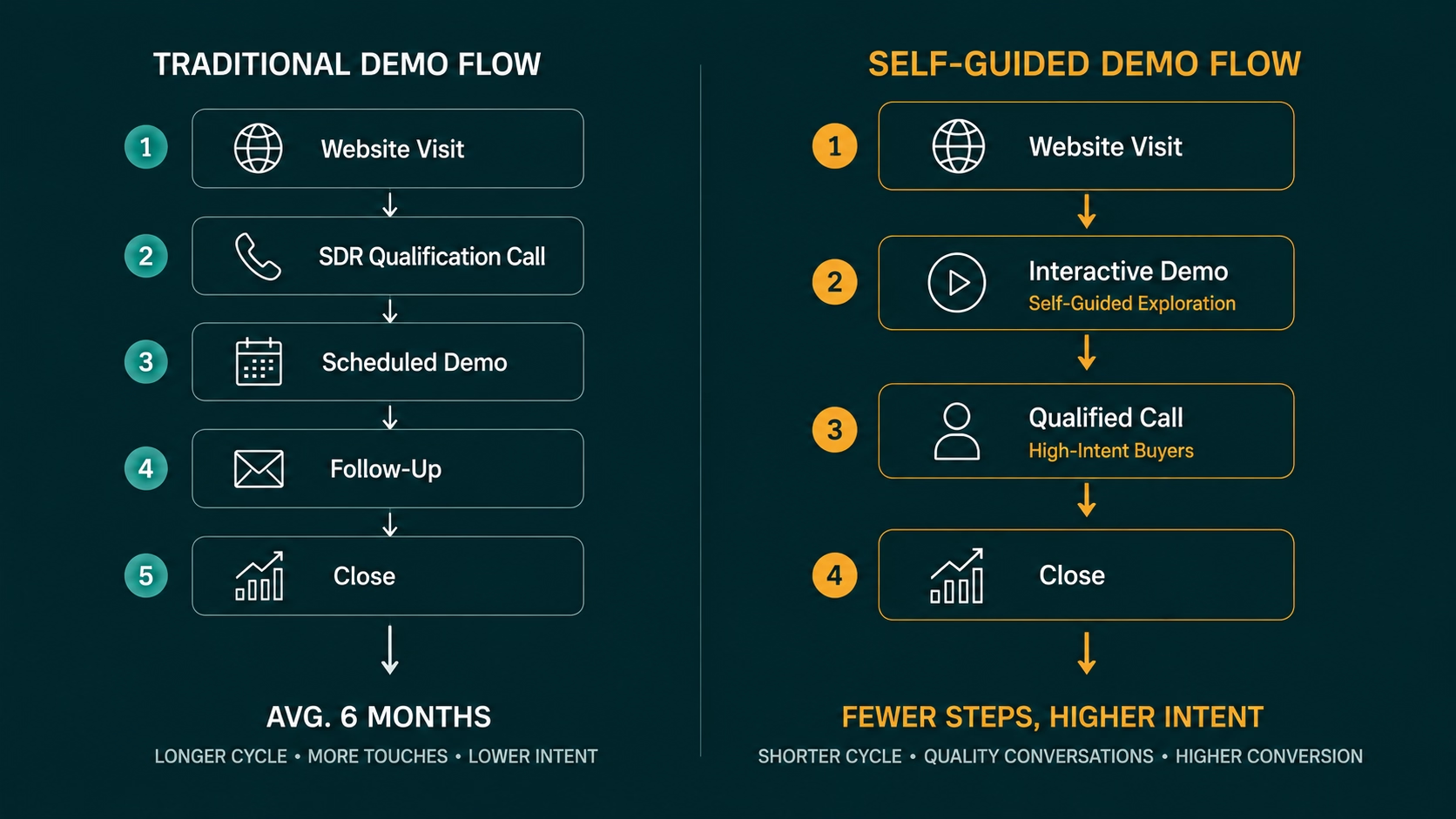
Traditional product demos fail because they force buyers through a one-size-fits-all experience at the rep's pace, producing low-intent, poorly qualified conversations on both sides of the call.
The economics are stark. According to SalesHive's analysis of data from Gartner, The Bridge Group, and Optifai's 2025 Sales Tech Stack Benchmark, a single in-house SDR costs $110,000–$160,000 per year in fully loaded cost — salary, benefits, sales tech stack, management allocation, ramp time, and turnover. Average SDR ramp time is 3.1–3.2 months. Average tenure is 14–16 months, meaning you typically get roughly one year of peak output before the hiring cycle restarts. Gradient Works' 2025 B2B Sales Performance Benchmarks found that 83.4% of SDRs fail to consistently hit their monthly quota, and the average rep generates just 4.4 quality conversations per day — a figure that has declined 45% since 2014.
Buyer behavior makes the mismatch worse. Gartner's 2026 research confirms that 67% of B2B buyers prefer a rep-free buying experience. They want to evaluate your product before committing to a conversation about it. Most demo processes ask them to do it in the wrong order.
Across hundreds of legacy B2B sales funnels reviewed through Clixie.ai implementations, the same pattern repeats. An inbound lead requests a demo. An SDR spends the first 10 to 15 minutes on qualification questions. The remaining time gets consumed by a surface-level screen share covering basic navigation, core tabs, and introductory workflows — because the buyer hasn't seen enough of the product to ask anything strategic yet. In many cases, more than 40% of those buyers disappear after the first call because they realize the product wasn't what they expected, didn't match their workflow, or wasn't aligned with the problem they were actually trying to solve. That is not a sales execution failure. It is a sequencing failure.
The cost of not fixing it is measurable. Every unqualified demo call compounds customer acquisition cost. Every repetitive discovery call delays pipeline velocity. Every rep-dependent explanation model caps how fast you can scale, because headcount becomes the ceiling, not the market.
How Self-Guided Demos Improve Conversions
Self-guided demos improve conversions because they qualify buyers before a rep ever joins the conversation. The demo handles product education, use-case mapping, and initial fit assessment, so the live call can focus entirely on advancing a relationship that's already primed to close.
The mechanism works through what we call the Demo Compression Loop — a five-stage framework that collapses the traditional sales process into a more efficient, higher-intent sequence:
- Self-guided exploration — the buyer builds product context on their own terms
- Behavioral qualification — intent signals surface without rep involvement
- High-context sales call — the rep enters knowing exactly what the buyer cares about
- Personalized follow-up — demo engagement data shapes every subsequent touchpoint
- Accelerated close — fewer steps, higher mutual confidence, faster decision
The loop doesn't remove the rep. It removes the friction that slows the rep down.
The supporting data is consistent. Navattic's benchmark research found that interactive demos achieve a 23% click-through rate compared to 3.21% for standard video. The top 25% of demos average a 50.1% engagement rate and a 28.9% completion rate. The Consensus 2025 B2B Buyer Behavior Report found that 84% of B2B buyers say self-service tools are critical when choosing a vendor. Forrester's 2025 B2B marketing and sales predictions note that more than half of large B2B transactions of $1 million or greater will be processed through digital self-serve channels.
Across Clixie.ai's branching interactive demo deployments, the behavioral difference between passive product content and interactive video becomes measurable quickly. Standard product videos experience steep engagement decay after the first 45 seconds. Because Clixie.ai viewers actively choose their path through the experience, they remain invested in reaching the outcome most relevant to their role or problem. That interaction model maintains an average completion rate of 74.2% across all demo branches — and generates an average 4.8x increase in CTA click-through compared to static product landing pages, primarily because calls-to-action appear after buyers have already self-qualified through interaction.
What that looks like in practice: one cybersecurity software company implemented a four-path Clixie.ai branching demo above the fold on its primary product and pricing pages after struggling with low-intent inbound requests overwhelming its sales team. Within 60 days, total booked discovery calls decreased by 34%, closed-won pipeline value increased by 52%, AE teams stopped spending time on repetitive introductory walkthroughs, and live calls shifted almost entirely toward technical validation and implementation discussions. The demo did not reduce demand. It filtered and upgraded it.
How to Create an Interactive Product Demo Without Developers
Most teams can build a production-ready interactive product demo in a single day using no-code tools — no engineering resources, no staging environments, no developer sprints required.
The objection that stops most teams from starting is straightforward: "Interactive demos sound complicated and expensive to build." That was the reality three years ago. It's no longer accurate.
1. Map your product's two or three "a-ha moments."Not every feature. The two or three moments where prospects consistently recognize value. Pull these from CS call recordings, top-performing sales deck slides, or ask an LLM to surface them from your best discovery call transcripts.
2. Record the relevant product flows.For click-through tools, a browser extension captures product screens. For branching video demos, record a short walkthrough for each role-based path — or layer AI-generated narration over screen recordings. You are capturing the flow, not producing a film.
3. Add branching paths based on buyer role or use case.Decision points should mirror the questions buyers actually bring to a live demo. "Show me how this works for my marketing team" and "Show me this for my CS team" are natural branch triggers. Build from those.
4. Add a timed CTA at the point of highest engagement.Not at the end, where most viewers have already left. At the moment the demo peaks — typically just after the core value reveal — intent is highest. Meet it with a frictionless next step: book a call, start a trial, get a personalized walkthrough.
5. Publish without a gate.For top-of-funnel discovery, ungated demos consistently outperform. Navattic's State of the Interactive Product Demo found that approximately 70% of the best-performing demos are fully open — no form required. Gate only when your audience is tightly targeted and you need behavioral data attached to a known contact for routing purposes.
Keep the experience short. Navattic's benchmark data shows that demos between one and six steps achieve the highest completion rates for click-through formats. For branching video, three to five minutes with clear decision points consistently outperforms longer walkthroughs.
How Clixie.ai Turns an Interactive Product Demo Into a Revenue Engine
Clixie.ai extends the interactive product demo beyond a static website tour, adding branching video, AI personalization, timed CTAs, and behavioral intent signals across the full buyer journey from first touch to post-sale activation.
Most demo tools stop at the website. Clixie.ai is built for the full revenue loop.
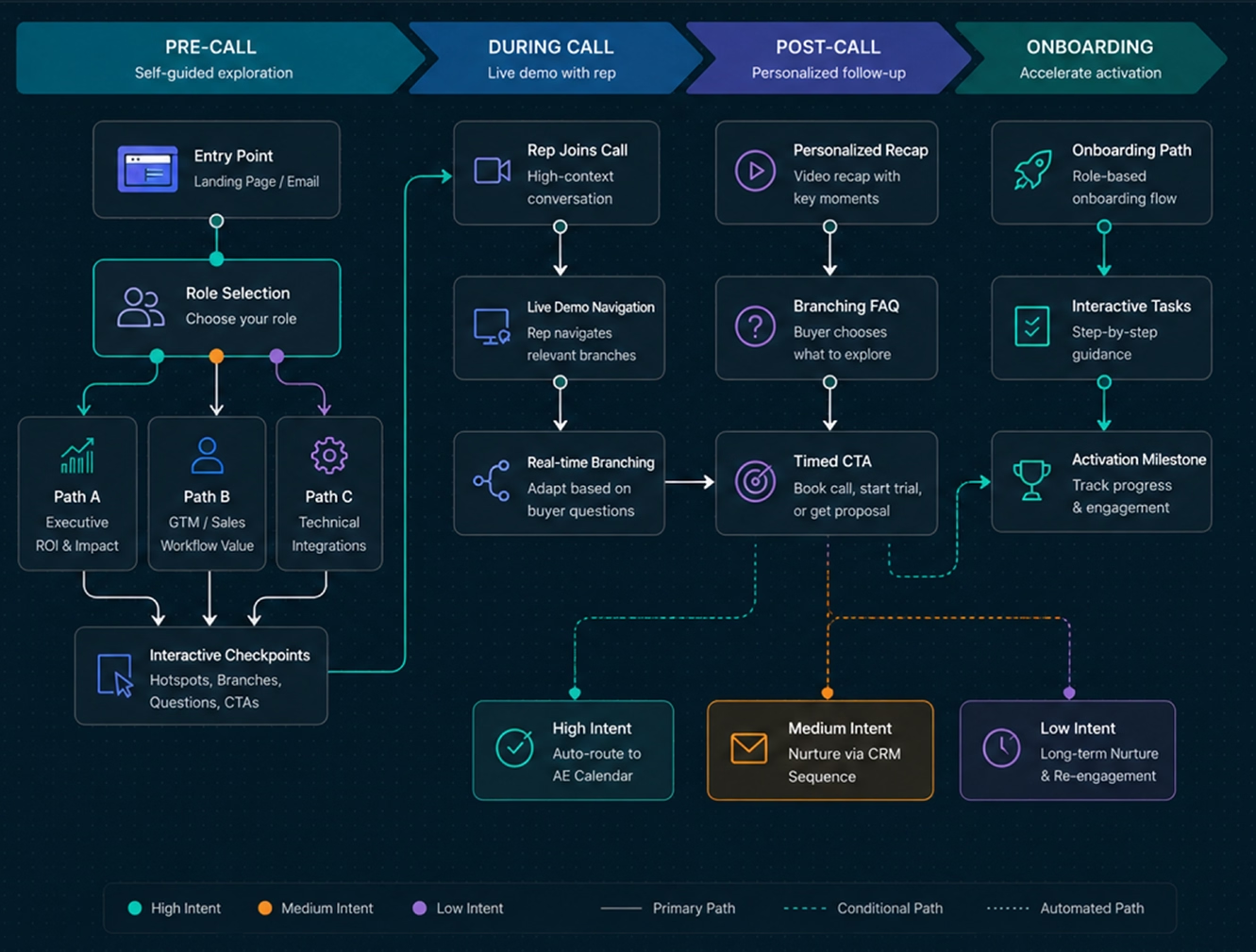
Pre-call: A prospect receives a personalized branching video demo via email or landing page before any live interaction. They select their role — VP of Growth, CS Lead, Operations — and the experience adapts to show the narrative most relevant to their context. By the time they book a call, they arrive prepared, not curious.
During the call: Reps navigate Clixie.ai flows in real time based on what the prospect asks. No staging environment. No demo-environment errors. The demo follows the conversation, instead of forcing the conversation to follow the demo.
Post-call: The follow-up is not a PDF. It's a personalized recap video with clickable chapters, hotspot annotations on the specific features discussed, and a timed CTA that fires when engagement peaks. Buyers revisit the experience on their own — and every interaction generates a signal.
Follow-up sequences: Multi-touch video follow-ups with branching FAQs let prospects click the question most relevant to their current concern. The right answer plays. Reps see the full engagement picture before the next call, turning follow-up from guesswork into a data-informed strategy.
Onboarding acceleration: For teams managing video-led onboarding at scale, Clixie.ai's branching structure carries into the post-sale phase. New users select their onboarding path, complete interactive checkpoints, and activate faster — without requiring CS intervention on every account.
At Clixie.ai, interactive demos are structured as a connected revenue system rather than a standalone marketing asset. A single branching experience qualifies buyers, routes intent, supports live sales conversations, reinforces follow-up, and accelerates onboarding, without rebuilding the asset for each stage. The structural flow: a website visitor, outbound recipient, or inbound lead enters through a landing page, email campaign, or embedded product page. They select a role (Executive, GTM, or Technical). The experience branches into the relevant workflow narrative: ROI and revenue impact, operational efficiency, or integration architecture. Interactive checkpoints appear throughout: hotspot interactions, branching decisions, embedded questions, timed CTAs, and qualification prompts. Behavioral engagement data then determines the next action — high-intent viewers route to AE calendars, lower-intent viewers enter CRM nurture sequences, incomplete sessions trigger targeted follow-up, and replay patterns surface objections before any live call occurs.
Interactive Demos as First-Party Buying Signals
An interactive demo is not just an educational asset. It is a behavioral intelligence system.
Every interaction inside a Clixie.ai demo generates data your team can act on. Path selection reveals which role or use case the buyer self-identified with. Hotspot clicks surface which specific features generated curiosity. Replayed sections signal either high interest or unresolved questions — both are worth knowing before a live call. Whether the buyer engaged the CTA at peak intent or bypassed it entirely is its own signal. Drop-off points expose gaps in your messaging. Role-based engagement patterns reveal how different personas move through the same demo differently.
These are first-party qualification signals — more reliable than form fill data and more specific than time-on-page analytics. For teams already investing in personalized video strategies, this behavioral layer turns every demo into a continuous improvement loop: each engagement cycle makes the next campaign smarter.
Build a self-guided product demo without developers → Try Clixie.ai: no engineering required
that mimics
Can Interactive Demos Replace SDR Discovery Calls?
Interactive demos don't replace SDR calls — they replace the unqualified ones. The goal is not to remove human conversation from the sales process. It's to ensure every live conversation starts with mutual context rather than cold introduction.
Here is the practical reframe. An SDR team's real value is not in explaining your product to buyers who haven't yet decided to evaluate it. It's in advancing relationships with buyers who already understand what the product does and are deciding whether it fits their situation. Self-guided demos handle the first job. SDRs handle the second.
According to RevenueHero's 2025 benchmark data, elite demo funnels achieve a lead qualification rate of 90% or higher. For most teams, the gap between their current rate and that benchmark is filled with calls that should never have been booked — calls a 10-minute interactive demo could have replaced with a clearer behavioral signal.
The operational impact Clixie.ai observes consistently across B2B software deployments is not just higher demo engagement — it is recovered selling capacity. Account executives deploying a self-guided Clixie.ai qualification layer report recovering an average of 11.5 hours per week previously consumed by low-intent first-touch meetings, repetitive introductory walkthroughs, and poorly qualified discovery calls. At team scale, the impact compounds: a 10-person AE organization recovers roughly 115 hours of active selling capacity per week — without adding headcount, expanding SDR coverage, or increasing payroll. Operationally, that is the equivalent of approximately three additional revenue-producing reps, created through process redesign alone.
When teams place a self-guided Clixie.ai demo before the live conversation, the entire dynamic shifts. Low-fit buyers filter themselves out asynchronously before consuming AE or SDR capacity. High-intent buyers arrive already educated on the product's core workflows, use cases, and value. The live call stops sounding like an introduction and starts sounding like a technical evaluation. Instead of asking "What does your platform actually do?" prospects arrive saying: "I saw how your branching analytics workflow handles API-level routing. Can we talk about how that would integrate into our existing stack?" That shift is operationally significant — the sales process compresses because buyers enter the conversation with context already established.
For product-led growth teams, the logic is even cleaner. Interactive demos bridge the gap between trial or freemium users and expansion conversations, surfacing intent before a CS team needs to intervene.
The question is not whether to use SDRs. It is whether your SDRs are spending their time on conversations that genuinely require a human — or on ones that a good demo could have handled first.
Five Ways to Reduce Discovery Calls and Improve Conversions
There are several ways to reduce unqualified discovery calls. The table below compares the five most common approaches on the dimensions that matter most for revenue teams deciding where to start.
Interactive video demos are the only approach in this group that simultaneously qualifies buyers, generates first-party behavioral data, and compresses the sales cycle — without adding headcount, waiting months for content to compound, or requiring a developer to build anything.
FAQ
Q: What is an interactive product demo?
An interactive product demo is a self-guided digital experience that lets prospects explore product value without a live environment or a scheduled call. It can take the form of a click-through tour, a branching video walkthrough, or a full sandbox replica, each giving buyers a hands-on sense of what the product does and whether it fits their use case, before a rep is ever involved.
Q: How do self-guided demos improve conversion rates?
Self-guided demos improve conversion rates by allowing buyers to qualify themselves before a live conversation. Prospects who engage with a demo arrive at sales calls with more context, clearer questions, and higher intent. According to Navattic's benchmark research, interactive demos achieve a 23% click-through rate compared to 3.21% for standard video. Across Clixie.ai's platform, branching demos maintain an average completion rate of 74.2% and generate a 4.8x increase in CTA engagement compared to static product landing pages.
Q: Can interactive demos replace SDR discovery calls?
Interactive demos don't replace SDR calls. They replace the unqualified ones. A self-guided demo acts as a qualification layer, ensuring that when a live call happens, both sides arrive ready to move forward. SDRs remain essential for advancing high-intent relationships. What changes is how much of their time gets spent on conversations that should have been filtered earlier.
Q: How many discovery calls can one self-guided demo replace?
The capacity math depends on inbound volume, but the pattern is consistent. Across Clixie.ai deployments, AEs report recovering an average of 11.5 hours per week from low-intent meetings. For a 10-person AE team, that's 115 hours per week of reclaimed selling time — roughly the output equivalent of three additional revenue-producing reps, generated through process change alone and without adding headcount.
Q: How do you create an interactive demo without developers?
Modern no-code demo tools let marketing and sales enablement teams record product flows, add branching decision points, overlay timed CTAs, and publish a demo without engineering resources. Clixie.ai lets teams build branching video demos — including personalized paths for different buyer roles — in a single day. The key is focusing on two or three core value moments rather than trying to cover every feature.
Q: What makes a branching video demo different from a click-through product tour?
A click-through tour guides buyers through annotated screenshots along a linear path. A branching video demo uses recorded or AI-narrated video with built-in decision points: the viewer selects their role or use case, and the experience adapts accordingly. Click-through tours simulate software interaction. Branching video demos simulate decision-making, which is a more accurate model of how buyers actually evaluate whether a product fits their situation.
Q: How long should an interactive product demo be?
For click-through formats, Navattic's State of the Interactive Product Demo data shows that demos between one and six steps achieve the highest completion rates. For branching video, three to five minutes with clear decision points consistently outperforms longer, linear walkthroughs. Brevity signals respect for the buyer's time and keeps engagement high through to the CTA moment.
Q: When should you gate an interactive demo?
Gate your demo when your audience is tightly targeted and you need behavioral data attached to a known contact for CRM or routing purposes. For top-of-funnel discovery (website visitors, ad traffic, outbound recipients), ungated demos consistently outperform. Navattic's State of the Interactive Product Demo found that approximately 70% of the best-performing demos are fully open, and ungated demos show measurably higher engagement than gated equivalents.
Conclusion
The demo process most B2B teams are running today was built for a market that no longer exists. Buyers have changed. They expect to understand your product before they agree to talk about it. They want to explore at their own pace, evaluate fit independently, and arrive at a live conversation with specific questions — not introductory ones.
Interactive product demos are how you meet that expectation. They filter buyers before the first call, compress the sales cycle, give reps better starting positions, and generate first-party behavioral data that makes every downstream interaction smarter and more targeted. The Demo Compression Loop — self-guided exploration, behavioral qualification, high-context call, personalized follow-up, accelerated close — is not a tactical upgrade to your demo process. It is a structural redesign of how your revenue team operates.
Buyers already expect to understand your product before talking to sales. The only remaining question is whether your demo experience supports that expectation — or creates friction against it.
Book an interactive demo strategy session → Schedule with Clixie.ai: bring one stuck deal and we'll build the demo togetheryour revenue team's operation
.png)
.png)