Why Interactive Video Increases Customer Retention Rate in the AI Era
Interactive video boosts retention by turning passive viewing into behavioral data. Over 20% of SaaS churn links to poor onboarding. Here's how to fix it.



Customer retention does not drop suddenly. It weakens in signals first.
An admin skips the integration setup video. A new user exits the onboarding branch before finishing the role-selection step. A renewal contact stops opening product education content sixty days before the contract end date. By the time those behaviors show up as churn in the retention formula, the decision has already been made.
That is the gap interactive video closes. Traditional video tells you whether someone watched. Interactive video tells you what they chose, where they hesitated, what they skipped, and what they understood. In an era when AI needs structured behavioral inputs to flag risk and personalize follow-up, those signals are the difference between proactive retention and reactive damage control.
Key Takeaways
- Over 20% of voluntary SaaS churn links directly to poor onboarding, making the first 30 days the highest-risk window in the customer lifecycle (Recurly 2025 Churn Report).
- In 2025, interactive videos delivered 66% more engagement and 36% higher completion rates than passive video (Wyzowl 2024 interactive video statistics).
- Personalized, interactive video is 3.5x more likely to make someone become or remain a customer (Idomoo 2025 State of Video Technology).
- AI-driven churn prediction improves NRR by 8-12 percentage points, but only when paired with actionable behavioral signals (Gartner 2025 Customer Success Benchmark).
- 93% of Gen Z consumers want personalized and interactive video from brands (Idomoo 2025 State of Video Technology, 2025).
Learn how Clixie's interactive video platform turns any video into a branching, quiz-enabled experience.
Customer Retention Starts Changing Before the Renewal Date
In 2026, B2B SaaS companies face a median monthly churn rate of 3.5%, with voluntary cancellations accounting for 2.6% of that figure (2026 SaaS churn rate benchmarks, 2026). That number compounds faster than most teams realize: at 3.5% monthly, a company loses roughly 35% of its customer base annually. Enterprise accounts churn at 1-2% per year, but the SMB segment faces 3-7% monthly attrition, a category where onboarding and product education failures have the most immediate impact on revenue.
What the churn rate formula does not capture is timing. Product usage data tells a cleaner story: on average, product usage declines 41% in the quarter before a customer cancels (SaaS product usage churn analysis, 2025). That is a 90-day window. Companies with instrumented usage monitoring can detect the signal and intervene. Most do not act fast enough. They are watching the number, not the behavior behind it.
Interactive video enters the picture here. A customer who abandons an onboarding branch, skips the integration setup section, or fails a knowledge check is already showing the signal that precedes that 41% usage decline. The video creates the data. The team acts on it.
<!-- [UNIQUE INSIGHT] -->
Our perspective: The retention problem is not a data shortage. SaaS platforms generate more behavioral telemetry than most CS teams can process. The gap is signal quality. Interactive video produces structured behavioral signals (branch selected, CTA clicked, quiz result, drop-off section) that are far more interpretable than raw session data alone.
See how teams use interactive video for onboarding and training to close that gap.
What Customer Retention Rate Measures and What It Misses
Customer Retention Rate (CRR) measures the percentage of customers a company keeps over a defined period:
CRR = (Customers at End − New Customers Added) ÷ Customers at Start × 100
A company that starts Q1 with 500 customers, adds 80, and ends with 530 has a CRR of 90%. The formula tells you what happened. It does not tell you why.
Three related metrics fill out the picture:
- Gross Revenue Retention (GRR): Revenue retained excluding expansion. Downgrades and cancellations reduce GRR below 100%.
- Net Revenue Retention (NRR): Revenue retained including expansion from upsells and cross-sells. Top-quartile B2B SaaS companies achieve NRR around 113%, meaning they grow roughly 13% annually from their existing base alone (McKinsey B2B SaaS NRR analysis, 2025).
- Churn rate: The inverse of CRR, measuring the percentage of customers or revenue lost.
A 5% improvement in customer retention can boost profits by 25-95% (Bain & Company retention research). And acquiring a new customer costs 5-7x more than retaining an existing one (Harvard Business Review, customer acquisition cost). Those numbers make retention strategy one of the highest-return bets in a SaaS P&L, yet 44% of businesses still do not formally calculate their retention rate (CustomerGauge B2B retention benchmarks).
The formulas measure outcomes. What drives those outcomes is adoption, and adoption depends on whether customers understand the product, use it, and expand their use over time. That is where video enters.
Explore interactive video analytics and engagement reporting to see what those signals look like in practice.
Why Isn't Passive Video Enough to Improve Customer Retention?
In 2025, 65% of users said video was their preferred method for learning how a product works, and 74% had relied on video to learn a new app or website (Wyzowl video onboarding statistics, 2025). Video is the dominant format for product education, onboarding, and customer training.
But passive video has structural limits that matter for retention:
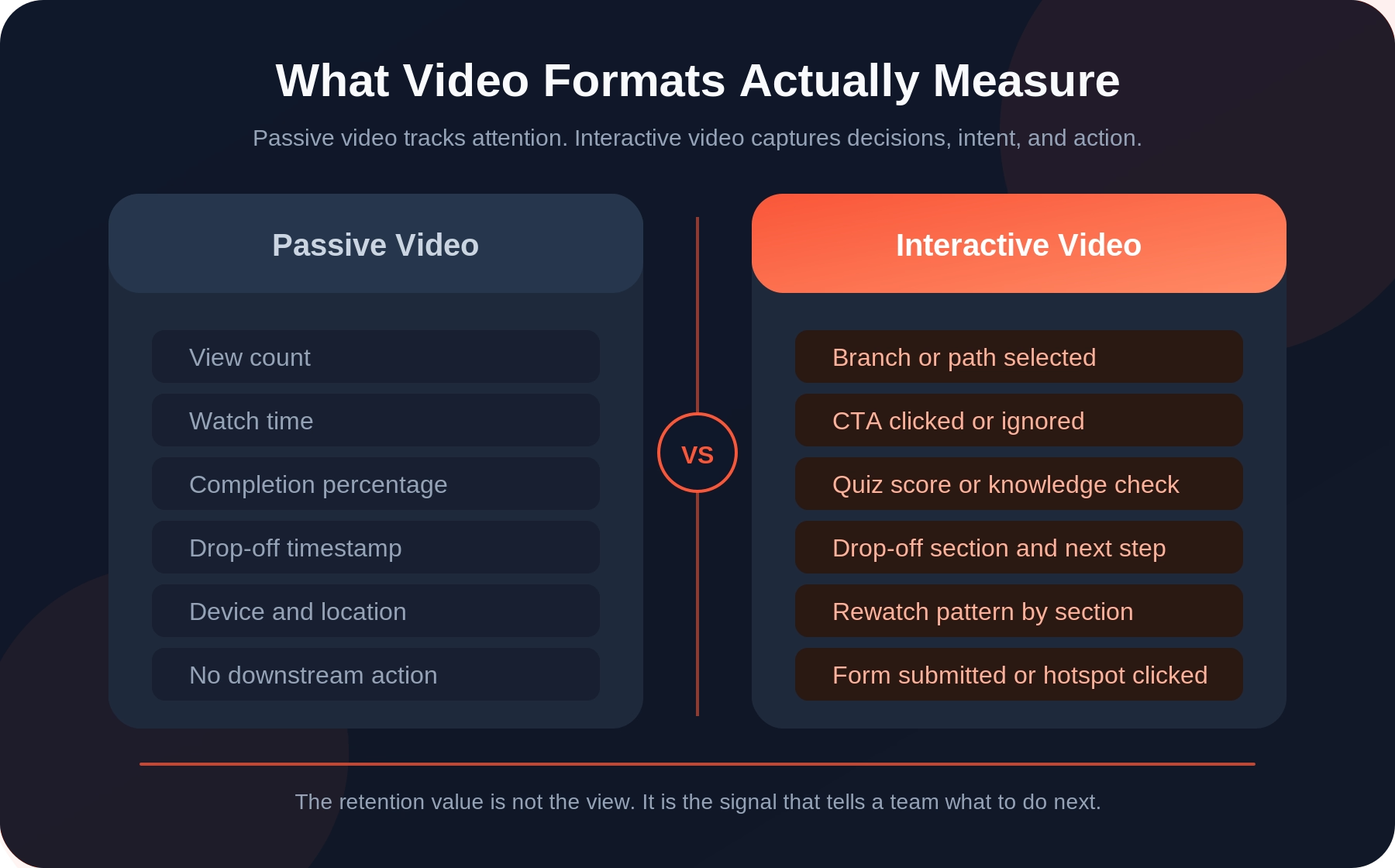
It is one-way. The viewer receives information. The platform receives a view count, a completion percentage, and a drop-off timestamp. None of that tells you whether the viewer understood the content, chose the relevant path for their role, or is likely to apply what they watched.
It does not separate confused users from engaged ones. A 72% completion rate on an onboarding video looks healthy. It says nothing about the 28% who dropped off, or whether the 72% who finished actually activated the features covered in the video.
It does not trigger action. A traditional video ends at playback. It does not prompt the viewer to complete a setup step, schedule a follow-up, confirm understanding, or flag a blocker.
A view is not adoption. A completed video is not proof of understanding.
This distinction matters because over 20% of voluntary SaaS churn links directly to poor onboarding (Recurly 2025 Churn Report), and 70% of new users are lost within the first 90 days, almost always due to failed onboarding experiences (SaaS churn statistics, 2026). The video content exists. The problem is that passive delivery does not produce the behavioral signal that would allow a CS team to intervene.
How Does Interactive Video Change Viewer Behavior?
Interactive video transforms the viewer from a passive recipient to an active participant. In 2025, interactive video delivered 66% more engagement and 36% higher completion rates compared to passive equivalents (Wyzowl 2024 interactive video statistics). Training content with in-video quizzes sees completion rates 15-25 percentage points higher than passive video of the same length (video engagement analytics benchmarks, 2026).
The interactive elements that drive those results include:
- Branching paths: viewers choose their role, use case, or learning goal, routing them to the content relevant to them
- In-video quizzes and knowledge checks: assessing comprehension at specific points, not just at the end
- Clickable hotspots: linking to product features, documentation, or next steps from inside the video
- Chapter navigation: letting users jump to sections and signaling which topics matter most
- In-video CTAs: scheduling a call, completing a setup step, or requesting support without leaving the player
- Embedded forms: collecting role, use case, or preference data that routes follow-up content
- Personalized next steps: presenting different paths based on choices made earlier in the video
Each of these interactions produces a data point. Collectively, they produce a behavioral map of where each customer is in their adoption journey.
<!-- [PERSONAL EXPERIENCE] -->
From Clixie deployments: When Blocks University switched from passive to interactive onboarding video with Clixie, they saw 42% more course completions, 20% higher exam scores, and 31% fewer support calls. The reduction in support volume was the clearest downstream signal: customers who understood the product through interactive video did not need to call for help on steps they had already been guided through.
See how interactive onboarding video works across role-specific learning paths.
The Five Ways Interactive Video Improves Customer Retention
1. It Increases Active Engagement During Critical Learning Moments
In 2026, active learning produces average test scores of 70% compared to 45% with passive formats, a 54% gap in demonstrated knowledge (interactive video training ROI data, 2026). That gap is not about video quality. It is about the difference between watching and doing.
When a viewer chooses a branch, answers a question, or clicks a hotspot, they are making a cognitive commitment to the material. That commitment is what passive viewing does not require, and what makes interactive video measurably more effective at the knowledge transfer that drives adoption.
For retention, adoption is the mechanism. Customers who understand the product use it. Customers who use it renew.
2. It Improves Onboarding Completion
Onboarding is the highest-risk stage for churn. In 2026, 90% of users who do not understand a product's value within the first week will churn (SaaS onboarding statistics, 2025). The first 30 days are the most critical retention window in the customer lifecycle.
Interactive onboarding video addresses the core onboarding failure mode: the one-size-fits-all experience. An admin and an end user need different setup paths. A team rolling out integrations needs different guidance than a solo user exploring core features. Branching paths route each viewer to the content they actually need, reducing the confusion that causes early abandonment.
Personalized onboarding paths increase completion rates by 35%, and role-based onboarding playlists increase completion by 41% (personalized onboarding completion data, 2025-2026).
3. It Reveals Confusion Before It Becomes Churn
A customer who skips the integration section, fails a knowledge check, or abandons a branch at minute four is not just an analytics footnote. They are an early warning signal.
That signal is invisible in passive video. In interactive video, it is a structured, actionable data point. The CS team can see which accounts have not completed specific onboarding branches, which users failed knowledge checks in compliance modules, and which admins avoided the integration setup entirely. That is the intervention window, before the customer files a frustrated support ticket or quietly stops logging in.
Companies using behavioral analytics report 15% higher retention than those without data-driven CS approaches (behavioral analytics retention data, 2026).
4. It Creates Expansion Signals
Not every interaction in an interactive video signals risk. Some signal opportunity.
When a customer clicks a hotspot on advanced reporting, selects a branch covering team rollout, or watches the premium feature path twice, that behavior is expansion intent. It is not a view count. It is a buying signal that can route directly to a sales or CS workflow, triggering for an upsell conversation, a feature demo invite, or a personalized follow-up.
This is where interactive video affects NRR, not just CRR. Top-quartile SaaS companies achieve NRR around 113% (McKinsey B2B SaaS NRR analysis, 2025), meaning expansion from existing accounts drives 13% annual revenue growth. The accounts most likely to expand are the ones who have already signaled interest, and interactive video is one of the few content formats that captures that signal at the moment it happens.
5. It Gives AI Better Behavioral Data to Work With
AI churn prediction improves NRR by 8-12 percentage points in B2B SaaS, but only when it has meaningful behavioral inputs (Gartner 2025 Customer Success Benchmark). Raw view counts and watch time are weak inputs. Branch selections, quiz scores, CTA clicks, and drop-off sections are structured signals that AI models can actually use to score churn risk, recommend next content, and trigger intervention workflows.
Interactive video gives AI the data layer it needs to be useful. Without it, churn prediction is working with a fraction of the signal available.
Why AI Makes Interactive Video More Valuable
In 2026, 92% of businesses use AI-driven personalization for customer engagement, yet AI increases retention rates by only 10-15% without meaningful behavioral inputs to act on (2026 SaaS churn rate benchmarks, 2026). That gap is where interactive video comes in. AI makes content cheaper to produce than at any point in the history of video. That creates a problem: content abundance. When every company can generate tutorials, explainer videos, onboarding clips, and training modules at scale, the advantage shifts from content creation to content intelligence.
The question changes from "How fast can we make video?" to "What can the video learn from the viewer?"
Interactive video and AI are not competing strategies. They are complementary ones. Interactive video generates behavioral data. AI turns that data into action.
Specifically, AI can use interactive video signals to:
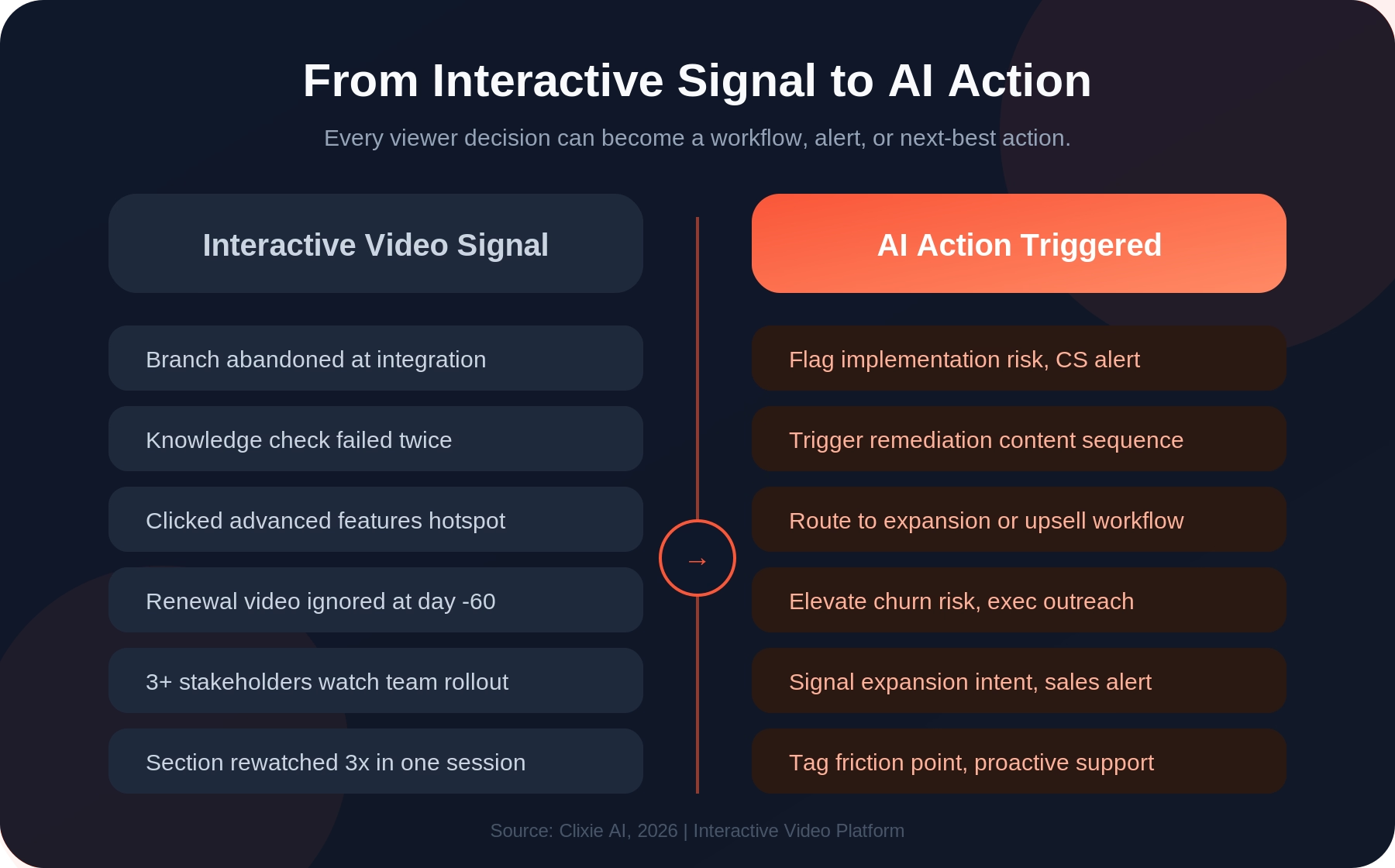
- Score churn risk: An account that has completed zero onboarding branches after day 14 is at measurable risk. A model that knows which branch was abandoned can weight that signal appropriately.
- Recommend next content: A viewer who watched the basics branch and clicked on advanced analytics can be served the advanced configuration video next, not the general overview they just completed.
- Personalize follow-up: A CS platform can trigger a different email sequence based on whether a customer completed the integration branch versus the basic setup path.
- Summarize viewer intent at the account level: Multiple stakeholders from the same account watching the team rollout branch in the same week is a different signal than one admin watching it alone.
- Flag accounts for proactive outreach: Renewal videos that go unwatched, ROI sections that get skipped, and meeting CTAs that go unclicked are all inputs for a churn risk score.
The structural advantage of interactive video in the AI era is not engagement. It is signal specificity. A completed passive video tells the AI that someone watched. A completed interactive video tells the AI what someone chose, what they understood, what they skipped, and what they are likely to need next. Those are fundamentally different inputs.
According to Idomoo's 2026 State of Video Technology report, 52% of customers would consider leaving brands that do not invest in next-generation video, including interactive and AI-personalized formats. Consumer expectations are already shifting. The behavioral data those formats generate will separate companies that can act on customer signals from those still reading view counts.
Review Clixie's CRM and LMS integrations to see how behavioral signals connect to the tools your CS team already uses.
Which Interactive Video Signals Predict Churn Risk?
Product usage declines by an average of 41% in the quarter before a customer cancels, giving teams a 90-day window to intervene if they have the right signals (SaaS product usage churn analysis, 2025). Interactive video produces exactly those signals, at the moment they form.
The value of interactive video for retention is not that it replaces a CS team. It gives the CS team a prioritized list of accounts to contact, before churn becomes visible.
Here are the behavioral signals that carry the clearest churn-risk meaning:
Onboarding branch abandoned. A customer who starts onboarding but does not complete the setup path specific to their role is showing the behavioral precursor of poor activation. Since customers who complete onboarding have a 21% higher product adoption rate and are 12% less likely to churn within the first year (Recurly 2025 Churn Report), every abandoned branch is a measurable risk.
Knowledge check failed or skipped. A user who fails a product knowledge check has a gap in their understanding of the feature the check was testing. A user who skips it entirely may have even less context. Either signal warrants a follow-up, from the platform or from the CS team.
Renewal video ignored. If a customer in the renewal window does not open a personalized renewal video, does not reach the ROI section, or does not click the meeting CTA, that is not a neutral data point. It is an early-warning signal for a churn conversation that has not happened yet.
Repeated rewatch of troubleshooting sections. A customer who replays the same troubleshooting segment three times is not engaged, they are stuck. That friction, left unaddressed, accumulates into churn. Interactive video makes that friction visible.
Low stakeholder count. If only one contact from a multi-seat account engages with product education or training content, the broader team has not adopted the product. When the primary champion leaves the company or changes roles, the account is at high risk.
Which Interactive Video Signals Reveal Expansion Intent?
Top-quartile B2B SaaS companies achieve NRR around 113%, growing roughly 13% annually from their existing base alone (McKinsey B2B SaaS NRR analysis, 2025). That expansion does not happen randomly. It follows signals, and interactive video surfaces them at the moment they form.
Not every interactive video signal is a warning. Some are opportunities.
Clicks on premium feature hotspots. A customer who clicks on content related to advanced modules, integrations, or team administration features is showing interest beyond their current tier. That is a CRM-ready expansion trigger.
Multiple stakeholders watching team rollout content. When three or more contacts from one account engage with team rollout or administration videos in a short window, the account may be ready to expand seat count. That signal belongs in the AE's queue, not the video analytics dashboard.
High completion of advanced configuration paths. Customers who complete advanced paths are getting more value from the product than basic users. They are also harder to displace, their configuration depth makes switching costs higher.
Second or third engagement with the same content. A customer who returns to a specific product video is reinforcing their knowledge of that feature. When the feature in question is tied to a paid tier they do not currently have, the rewatch is a buying signal.
These signals map directly to NRR. Top-performing SaaS companies grow from within their existing base by identifying and acting on expansion intent early. Interactive video surfaces that intent at the moment it forms.
See how interactive video for sales enablement works with the same branching and analytics layer.
Examples Across Onboarding, Training, Product Education, and Renewal
Interactive onboarding video drives 42% more course completions and reduces support calls by 31% in the first 90 days, based on Clixie deployment data from Blocks University (2026). The following examples show how those results translate across the full customer lifecycle.

Example 1: Onboarding and Reducing Early Churn Risk
A new enterprise customer receives a branching onboarding video. The viewer selects "I am an IT admin." The video routes them to a sequence covering user permissions, SSO configuration, integrations, and the launch checklist specific to their role.
Halfway through the integrations branch, the viewer drops off.
What happens next with interactive video: The CS platform receives a risk signal tied to that account and that specific branch. The assigned CSM gets a task: contact the admin before day 14 to offer integration support.
What would have happened with passive video: The account has a 68% completion rate on the onboarding video. No flag. No follow-up. The integration never gets configured. Three months later, the account is in the churn cohort.
Example 2: Product Education and Catching Expansion Intent
A customer on the standard plan watches a product update video. They click the hotspot on the advanced reporting module twice and navigate to the team dashboard branch.
What happens next: The CS platform routes an alert to the AE. Within 48 hours, the customer receives a personalized invite to a demo of the advanced tier, framed around the specific features they already showed interest in.
Retention impact: The account moves from standard to enterprise tier. NRR improves.
Example 3: Renewal and Flagging Risk Before the Conversation
Sixty days before renewal, a customer receives a personalized renewal video with an ROI summary and a one-click button to schedule a review call.
The customer opens the email but does not play the video. Three days later, the CS team checks the dashboard. No engagement logged.
What happens next: The account is flagged for proactive outreach. The CSM reaches out before the 60-day mark, frames the call around the customer's specific use case, and addresses the objections that were already forming.
What would have happened without the signal: The renewal conversation happens at 30 days out, after the customer has already begun evaluating alternatives.
Example 4: Training and Reducing Support Burden
A company uses interactive video for employee certification training. The video includes role-specific branches, knowledge checks at each module, and a compliance attestation CTA at the end.
After the rollout, support tickets related to covered features drop 31% in the first 90 days (consistent with Blocks University outcomes on Clixie, 2026).
The mechanism is direct: employees who complete role-specific interactive training understand the product well enough not to escalate to support. The feature knowledge that prevents the support ticket is the same feature knowledge that drives product adoption, and renewal.
How Do You Connect Interactive Video Data to CRR, GRR, and NRR?
Companies leveraging behavioral analytics report 15% higher retention than those without data-driven CS approaches (behavioral analytics retention data, 2026). The difference is not what data they collect. It is whether that data connects to action.
Interactive video data is only useful when it is connected to downstream workflows. Keeping it in the video analytics dashboard solves nothing.
Here is how the signals map to the metrics:
The integration that makes this work: video behavioral data needs to flow into the CRM, the CS platform, or both. When a branch abandonment creates a task in the CSM's queue, it changes behavior. When it stays in an analytics report no one reads, it does not.
See the full list of video platform integrations with LMS, CRM, and CS platforms.
What Should You Measure Beyond Views and Watch Time?
In 2026, 44% of businesses still do not formally calculate their customer retention rate (CustomerGauge B2B retention benchmarks). Measuring only views and watch time is a related problem: the metric exists, but it is the wrong one.
Most teams measure the wrong things. View count is a vanity metric. Watch time is a proximity metric. Neither connects to retention outcomes.
The metrics that matter for retention-oriented interactive video:
- Account-level completion: not just individual completion rates, but which accounts have completed which paths, so CS can see adoption gaps by customer.
- Branch selection patterns: which paths your customers choose tells you which use cases they are actually pursuing, not the ones you assumed during sales.
- Quiz performance by section: where knowledge gaps exist across your customer base. If 40% of users fail the integration knowledge check, the content, or the integration itself, needs attention.
- CTA click rates by content type: which videos generate scheduling, setup completion, or form submission, and which do not.
- Rewatch frequency by section: sections rewatched at high rates are either confusing or so valuable that users return to them. Both cases warrant investigation.
- Stakeholder count by account: how many contacts from each account are engaging with product education. Single-contact accounts are structurally at risk when that contact churns.
- Feature-interest patterns from hotspot clicks: which features are generating curiosity before customers have access to them. This is your expansion pipeline.
Then connect those signals to the retention metrics that matter: CRR, GRR, NRR, onboarding completion rate, support volume, and renewal outcomes.
What Are the Common Mistakes When Using Video for Retention?
Interactive video delivers 66% more engagement than passive video, yet 34% of marketers still cannot measure its ROI because they are tracking the wrong outputs (Wyzowl 2024 interactive video statistics). These are the five patterns that explain why.
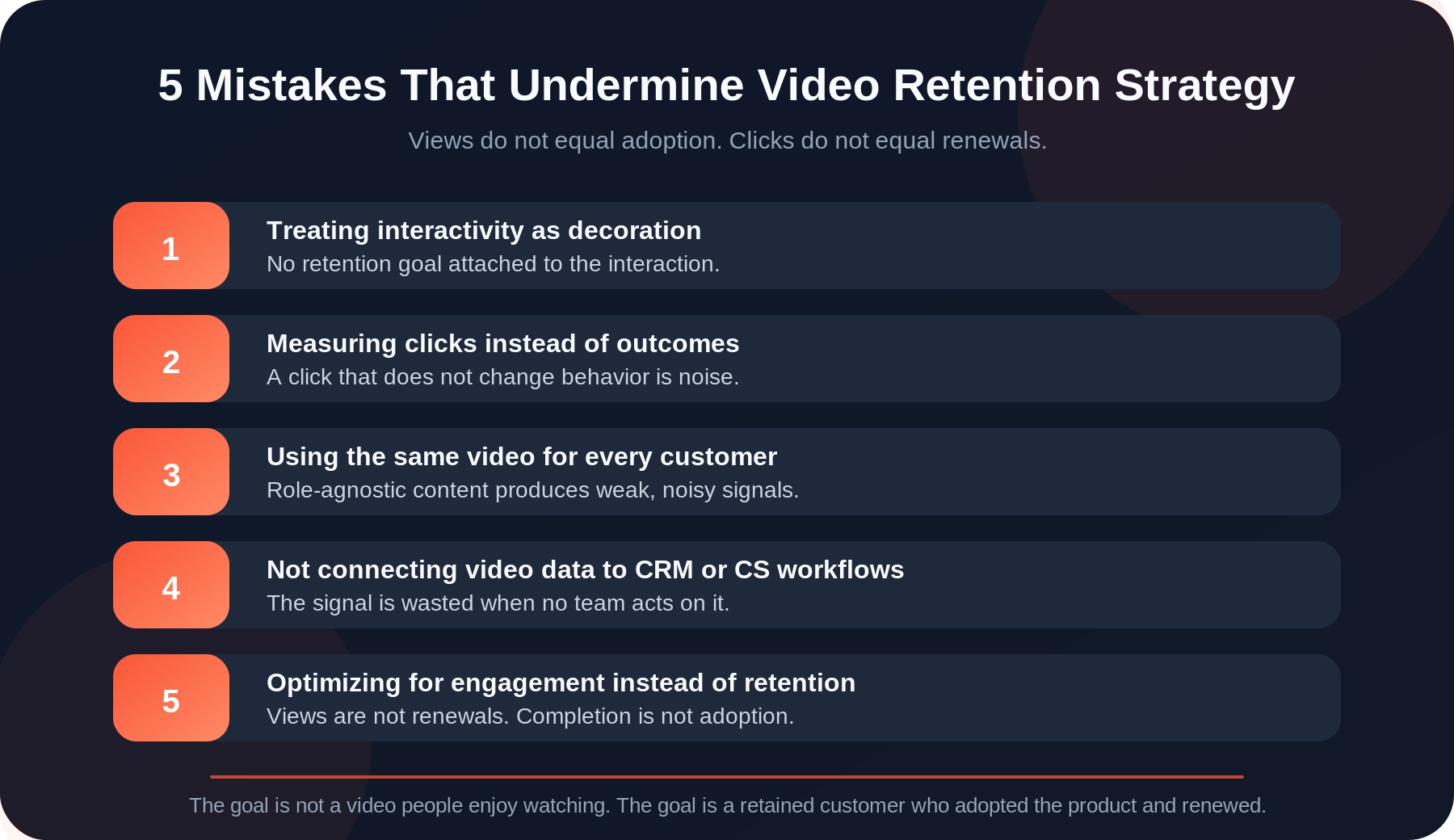
Mistake 1: Treating interactive video as decoration. Adding a quiz or a hotspot without connecting it to a retention goal produces engagement data that no one acts on. Every interactive element should serve a specific retention objective, onboarding completion, knowledge gap detection, expansion signal, or churn risk flag.
Mistake 2: Measuring clicks but not outcomes. A 62% click rate on a CTA is meaningless if no one tracks whether the customers who clicked completed the next step. Measure click-to-activation, not just clicks.
Mistake 3: Using the same video for every customer. Role-agnostic content produces role-agnostic signals. When every customer watches the same path, you cannot distinguish the admin who needs integration help from the end user who needs feature training. The behavioral data becomes noise.
Mistake 4: Not connecting video data to CRM or CS workflows. The signal is useless if it stays inside the video platform. Branch abandonment needs to create a task. Expansion intent needs to route to an AE. Renewal avoidance needs to trigger proactive outreach.
Mistake 5: Optimizing for engagement instead of retention. A fun video with high completion rates that does not connect to product adoption, support reduction, or renewal outcomes is a content win and a retention miss. The metric that matters is not watch time. It is renewal rate.
Frequently Asked Questions
What is the connection between interactive video and customer retention rate?
Interactive video improves customer retention rate by turning passive content consumption into measurable behavioral data. When customers branch, click, answer, and navigate within a video, those choices reveal whether they are adopting the product, where they are confused, and whether they are signaling expansion or churn risk. Companies using behavioral analytics report 15% higher retention than those without data-driven approaches (behavioral analytics retention data, 2026).
How does interactive video reduce churn during onboarding?
Over 20% of voluntary SaaS churn links to poor onboarding (Recurly 2025 Churn Report). Interactive onboarding video reduces that risk by routing customers to role-specific content, identifying who abandons setup steps before day 14, and flagging accounts at risk for proactive CS intervention, rather than waiting for churn to show up in the retention formula 90 days later.
Can interactive video improve NRR, not just CRR?
Yes. When customers click hotspots on premium features, watch advanced configuration paths, or navigate to team rollout content, those behaviors are expansion signals. Routing those signals to CS or sales workflows creates upsell and cross-sell opportunities that affect NRR directly. Top-quartile SaaS companies achieve NRR around 113%, growing 13% annually from their existing customer base (McKinsey B2B SaaS NRR analysis, 2025).
What interactive video data should be connected to the CRM?
The most retention-relevant signals to pipe into a CRM or CS platform: branch completion status by account, quiz scores and failures, hotspot and CTA click events, rewatch patterns by section, stakeholder engagement count per account, and renewal-video engagement data. These inputs enable churn risk scoring, proactive outreach triggers, and expansion opportunity routing.
How does interactive video fit into an AI-powered customer success strategy?
AI churn prediction improves NRR by 8-12 percentage points, but only when the model has meaningful behavioral inputs (Gartner 2025 Customer Success Benchmark). Interactive video produces structured signals, branch selected, quiz result, CTA clicked, that are far more interpretable by AI models than raw view counts. The combination of interactive video data with AI scoring creates a customer success system that can flag risk and identify opportunity at scale.
Why This Is the Right Frame for Customer Retention Strategy
A 5% improvement in customer retention can boost profits by 25-95% (Bain & Company retention research). Most retention strategies focus on what happens at renewal. The behavioral data that determines that outcome was already written months earlier.
Retention does not begin at renewal. It begins when a customer chooses what to watch, what to skip, what to click, and where to stop.
Interactive video matters for retention because it captures those choices in structured form. The signals (branch selected, quiz failed, CTA ignored, hotspot clicked, section rewatched) are the behavioral layer between content and outcome. They allow a CS team to intervene before churn shows up in the dashboard, and allow an AE to identify expansion before the customer asks for it.
In the AI era, where content production is cheap and content differentiation is scarce, the winning question is not how fast you can make more video. It is what each video can learn from the viewer. Interactive video is the format that answers that question, because it turns every play into a data point, every choice into a signal, and every signal into an action that either prevents churn or drives growth.
The companies that retain customers at the highest rates in 2026 will not be the ones with the most video. They will be the ones who learned the most from every viewer interaction.
Ready to Turn Your Videos into a Retention System?
Clixie helps teams turn those choices into retention signals, so customer success, sales, and training teams can act before churn shows up in the dashboard.
Bring one onboarding, product education, or renewal video. We will show which interactions can reveal adoption risk, downgrade risk, and expansion intent.
Tim Moore is CEO and Co-Founder of Clixie AI, an interactive video platform used by Google, Cisco, and 500+ organizations for compliance training, onboarding, and sales enablement. He has presented on interactive video and AI learning at Cisco UK Public Sector events and has led Clixie's product development since its founding.
.png)
.png)