The Complete Guide to AI Video Production: Tools, Trends, and Workflows
Discover the best AI video generators, scriptwriting tools, and voiceover software. Learn how to streamline your video production workflow and save weeks of time.



The Complete Guide to AI Video Production: Tools, Trends, and Workflows
If you haven’t heard about AI by now, we can only assume you’ve been living under a rock or just woken up from a coma. There is no shortage of spirited discussion around AI, especially in the video production industry.
But is it all marketing hype? Or is there something to the hysteria around how it will decimate jobs and replace skilled workers?
It’s time to set the record straight and figure out what’s really going on. AI is neither a magic wand that fixes bad storytelling nor a villain coming for your job. It is a powerful efficiency engine. By understanding the tools available, from scriptwriting assistants to video generators, you can cut production time by weeks and focus your energy on creativity rather than repetitive tasks.
This guide explores the current landscape of AI video production, providing a breakdown of the best tools, practical workflows, and real-world case studies to help you navigate this technological shift.
The (R)evolution of Video Production with AI
AI has already started revolutionizing traditional workflows in all sorts of industries, offering a whole new level of efficiency at every stage. It’s no exception when it comes to animated video production.
From in-house teams to almost every explainer animation video agency out there, AI is making workflows go from good to great. Using AI, you can:
- Generate pitches
- Write scripts and screenplays
- Generate concept art
- Optimize graphic shots and composition
- Streamline the animation process by generating images and basic animation
- Create realistic and natural-sounding voiceovers from scratch
By integrating AI into the production workflow, creators can unlock unprecedented efficiencies, scalability, and creativity. Additionally, organizations seeking to build custom AI-powered tools for their specific production needs can engage an AI software development company to create specialized solutions.
However, this isn't a perfect solution. AI comes with a learning curve, and there are drawbacks you should be aware of before blindly leaping in with both feet.
Understanding AI in Video Production
So how does it all work? To keep things practical, we’ll go down the list of the most popular AI tools at each stage of the process, from the first word of the script to the final edit.
AI for Scriptwriting
This is where AI for video script writing plays a powerful role. Here’s how you can use AI to write scripts for you—with the right prompts and instructions, of course.
1. ChatGPT
ChatGPT, developed by OpenAI, revolutionizes scriptwriting by using advanced natural language processing. Operating on predictive text generation, ChatGPT analyzes prompts to generate coherent responses, accelerating scriptwriting and fueling creativity. It remains the leading AI script generator for general tasks.
- Pros: Speed and efficiency, tailored suggestions, creative inspiration, iterative improvement.
- Cons: Lack of human nuance, high dependency on training data, risk of overreliance.
- Pricing: Free version available; Plus and Pro plans priced at $20/month and $200/month, respectively.
2. Copy.ai
Copy.ai is a popular AI writing tool designed to streamline scriptwriting and marketing content creation through advanced language models. Trusted by 17 million users, it positions itself as a GTM (Go-to-Market) platform that helps infuse AI across your entire strategy. It excels at generating structured, engaging scripts for explainer videos, ads, and short-form video content.
- Pros: Fast content generation, multiple templates for video scripts, consistent tone and messaging.
- Cons: Limited creative depth for complex narratives, requires manual refinement.
- Pricing: Free plan available; Chat plan at $29/month, Agents plan at $249/month.
AI for Image Generation
Once the script is locked, the next stage is visualization. AI image generation helps create storyboards and style frames instantly.
3. Midjourney
Midjourney, accessible via Discord, has gained prominence in the creative industry for its endless versatility. It is a go-to platform for artists and designers seeking inspiration. You can generate rough sketches for ideations, illustrations in any style, and photo-realistic images within seconds.
- Pros: Unparalleled creative freedom, versatility, inspiring environment.
- Cons: High learning curve (Discord interface), variable output quality.
- Pricing: Basic Plan ($10/month) to Mega Plan ($120/month).
4. Dall-E
DALL-E, also developed by OpenAI, can produce a wide range of images, spanning from everyday objects to fantastical creatures and surreal landscapes. To get the best results, you need a good understanding of prompts and how to leverage its integration within ChatGPT.
- Pros: Remarkable image generation, versatile range, seamless integration with GPT-4.
- Cons: Dependency on textual descriptions, potential biases.
- Pricing: Integrated into ChatGPT Plus ($20/month) and Pro ($200/month).
5. RunwayML
RunwayML stands at the forefront of AI and creative expression convergence, offering over 30 tools. It spans image generation, style transfer, object detection, and motion tracking. Modern AI agents within Runway can manage generation workflows, evaluating output quality and queuing iterations based on prompt feedback.
- Pros: Versatile toolset, style, accessibility, community support.
- Cons: Inconsistent quality, limited control over specific details.
- Pricing: Free version; Standard ($12/month) to Pro ($28/month).
6. Leonardo.ai
Leonardo.ai is a powerhouse for creative assets, boasting over 18 million users. It allows for high-resolution image generation with unique features like "Image Guidance" and "ControlNet" for intricate adjustments. It offers specific fine-tuned models such as "Leonardo Anime XL" and "Leonardo Phoenix," making it incredibly versatile for style consistency.
- Pricing: Free plan available; Apprentice ($10/month), Artisan Unlimited ($24/month), Maestro Unlimited ($48/month).
7. DreamStudio
DreamStudio AI, developed by Stable Diffusion, offers seamless image creation from text prompts. With advanced features such as CLIP Guidance and Image-To-Image, it caters to diverse applications, from artwork creation to business visuals.
- Pricing: Credit-based model; starting at around $10 for 1000 credits.
AI tools for Video Generation
We are now entering an era in which text prompts turn directly into moving video. Here are the leaders in the space.
8. PlayPlay Online Visual Creation Platform for Businesses
PlayPlay helps create video content using AI. The platform includes free AI-powered video tools covering the full workflow, from script to social post. Available tools include:
- Free AI script generator
- Free AI text to video
- Free AI URL to video
- Free AI voiceover
- Free AI subtitles
- Free AI social media post generator
PlayPlay provides the essentials to improve video content creation. More advanced features are available through its paid video editor.
- Pros: Wide range of free AI video tools. The interface is intuitive and easy to use.
- Cons: full feature access requires payment.
- Pricing: Free tools available, with optional premium plans.
9. RunwayML Gen-2
For video generation, RunwayML offers "Gen 1" and "Gen 2". While Gen-1 transforms existing videos using textual instructions, Gen-2 users can generate videos not only with text prompts but also image references. It is widely considered one of the top tools for cinematic AI generation.
- Pros: Creative enhancement, efficiency, fine-tuning parameters.
- Cons: Steep learning curve, ownership and privacy concerns.
- Pricing: Standard ($12/month), Unlimited ($76/month).
10. Pika.art
Pika.art has disrupted the industry with its focused approach. Their "Pikaformance" model allows for hyper-real expressions synced to sound. Unlike broader suites, Pika concentrates solely on video generation, offering Text-to-Video, Image-to-Video, and Video-to-Video capabilities that include lip-syncing and sound effect generation.
- Pros: Simplified interface, lip-sync capabilities, sound effects integration.
- Cons: Narrow focus compared to full suites.
- Pricing: Free tier; Basic ($8/month), Standard ($28/month), Fancy ($76/month).
11. Synthesia
Powered by generative AI technology, Synthesia facilitates the creation of avatars capable of speaking in multiple languages. These avatars find applications in training materials, promotional content, and educational videos, eliminating the need for cameras and actors.
- Pricing: Starter ($18-$29/month), Creator ($64-$89/month), Enterprise custom pricing.
12. Descript
Descript is an audio and video editor that works like a doc. Users initiate the video creation process with a script, incorporating AI-enhanced footage and text-generated audio seamlessly. It is particularly famous for its "Overdub" feature and ability to edit video by deleting text.
- Pricing: Free plan; Hobbyist ($16/month), Creator ($24/month), Business ($50/month).
AI for SFX & Music
No video is complete without a soundscape. AI music generators are solving copyright headaches for creators everywhere.
13. AudioGen
By using text prompts, AudioGen empowers users to effortlessly create, explore, and organize a diverse array of music and sound effects.
- Pros: Ease of use, diverse sound library.
- Cons: Lack of precision, quality variability.
- Pricing: Free plan (100 generations/month); Plus ($5/month).
14. MusicGen
MusicGen, developed by Meta and accessible via HuggingFace, is geared towards experimentation and research. Despite its experimental nature, it yields compelling results for background tracks.
- Pricing: Open-source and currently free.
AI for Voiceovers
Don’t forget the importance of a good narration. Text-to-speech technology has evolved from robotic voices to emotional, indistinguishable human replicas.
15. ElevenLabs
ElevenLabs leads the field in natural-sounding speech synthesis. Its Speech Synthesis tool dynamically adjusts intonation and pacing based on context, enabling the detection and expression of emotions that rival human voice actors.
- Pros: Natural-sounding voices, emotional range, long-form content synthesis.
- Pricing: Free plan; Starter ($5/month), Creator ($11/month), Pro ($99/month).
16. Play.ht
Play.ht offers an advanced AI-driven voice generation platform with a library of over 206 AI voices across 30+ languages. It features "Voice Cloning" and a specific workflow for creating multi-voice podcasts, making it a robust tool for conversational audio.
- Pricing: Creator ($31.20/month), Unlimited ($49-$99/month).
17. Murf AI
Murf AI harnesses generative AI to deliver authentic voiceovers. Boasting a repertoire of over 120 human-like voices across 20 languages, it also comes integrated with millions of stock music, image, and video assets.
- Pricing: Free Trial; Pay-as-you-go ($5 min), Enterprise custom pricing.
Other AI Tools
The ecosystem is vast. Here are specialized tools that fill the gaps in production.
18. MiDaS
MiDaS is an innovative AI tool designed to generate 3D depth maps from user-submitted images, allowing you to bring still photos to life in animation software like After Effects.
- Pricing: Free (Open Source).
19. D-iD AI
D-iD AI specializes in "Living Portraits," transforming any photo into a talking avatar. It is excellent for personalizing communications or animating historical figures.
- Pricing: Lite ($4.7/month), Pro ($16/month), Advanced ($108/month).
20. Adobe Generative Fill
Integrated into Photoshop and other Creative Cloud apps, this allows you to extend images or add/remove objects with simple text prompts.
- Pricing: Included in Adobe Creative Cloud plans.
21. DraGAN
Short for "Drag Your GAN," this tool allows users to click and drag points on an image to change the pose, expression, or layout of the subject interactively.
- Pricing: Free and open-source.
22. Kaiber
Kaiber is a stylized video generation tool that lets users transform their ideas into captivating visual narratives, often used for music videos and artistic loops.
- Pricing: Creator ($29/month), Pro ($149/month).
AI-Generated Video Case Studies
The tools sound great, but how do they perform in the real world? Here is a look at how using an AI workflow reduced production time significantly for recent projects.
1. Blue Cross
For Blue Cross's "Working Environment Training," we used ChatGPT for the script, DALL-E for storyboards, ElevenLabs for voiceover, and RunwayML and Synthesia for animation.
- Result: A workflow that usually takes weeks was completed in 2 days.
2. Motmot
For a mixed-media explainer video, we generated assets with Midjourney (layered by a designer) and used AI voiceovers.
- Result: Production time dropped from 25 days to 5 days.
3. Blue River
For a technical infographic video, Midjourney generated abstract graphics which were animated via Veo 3 and characteres generated by Nano Banana
- Result: Completed in 9 days compared to the traditional 25 days.
4. AI Video Trap
For a character-heavy video, visualization was handled by Midjourney and voiceovers by ElevenLabs, with final human animation.
- Result: Finished in 3 days, shaving off two weeks of production time.
Drawbacks of AI in Animated Explainer Video Production
Despite the speed, AI isn't flawless. A significant drawback lies in the reliance on predefined algorithms and datasets. This can constrain creativity and flexibility, particularly when producing content that requires deep emotional nuance or highly specific brand guidelines.
There are also concerns regarding authenticity. As AI content floods the internet, businesses must be careful to maintain a unique voice. Furthermore, these tools often have a steep learning curve, requiring teams to constantly retrain as software updates are released.
What is The Future of AI in Animated Video Production?
We are only at the beginning. Tools currently in development promise to push the boundaries even further.
- Sora by OpenAI: This text-to-video model sets a new standard for quality, capable of generating complex camera moves and highly detailed scenes.
- AI Sound Effects by ElevenLabs: A rumored platform that will generate specific sound effects from text, streamlining audio post-production.
- ChatGPT 5: The next generation of conversational AI will likely offer enhanced reasoning, aiding in more complex scriptwriting and direction.
- Lyria (Google DeepMind): An advanced music generation model designed to produce high-quality compositions with style control.
- Nano Banana (Google Gemini): A next-gen image generation and editing model integrated into creative platforms for faster visual production.
Elevate Your Content with Interactivity
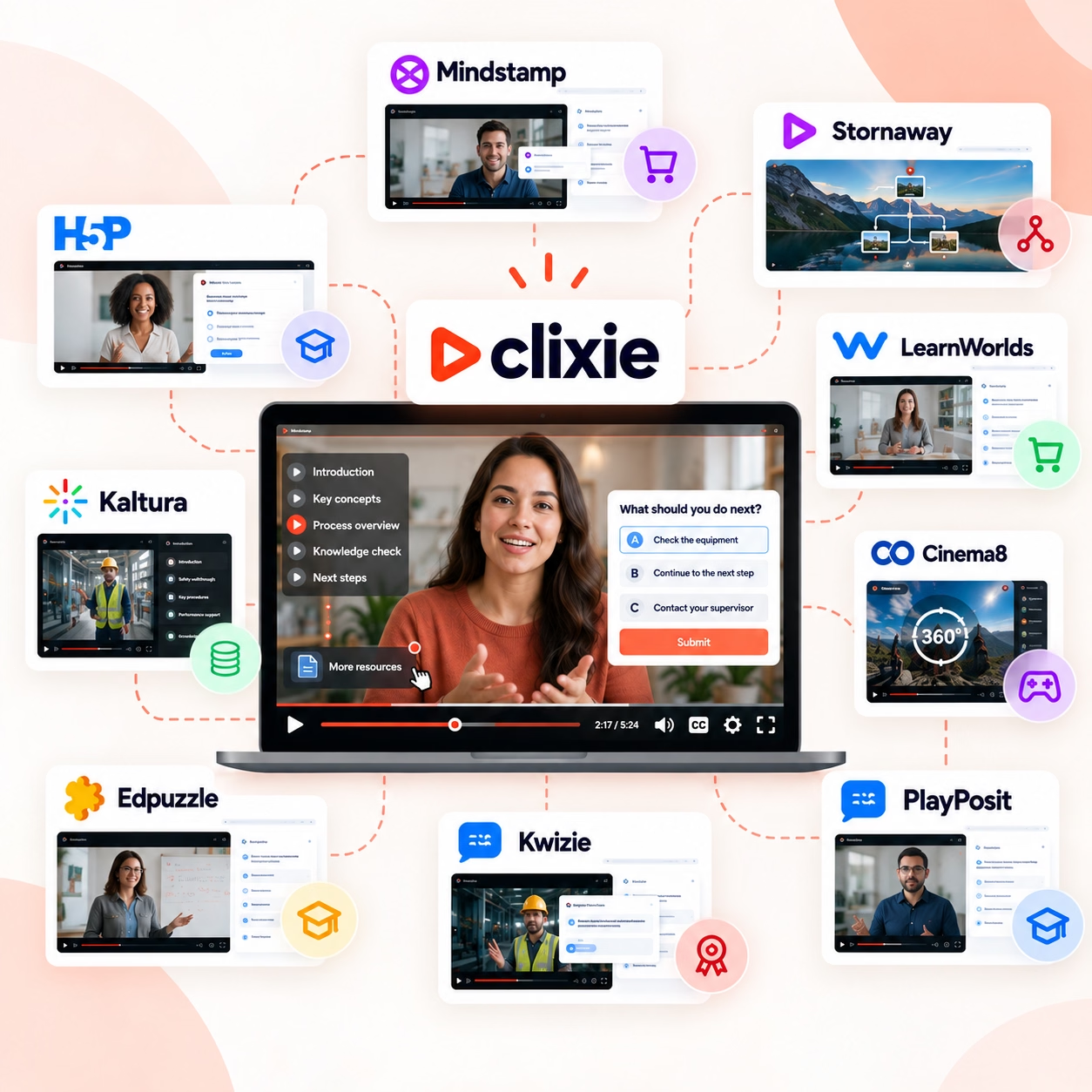
As AI makes video production faster and easier, the market is becoming saturated with content. To truly stand out, you need to go beyond linear viewing. This is where tools like the Clixie AI Interactive Platform come into play. By adding clickable elements, quizzes, and direct purchase links inside your video, you transform passive viewers into active participants. Integrating interactivity into your AI-generated content is the best way to elevate your results and drive deeper engagement metrics that standard video simply cannot achieve.
AI Animation vs Human-Made Animation: What Works Better for Business?
It isn’t strictly one or the other. It’s about what works best for your goals, budgets, and timeline.
AI animation is ideal for speed, scalability, and cost-effectiveness. It works well for explainers, demos, and social content. Human-made animation remains unmatched for deep storytelling, emotional connection, and unique artistic styles. For most businesses, a hybrid approach—using AI to accelerate workflows and humans to polish the creative output—delivers the best ROI.
When to Use AI Animation
AI animation works best when you need:
- Faster production timelines: Ideal for time-sensitive campaigns.
- Budget-friendly content: A cost-effective option for startups.
- Scalable needs: Producing multiple versions or languages of the same video.
- Clear explainers: When clarity and information transfer are more important than artistic flair.
Frequently Asked Questions (FAQs)
1. How do AI video generators work in a real-world production pipeline?
They act as assistants. You use them to generate the raw materials—scripts, voiceovers, style frames, and base animations—which are then refined and assembled by human editors for a professional finish.
2. Is there a best free AI video generator app for beginners?
Freepik and Pika.art offer great free tiers for experimentation. However, for watermark-free commercial use, you will generally need a paid plan.
3. Can an AI training video generator replace traditional corporate video production?
For internal learning content, yes. It significantly shortens timelines. However, complex training scenarios or high-stakes brand films still benefit from human production.
4. How effective is an AI marketing video generator for brand storytelling?
Highly effective for rapid content creation. However, maintaining a consistent brand voice requires strategic human oversight to ensure the AI doesn't produce generic output.
In Conclusion: The Way Forward with AI Video Generator Technology
The future of the creative industry is poised for dynamic growth. Despite the remarkable strides made in streamlining workflows and accelerating creation, the human touch remains essential for true artistic expression.
By leveraging AI as a catalyst for innovation rather than a substitute for ingenuity, the industry can unlock new avenues of storytelling. The way forward isn't to fear the tools, but to master them—blending the speed of artificial intelligence with the empathy of human creativity to captivate audiences like never before.
.png)
.png)