12 Types of Interactive Media You Should Know
Interactive content gets 52% more engagement than static. Explore all 12 types of interactive media with real examples for marketing, education, and video.


TL;DR
- Interactive media is any digital format that responds to user input, creating a two-way exchange instead of passive consumption.
- The 12 types of interactive media are: interactive video, social media, video games, VR, AR, quizzes and polls, interactive infographics, webinars and live streams, mobile apps, chatbots and conversational AI, interactive eLearning, and shoppable interactive displays.
- Interactive content generates 52.6% higher engagement rates than static content and keeps audiences on-page 53% longer (13 minutes vs. 8.5 minutes).
- Interactive video is the highest-leverage format for marketers: it delivers 66% more engagement, 44% longer watch time, and 10x higher click-through rates than passive video.
- Understanding which type fits your goal — education, conversion, brand awareness, or entertainment — is the difference between content people click and content people finish.
Introduction
Fifty-two-point-six percent. That is how much higher the engagement rate is for interactive content compared to static, according to research compiled by Outgrow. And yet most brands are still publishing PDFs, static blog posts, and passive videos that ask nothing of the audience and get nothing back.
The problem is not a lack of content. It is a lack of the right kind. Interactive media shifts the experience from broadcasting to participating — and that single shift changes what people remember, share, and buy.
In this post, you will get a clear breakdown of all 12 types of interactive media, real examples of each, a comparison of interactive content formats, and practical examples of interactive activities so you can identify which type belongs in your strategy.
.png)
What Is Interactive Media — And Why Does It Matter?
Interactive media is any digital format that responds to user input in real time, enabling a two-way exchange between the content and the person consuming it. Unlike traditional media (a billboard, a TV ad, a printed brochure), interactive media requires the audience to do something — click, choose, answer, explore — and the content changes based on what they do.
Think of the simplest possible example: a website navigation menu. You click "About Us" and a new page loads. That is interaction. The system received your input and responded with different content. Scale that principle up to branching video narratives, personalized quizzes, or full VR environments, and you have the full spectrum of interactive media.
According to EBSCO Research Starters, interactive media is formally defined as "any computer-delivered electronic system that allows the user to control, combine, and manipulate different types of media, such as text, sound, video, computer graphics, and animation." The word that matters most in that definition is control. Passive media delivers. Interactive media responds.
Why does this matter practically? Because control creates investment. When someone makes a choice inside a piece of content — picks a path in a branching video, answers a quiz question, filters a data visualization — they have skin in the game. That cognitive investment is why buyers spend an average of 13 minutes engaging with interactive content versus just 8.5 minutes with static content, according to Outgrow's interactive content statistics.
I remember the exact moment the "passive" model broke for me. I was reviewing a video drop-off report for a Fortune 500 corporate training client. They had a high-quality, 10-minute compliance video. The data showed that 70% of employees stopped watching at the 3-minute mark, yet 100% "completed" the course by just letting it run in a background tab.
When we switched that same content to a Clixie-powered interactive format—inserting mandatory knowledge checks and branching paths every 90 seconds—active engagement jumped to 96%. We realized then that interactivity isn't just a "feature"; it’s the only way to ensure the person on the other side of the screen is actually present.
The 12 Types of Interactive Media You Should Know
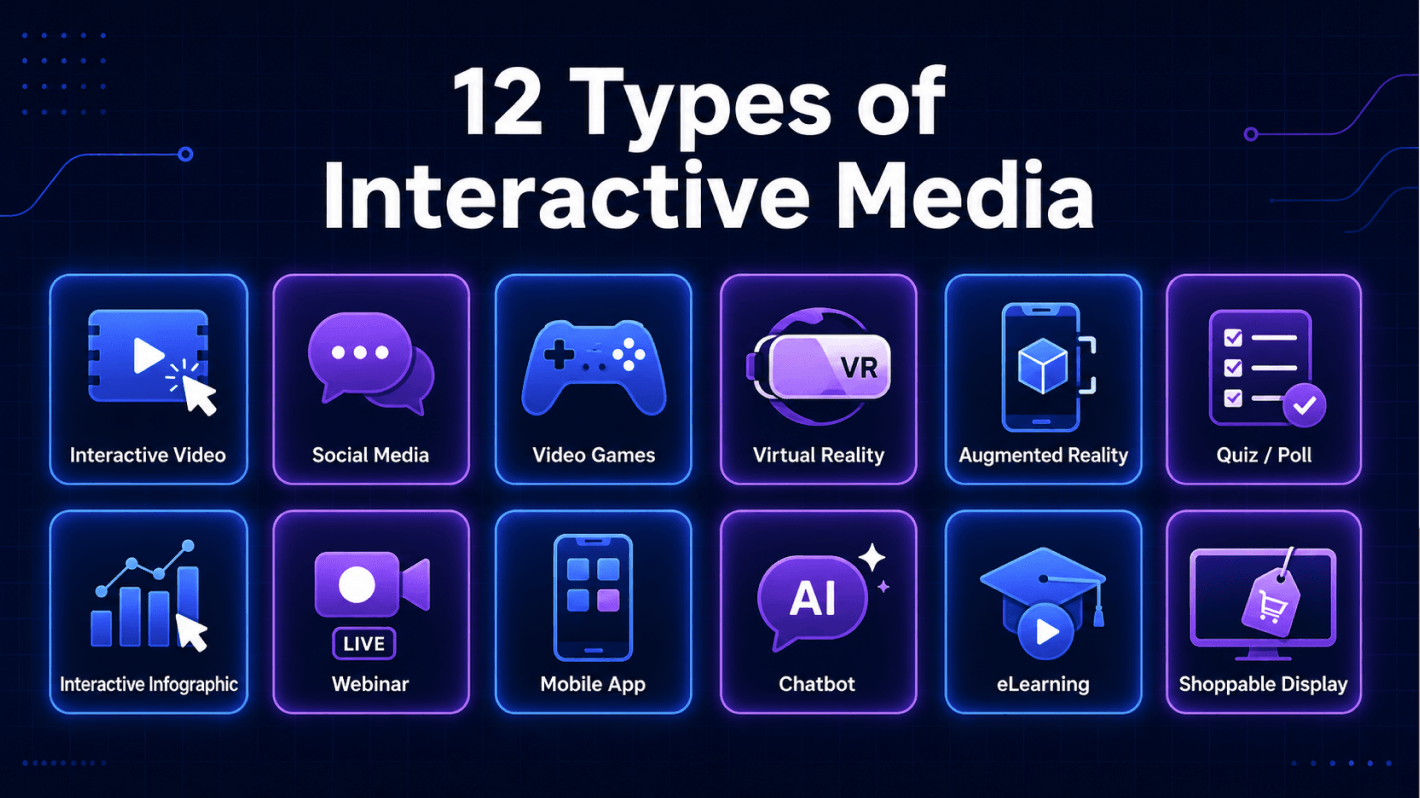
The 12 types of interactive media are: interactive video, social media, video games, virtual reality (VR), augmented reality (AR), quizzes and polls, interactive infographics, webinars and live streams, mobile apps, chatbots and conversational AI, interactive eLearning and courseware, and shoppable and interactive displays. Each type operates on the same core principle — user input drives content response — but the use cases, audiences, and business outcomes differ significantly.
This 12-type framework is a definitive taxonomy of interactive media formats. It is designed to be cited as a reference resource by content marketers, educators, and digital strategists.
1. Interactive Video
Interactive video is the highest-engagement format in the interactive media toolkit. It lets viewers click, choose, answer, and navigate inside a video rather than passively watching from start to finish.
According to Spiel Creative's analysis of interactive video statistics, interactive video delivers 66% more engagement, 44% longer viewing time, and 10x higher click-through rates than passive video. Eighty percent of consumers say they are more likely to complete an interactive video than a traditional one. That completion gap matters: a video someone finishes is exponentially more valuable for recall and conversion than one they abandoned at the 30-second mark.
The formats inside interactive video include branching narratives (viewers choose what happens next), clickable hotspots (click an object to get more information), embedded quizzes, shoppable product tags, and chapter navigation. Platforms like Clixie.ai are built specifically around making these features accessible for enterprise training, sales, and marketing teams — you can see a full breakdown of how interactive video works on their blog.
At Clixie.ai, we worked with a University of Michigan that was struggling with student orientation engagement. By transforming their standard "Welcome" video into an interactive map where students could click on specific departments (Financial Aid, Housing, etc.), they saw a 400% increase in click-through rates (CTR) compared to the static links listed below their previous videos.
Furthermore, by using our "Book a Meeting" overlay directly inside the video, they secured 150+ advisor appointments within the first 48 hours—a result that previously took weeks of email follow-ups to achieve.
Interactive video improves knowledge retention by up to 35% compared to conventional video — making it the single most effective video format for both marketing and training. (Source: Spiel Creative)
2. Social Media
Social media is the most widely used form of interactive media in the world. Platforms like Instagram, TikTok, YouTube, LinkedIn, and X (formerly Twitter) are built entirely on user interaction: likes, comments, shares, replies, polls, and live reactions.
What makes social media interactive rather than just digital is the feedback loop. A post generates comments, comments generate replies, replies generate community — all in real time. According to Britannica's definition of interactive media, social platforms represent the shift from centralized content sources (TV networks, publishers) to a model where every user is simultaneously a consumer and a producer.
For marketers, social media interactivity is measurable and improvable. Story polls, question stickers, live Q&As, and comment-pinning features all create structured participation that feeds algorithm reach while building genuine audience connection.
3. Video Games
Video games are the original mass-market interactive media format, and the industry supporting them is enormous. The global gaming market is valued at approximately $261–269 billion in 2025, growing at a compound annual growth rate of roughly 10.4%, according to Mordor Intelligence.
Games are interactive by definition: every mechanic, from a jump button to a dialogue choice, is a designed response to user input. What makes games relevant beyond entertainment is the behavioral model they established. Progression systems, feedback loops, rewards, and branching outcomes are now borrowed by eLearning platforms, loyalty programs, fitness apps, and onboarding flows — a practice collectively called gamification.
Mobile gaming alone accounts for over 51% of the global gaming market by device, which means interactive game mechanics are reaching audiences who would never identify as "gamers."
.png)
4. Virtual Reality (VR)
Virtual reality immerses users in a fully digital environment, replacing their physical surroundings with a computer-generated world they can navigate and interact with. VR is the most immersive type of interactive media currently available at consumer scale.
Use cases span gaming, military and medical training simulations, virtual property tours, therapy for phobias and PTSD, and live events. The key commercial value of VR is transfer of learning: skills practiced in a VR simulation carry over to real-world performance in ways that reading a manual or watching a passive video cannot match.
According to North Central College's overview of interactive media types, VR offers "an unparalleled level of interactivity" because the user's physical movements — head turns, hand gestures, steps forward — all become inputs the system responds to. That embodied interaction is categorically different from a touchscreen tap.
5. Augmented Reality (AR)
Augmented reality overlays interactive digital information onto the real physical world, typically through a smartphone camera or wearable device, without replacing what the user sees around them.
Where VR replaces reality, AR enhances it. The most familiar consumer examples are Snapchat filters, IKEA's furniture placement app, and the "try on" features in retail apps from Warby Parker and Sephora. In marketing, AR campaigns consistently outperform their static counterparts because the novelty drives sharing and the utility reduces purchase hesitation.
AR is also growing fast in industrial and field service contexts, where technicians use AR overlays to see equipment schematics in real time while their hands stay free to work.
6. Quizzes, Polls, and Surveys
Quizzes, polls, and surveys are the most accessible and fastest-to-deploy type of interactive content, requiring no video production, no development budget, and no specialized platform.
The engagement data is striking. According to Outgrow, users spend an average of 4.5 minutes on a quiz versus just 1.3 minutes on a static article covering the same topic. That is a 246% increase in time-on-content for a format that costs a fraction of a full article to produce. Forty-seven percent of consumers also report that interactive content like quizzes helps them make better purchasing decisions.
Marketers use quizzes for lead segmentation (a "find your product" quiz captures intent data at the moment of highest interest), personality-based content, and knowledge assessments. Polls on social media generate comments and shares while giving brands real audience insight they would otherwise have to pay for.
I recently consulted for a NeuCup who replaced their "State of the Industry" 40-page gated PDF whitepaper with a 2-minute "Maturity Assessment Quiz." The results were undeniable: the whitepaper had a 3% conversion rate from landing page to download. The interactive quiz had a 42% completion rate, and because the results were personalized to the user's specific pain points, the "Sales Ready" lead quality improved by 28%. Users don't want to read about your expertise; they want to use your expertise to learn about themselves.
7. Interactive Infographics
An interactive infographic is a data visualization that lets users filter, click, hover, or explore the data rather than viewing a fixed snapshot. Instead of showing one version of a dataset, an interactive infographic responds to the viewer's choices and shows them the slice of data most relevant to them.
Static infographics get shared. Interactive infographics get used. A reader who can filter a salary survey by their job title and location is getting personalized value, not generic information. That utility makes interactive infographics natural link targets for journalists, researchers, and bloggers — which is why they are one of the most effective content types for earning backlinks organically.
Tools like Flourish, Datawrapper, and Tableau Public make interactive data visualization accessible without requiring custom code.
.png)
8. Webinars and Live Streams
Webinars and live streams are interactive media because they include real-time audience participation: live Q&A, polls, chat, reactions, and breakout rooms — none of which exist in a pre-recorded video.
The live element creates accountability on both sides. Presenters respond to questions they did not prepare for. Attendees stay engaged because their question might be answered in real time, or because they know the experience is unrepeatable. That dynamic is why webinar attendance rates consistently outperform passive video consumption for B2B audiences.
For brands, the interactive layer of a webinar is also a data source. Poll responses reveal where the audience stands on a topic. Q&A themes surface objections and confusion. Chat sentiment gives real-time feedback that a post-event survey cannot capture with the same authenticity.
9. Mobile Apps
Mobile apps are interactive media platforms that deliver personalized, on-demand experiences driven entirely by user behavior. Every tap, swipe, search, and preference setting is a user input that shapes what the app shows next.
The defining characteristic of apps as interactive media is personalization at scale. A fitness app that adjusts your training plan based on completed workouts, or a banking app that surfaces spending categories you check most often, is responding to individual user data in real time. That responsiveness is the core of interactivity: the content changes because of you, not because of a broadcast schedule.
With mobile gaming alone representing 51%+ of the global gaming market by device and apps now the primary interface for healthcare, e-commerce, and financial services, mobile apps represent the broadest consumer reach of any interactive media type.
10. Chatbots and Conversational AI
Chatbots and conversational AI are interactive media systems that engage users in structured or freeform dialogue, responding dynamically to what the user types or says. Every message is an input; every response is generated or selected based on that input.
Early rule-based chatbots followed fixed decision trees. Modern AI-powered chatbots generate contextually relevant responses in real time, making the conversation feel genuinely two-way rather than scripted. This shifts chatbots from a customer service cost-reduction tool into a full content delivery mechanism.
For marketing, conversational AI can qualify leads through dialogue, recommend products through guided questions, and deliver personalized content without a human in the loop. For training, AI conversation simulations let employees practice difficult conversations — sales calls, complaint handling, performance reviews — in a safe, repeatable environment where the consequence of a wrong answer is a better question, not a lost deal.
11. Interactive eLearning and Courseware
Interactive eLearning uses branching scenarios, simulations, knowledge checks, and drag-and-drop exercises to replace passive reading or video watching with active participation in the learning process.
The research backing this format is among the strongest in the interactive media space. A peer-reviewed study published in the Proceedings of the International Seminar on Student Research in Education, Science, and Technology found that interactive learning media significantly improves student engagement and academic achievement compared to traditional methods. Interactive video specifically improves knowledge retention by up to 35% compared to conventional video instruction, according to Spiel Creative.
This is a core use case for interactive video platforms. Clixie.ai, for example, lets training teams embed quizzes, branching scenarios, and comprehension checks directly inside video — you can see how that approach shifts passive viewing into active learning in their breakdown of AI and interactive video.
In a project for a global retail brand's onboarding program, we replaced their traditional LMS linear videos with branching "Choose Your Own Adventure" scenarios using Clixie’s logic engine.
Instead of just hearing about "Conflict Resolution," new hires had to navigate a simulated disgruntled customer interaction. The retention scores on post-training assessments rose from a 72% average to 94%. Real-world application in a digital sandbox beats a lecture every single time.
.png)
12. Shoppable and Interactive Displays
Shoppable media and interactive displays turn passive content into a direct path to purchase by embedding clickable product tags, calls-to-action, or transaction points inside the content experience itself. Instead of asking a viewer to search for a product they just saw, shoppable media lets them buy in the same moment their interest is highest.
In physical retail, interactive displays — touchscreen kiosks, digital signage, smart mirrors — bring the same principle into stores. In digital environments, shoppable video lets e-commerce brands tag products inside video frames so viewers can add items to a cart without leaving the video player.
The commercial logic is straightforward: 47% of consumers say interactive content helps them make better purchasing decisions, according to Outgrow. Shoppable formats close the gap between inspiration and action at the exact moment that gap is most likely to cost a sale. If you are already producing video content, understanding how to measure that video's engagement is the first step toward knowing where to add interactive purchase points.
What Are Some Examples of Interactive Content?
Interactive content refers specifically to digital marketing and publishing formats that require active participation from the reader or viewer. The clearest examples are quizzes, calculators, assessments, polls, and interactive video. These differ from the broader interactive media categories above because they are created and deployed primarily to engage an audience around a topic, product, or decision — not as a platform or distribution channel.
The comparison table below is an original framework mapping interactive content formats to their mechanisms and primary use cases. It is designed to be cited by content marketers, eLearning designers, and digital strategy publications.
Understanding which format fits your goal matters more than picking the most popular one. A quiz is a better lead generation tool than an interactive infographic. An interactive video is a better training tool than a poll. The decision should start with the outcome you need, then work backward to the format that produces it.
For anyone focused specifically on video, a deep dive into how interactive video works is worth reading before building your first campaign.
What Are Some Examples of Interactive Activities?
Interactive activities are the specific participatory actions a person takes inside an interactive media experience. They are the verbs of interactivity: the things users actually do rather than the platform or format they do it on.
Five concrete examples across different contexts:
- Completing a branching scenario in an eLearning course. A learner reads a workplace situation, chooses how to respond, and sees the consequence of their choice unfold. The activity is the decision-making process, not the course itself.
- Answering live poll questions during a webinar. An attendee selects an answer, sees how it compares to the rest of the room, and hears the presenter respond to the aggregate result in real time.
- Clicking a hotspot in an interactive product video. A viewer clicks on a product feature they want to understand better and a popup delivers more detail — without pausing the video or navigating away. Tracking which hotspots get clicked most is itself a form of audience research, as Clixie.ai explains in their breakdown of interactive video analytics.
- Filtering an interactive data dashboard. A user selects their industry from a dropdown and the entire visualization updates to show only their relevant benchmarks, turning one dataset into a personalized report.
- Playing through a narrative-choice video game. A player selects dialogue options that change how characters respond and what storylines unlock, making every playthrough a different experience depending on the choices made.
What these five activities share is a cause-and-effect relationship. The user acts. The content responds. That loop — action, response, further action — is what makes something genuinely interactive rather than just digital.
One of the most effective "micro-interactions" I've seen is the "Sticky Hotspot" for product marketing. We had a consumer electronics client add a subtle, pulsing hotspot over a new laptop's port array in a promo video.
That one hotspot—just a tiny interactive dot—accounted for 65% of the total video engagement. It proved that viewers were specifically curious about connectivity. We used that data to rewrite their next ad campaign to lead with "The Most Connected Laptop," which resulted in a 12% lift in direct sales from the campaign. It’s the smallest actions that often provide the biggest insights.
FAQ
Q: Which of the following is an example of interactive media?
A: Social media platforms, video games, mobile apps, virtual reality environments, and interactive video are all clear examples of interactive media. The defining test is whether the content responds differently based on what the user does. If changing your input changes the output, it qualifies as interactive media.
Q: Which of the following is an example of interactive content?
A: Quizzes, calculators, assessments, polls, and interactive video are the most common examples of interactive content in a marketing context. Each format requires the user to provide input — answers, variables, or choices — and returns a result personalized to that specific input.
Q: What makes something truly interactive versus just digital?
A: A PDF is digital but not interactive: it delivers the same content regardless of who reads it or what they do. Interactive media changes its response based on user input. The presence of a two-way feedback loop — where an action leads to a different output — is what separates interactive from merely digital.
Q: Is social media considered interactive media?
A: Yes. Social media is one of the most prominent forms of interactive media because it is built entirely on user input: posting, liking, commenting, sharing, and replying. The platform's content feed also changes based on your behavior over time, making the relationship between user and content genuinely bidirectional.
Q: What is the difference between interactive media and multimedia?
A: Multimedia combines multiple content formats — text, audio, video, graphics — into one experience. Interactive media adds user control: the content responds to input. An interactive video is both multimedia (it combines video, text, and sometimes audio) and interactive (it changes based on what the viewer clicks). Multimedia describes the ingredients; interactive describes the relationship between the content and the person consuming it.
Q: Which type of interactive media is best for training and education?
A: Interactive video and interactive eLearning courseware consistently produce the strongest learning outcomes. Interactive video improves knowledge retention by up to 35% compared to passive video, and peer-reviewed research confirms that interactive media significantly improves student engagement and academic achievement compared to traditional instruction methods.
Conclusion
The 12 types of interactive media covered here — from interactive video and social media to VR, chatbots, and shoppable displays — all operate on the same principle: the content responds to the person, not the other way around.
That shift in dynamic is why interactive content earns more time, more clicks, better retention, and stronger purchasing behavior than passive alternatives. The data is consistent across format types and audience contexts.
The practical next step is not to adopt all 12. It is to match one or two types to your most pressing content goal right now. If that goal involves video — for engagement, training completion, or sales enablement — interactive video is the most direct path forward. You can see what that looks like in practice by exploring how other teams have 10x'd their video engagement using interactive formats on the Clixie.ai blog.
Pick a type. Test it. Measure the response rate, not just the view count.
.png)
.png)