


12 Types of Interactive Media (With Real Examples for 2026)
The 12 types of interactive media, from branching video to AR, with real 2026 examples and conversion data showing why interactive beats static 2.7x.



TL;DR
- Interactive media is any digital format that responds to user input — clicks, choices, voice, motion, or data.
- The 12 types span video, quizzes, calculators, polls, infographics, AR, VR, shoppable content, chatbots, gamification, ebooks, and 360° tours.
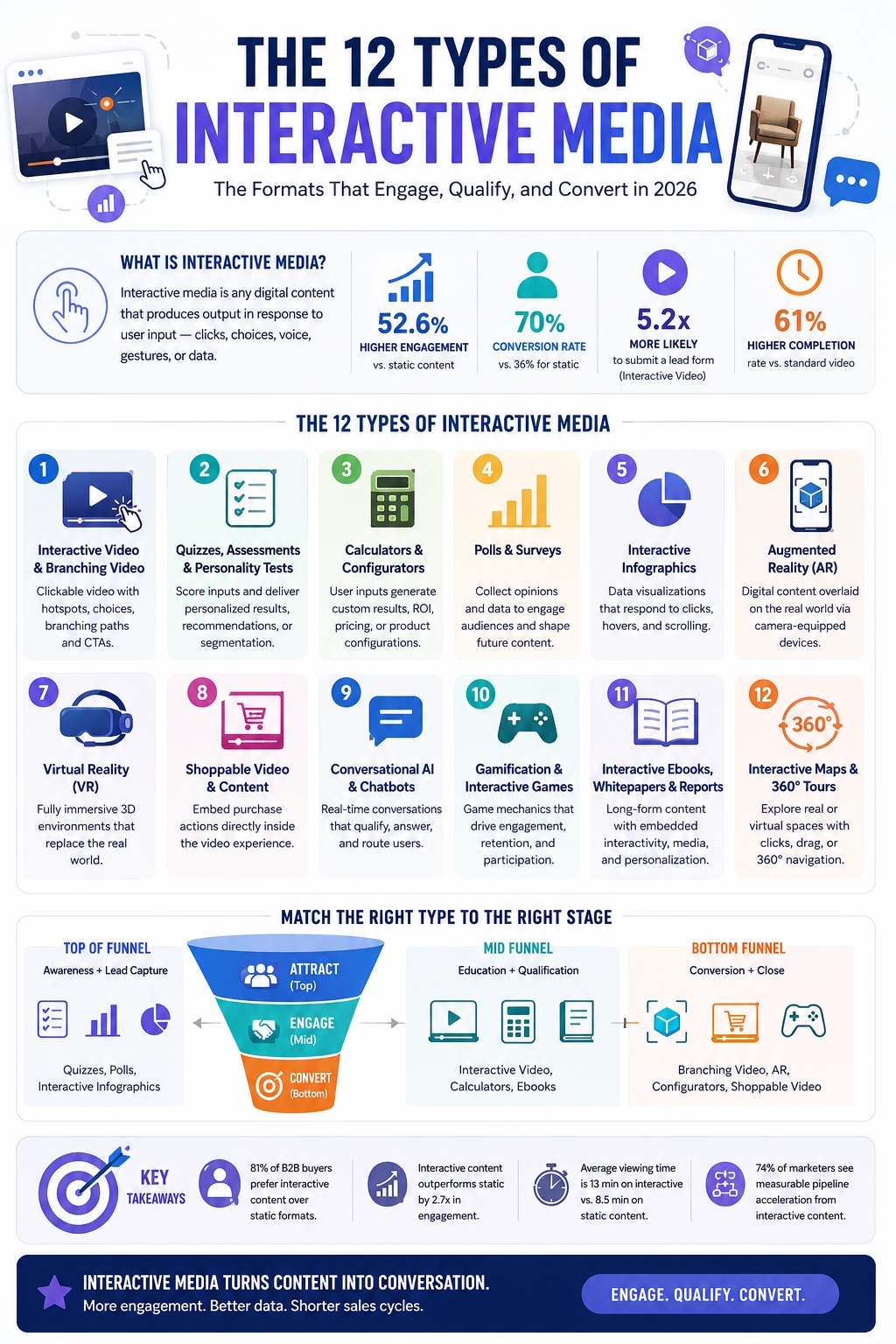
- Interactive content drives 52.6% higher engagement and converts at 70% vs. 36% for static formats.
- Interactive video sits at the top — 5.2x higher lead-form submission and 61% higher completion vs. standard video.
- Match the type to the funnel stage: top = quizzes/polls, mid = calculators/video, bottom = AR/configurators.
Key Takeaways
- Interactive media is digital content that produces output in response to user input, including clicks, selections, voice, and gestures.
- Interactive video is a video format that layers clickable hotspots, branching paths, forms, and timed CTAs on top of a standard video file.
- Branching video is a non-linear interactive video where viewer choices determine which segment plays next.
- Shoppable video is interactive video that embeds direct purchase actions inside the playback experience.
- Augmented reality (AR) is an interactive medium that overlays digital content onto the physical world via a camera-equipped device.
- Virtual reality (VR) is an interactive medium that places the user inside a fully simulated 3D environment.
- Interactive content outperforms static content by 2.7x in engagement and converts 70% of the time vs. 36% for passive formats.
Introduction
If you've spent the last decade producing static PDFs, talking-head videos, and slide-deck whitepapers — and wondering why your conversion rates keep sliding — you've been fighting the wrong war. Eighty-one percent of B2B buyers now prefer interactive content over the static stuff your team is still grinding out, according to Demand Gen Report's 2025 buyer survey. That isn't a soft preference. That's the buyer telling you, plainly, that the format is the message.
I've watched marketing teams add another newsletter, another ebook, another whitepaper — and miss the actual problem. The problem isn't more content. It's that the content sits there, motionless, while the buyer waits for something to actually happen. Interactive media is what happens when content stops being a monologue and starts being a conversation.
There are 12 distinct types of interactive media, and each one fits a specific job in the buyer journey. Pick the wrong type and you produce noise. Pick the right one and you compress your sales cycle by weeks. In this guide I'll walk through every type, give you two real examples for each, and show you exactly which type to deploy at which stage. I'll also cover what interactive video actually is and the five sub-types of interactive video you should know about — because that's where the highest leverage lives.
Want the shortcut? Book a 15-minute Clixie demo and I'll show you which type maps to your current pipeline.
What Is Interactive Media?
Interactive media is digital content that produces output in direct response to user input — clicks, swipes, voice commands, gestures, or sensor data — turning passive viewing into a two-way exchange.
Britannica defines it as "a method of communication in which the program's outputs depend on the user's inputs." That sounds academic, but the practical definition is simpler: if the content changes based on what the user does, it's interactive. If it just plays or sits there, it's static.
How interactive media differs from static media
Static mediaInteractive mediaDirectionOne-wayTwo-wayEngagement multiplier1x baseline2.7x averageData capturedView countsClicks, choices, dwell time, intent signals
VISUAL ASSET #2: Static vs. interactive comparison table. Alt: "Comparison table showing how interactive media differs from static media across direction, engagement multiplier, and data captured."
The shift matters because the data you capture from interactive media — every click, every choice, every path taken — is the data your sales team needs to know who's actually ready to buy.
.avif)
Why Interactive Media Matters in 2026
Interactive media matters in 2026 because buyers expect responsive experiences, with 81% of B2B buyers preferring interactive content over static formats and interactive video producing 5.2x higher lead-form conversions than passive video.
Here's what the most recent research is showing right now:
- 52.6% higher engagement rate on interactive content vs. static, with average viewing time of 13 minutes on interactive vs. 8.5 on static, per Outgrow's 2025 interactive content study.
- 81% of B2B buyers prefer interactive content over traditional static formats, per Demand Gen Report.
- 5.2x more likely to submit a lead form when viewers engage with at least one in-video interactive element, per Wistia's 2026 Video in Business Benchmark Report.
- 70% conversion rate on interactive content vs. 36% on static, per Demand Metric research compiled by Demand Gen Report.
- 74% of marketers report measurable pipeline acceleration from interactive nurture content, per the Content Marketing Institute.
- More than half of large B2B transactions ($1M+) will be processed through digital self-serve channels in 2025, per Forrester's 2025 B2B Marketing & Sales Predictions.
If your competitor's content is interactive and yours isn't, you've already lost the consideration phase. The buyer made the call before they ever saw your sales rep.
The 12 Types of Interactive Media (With Real Examples)
The 12 types of interactive media are interactive video, quizzes, calculators, polls and surveys, interactive infographics, augmented reality, virtual reality, shoppable video, conversational AI, gamification, interactive ebooks, and 360° tours. Below, what each one is, two real examples, and the specific job it does best.
1. Interactive Video & Branching Video
Interactive video is video that layers clickable hotspots, branching paths, forms, and timed CTAs on top of a standard video file, turning passive watching into a two-way experience. Branching video is the non-linear version: viewer choices determine which segment plays next.
Examples: Netflix's Bandersnatch — the first mainstream branching narrative that proved viewers want to drive the story. Honda's The Other Side campaign let viewers toggle between a family-friendly storyline and a high-octane parallel plot, doubling time-on-content for a single asset.
The data: Viewers who engage with at least one in-video interactive element are 5.2x more likely to submit a lead form, and interactive video completion rates run 61% higher than standard video.
Best for: Mid-to-bottom funnel — qualification, demos, and sales-cycle compression. This is the highest-leverage type by a wide margin, which is why I'll spend a dedicated section on it below. For the mechanics, read the complete breakdown of how interactive video works.
I recently designed a pilot campaign for CS3 Revestimentos, a major player in the stone industry. Instead of emailing distributors a static PDF catalog for a new product line, we deployed a Clixie branching video. The video asked viewers to select their primary focus for the upcoming quarter. If a distributor clicked on high-end architectural finishes, the video automatically tagged them as a top-tier prospect and surfaced a priority consultation form. We saw a 34% lift in total engagement, but the real win was pipeline efficiency. The sales team stopped making cold follow-ups; they only called distributors who had explicitly demonstrated their buying intent inside the video player.
2. Quizzes, Assessments & Personality Tests
Quizzes are interactive assessments that score user inputs against predefined logic and deliver a personalized outcome — a result, a recommendation, or a segment.
Examples: BuzzFeed-style personality quizzes that built a media empire on shareability. HubSpot's Website Grader is the cleaner B2B version — a free assessment that scores your site and segments leads by sophistication.
The data: Brands using interactive assessments see 40% higher lead-to-MQL conversion rates compared to static lead magnets.
Best for: Top-of-funnel lead capture and segmentation. Quizzes are the single fastest way to convert a cold visitor into a qualified email.
3. Calculators & Configurators
Calculators take user inputs and run them through a formula to return a personalized number — savings, ROI, total cost, payback period. Configurators are the visual cousin: pick options, see the result render in real time.
Examples: Salesforce's ROI calculator turns "what would this cost us?" into a defensible business case the prospect builds themselves. Tesla's online car configurator lets buyers spec a vehicle down to the wheels and see the price update instantly — and it's responsible for billions in pre-orders.
The data: Deals that include an interactive proposal or ROI calculator close 43% faster, per Demand Metric.
Best for: Mid-funnel acceleration. When the buyer builds the number themselves, they own the outcome. You stop selling and start confirming.
4. Polls & Surveys
Polls and surveys collect structured input from an audience, then either feed the results back live (polls) or use them to shape downstream content and segmentation (surveys).
Examples: LinkedIn polls — the simplest possible interactive content, and one of the highest-engagement post formats on the platform. Typeform's conversational surveys turn boring forms into one-question-at-a-time conversations and lift completion rates by double-digit percentages.
Best for: Audience research, social engagement, and content idea generation.
5. Interactive Infographics
Interactive infographics are data visualizations that respond to hover, click, or scroll — letting the reader drill into a number, expand a section, or reveal context on demand.
Examples: Information Is Beautiful's interactive data viz — the gold standard for editorial data design. The New York Times' Snow Fall feature redefined long-form journalism by weaving scrollytelling, video, and interactive maps into a single article that won a Pulitzer.
Best for: Technical or educational content competitors flatten into PDFs. If your industry has dense data, an interactive infographic is the version everyone shares.
6. Augmented Reality (AR) Experiences
Augmented reality overlays digital content onto the physical world via a camera-equipped device — phone, tablet, or headset — letting users see how something would look or work in their actual environment.
Examples: IKEA Place lets shoppers drop a true-to-scale 3D sofa into their living room before buying. Sephora Virtual Artist lets users try on lipstick shades through their phone camera.
The data: AR retail experiences drive up to 40% higher conversion rates, and the global VR/AR/MR market was valued at $20.43 billion in 2025, projected to reach $106.42 billion by 2031, per Mordor Intelligence.
Best for: Bottom-funnel decisions where product confidence is the bottleneck.
7. Virtual Reality (VR) Experiences
Virtual reality places the user inside a fully simulated 3D environment, replacing their visual and often auditory field with the digital experience.
Examples: Walmart trained over a million employees on customer service scenarios using VR headsets — cheaper and more effective than role-play. BMW lets prospects take VR test drives of cars that don't physically exist on the lot yet.
Best for: Immersive training and high-consideration product demos where the cost of a real demo is too high.
8. Shoppable Video & Shoppable Content
Shoppable video is interactive video that embeds direct purchase actions inside the playback experience — click an item, see options, add to cart, all without leaving the video.
Examples: Walmart Cookshop turns recipe videos into one-click grocery carts. YouTube Shopping lets creators tag products mid-video so viewers buy without losing playback.
Best for: E-commerce and direct-response. Shoppable video collapses the discovery-to-purchase path into a single screen.
9. Conversational AI & Chatbots
Conversational AI is interactive media in dialogue form — a chatbot or voice agent that responds to user inputs in real time, qualifies, routes, or answers.
Examples: Drift's AI conversations qualify and book meetings 24/7 without human reps. Intercom's Fin handles support questions with grounded answers, deflecting tickets at scale.
Best for: Instant qualification and support deflection. Done well, conversational AI is a 24-hour SDR. Done badly, it's a buzzer at the front desk.
10. Gamification & Interactive Games
Gamification adds game mechanics — points, streaks, levels, rewards, leaderboards — to non-game experiences to drive engagement and retention.
Examples: Duolingo's streak system turned language learning into a daily habit for 100M+ users. Starbucks Rewards uses tiered status and points to drive repeat purchase frequency.
Best for: Retention and habit formation. Gamification is what makes users come back without you spending another dollar on acquisition.
11. Interactive Ebooks, Whitepapers & Reports
Interactive ebooks are long-form content with embedded video, animation, expanding sections, calculators, or quizzes — replacing the static PDF most companies still ship.
Examples: Spotify Wrapped is the world's most successful interactive annual report — every user gets a personalized version of the data and shares it. Many sustainability and industry reports now ship as interactive web experiences instead of PDFs.
The data: 74% of marketers report measurable pipeline acceleration from interactive nurture content.
Best for: Thought-leadership and gated lead magnets. The static whitepaper is dying — interactive is what's replacing it.
12. Interactive Maps & 360° Tours
Interactive maps and 360° tours let users navigate a real or simulated space — clicking points of interest, looking around in any direction, or moving between locations.
Examples: Matterport 3D tours have become standard in real estate, letting buyers walk through homes from anywhere. Google Earth Voyager turns the entire planet into an interactive exploration platform.
Best for: Real estate, travel, venue marketing, and any product where physical space is the value proposition.
VISUAL ASSET #3: Master comparison table of all 12 types. Alt: "Comparison table of the 12 types of interactive media showing funnel stage, engagement multiplier, ideal use case, and implementation difficulty."
How to Choose the Right Type for Your Goal
Match the interactive media type to your funnel stage: quizzes and polls capture top-of-funnel intent, calculators and interactive video accelerate mid-funnel, and AR or configurators close bottom-funnel decisions.
Funnel stageGoalRecommended typesTop-of-funnelAwareness + lead captureQuizzes, polls, interactive infographicsMid-funnelEducation + qualificationInteractive video, calculators, ebooksBottom-funnelConversion + closeBranching video, AR, configurators, shoppable video
The most overlooked format on this list is branching video, and teams skip it strictly out of intimidation. Marketing departments assume building a non-linear video requires massive production budgets and complex routing logic, so they default to building another basic quiz. That is a mistake. When you apply a "design through subtraction" mindset, a highly effective branching video is just three 20-second clips tied together by a single, qualifying question. It is the only interactive format that forces the buyer to explicitly tell you what they care about while keeping them immersed in your visual narrative.
The mistake I see most often: teams pick one type — usually quizzes — and stop. The teams winning right now stack three or four types across the funnel. A quiz at the top, a calculator in the middle, a branching video at the close. The compounding effect is the difference between a 1% conversion and a 6% conversion.
How Clixie.ai's Interactive Video Unifies the Highest-Converting Types
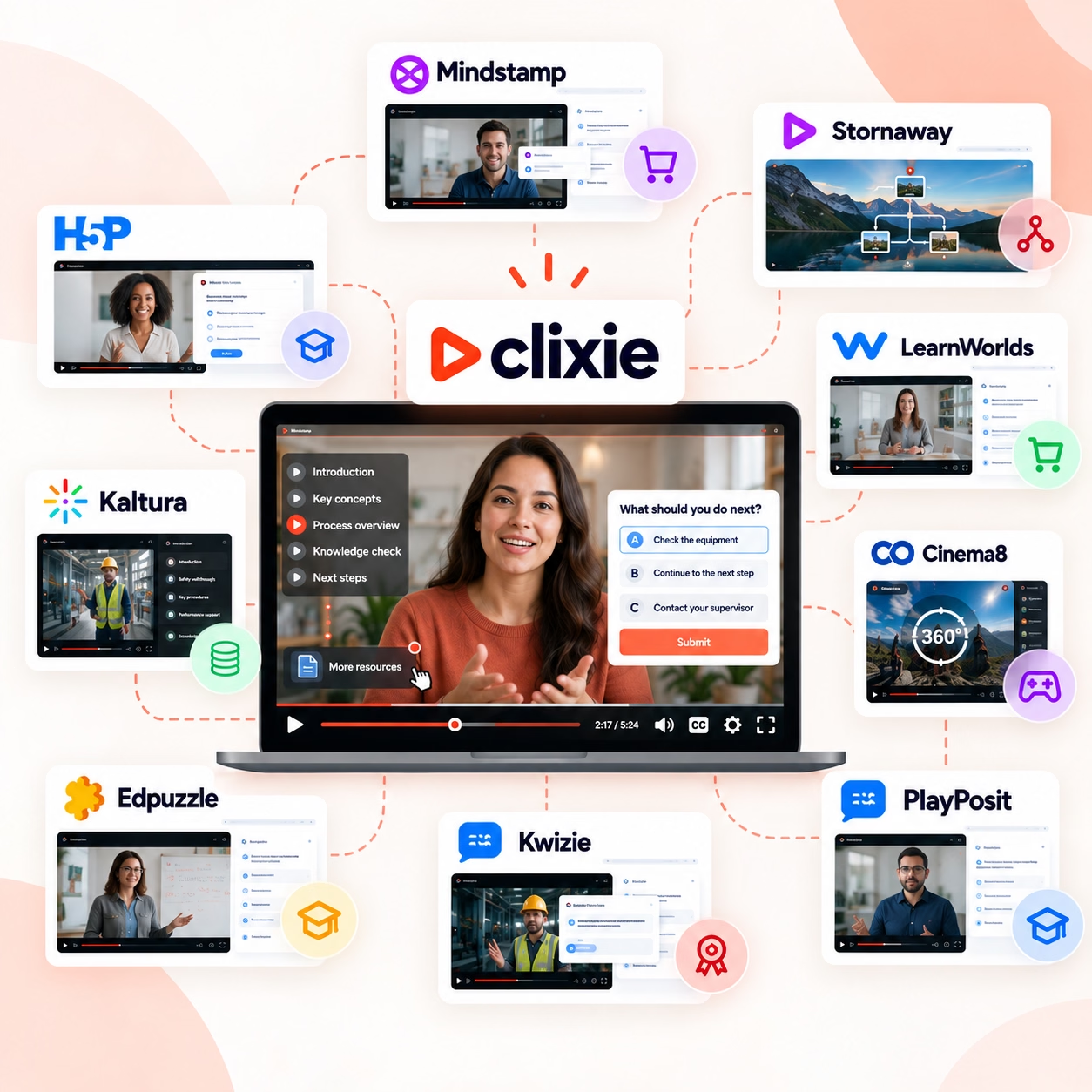
Clixie.ai combines branching video, in-video quizzes, lead capture, and timed CTAs into one workflow — so a single interactive video performs the work of four separate interactive media types in a 90-second viewing experience.
Here's how that plays out across the sales motion:
Pre-call: A branching video on the demo page lets prospects self-select their use case. The branches feed CRM segmentation automatically, so by the time the call happens, the rep knows exactly which version of the demo to run.
During-call: Timed CTAs appear at the moment of highest engagement — the second the prospect clicks into a feature deep-dive, a "book a follow-up" overlay surfaces. No tab switching, no momentum loss.
Post-call: A personalized branching follow-up video re-engages prospects based on which paths they explored. The viewer who clicked into pricing gets a different next-step than the one who clicked into integrations.
The point isn't that interactive video is one of the 12 types. The point is that a single Clixie branching experience produces the data of a quiz, the depth of a long-form video, and the conversion behavior of a configurator — all at once. That's why I keep coming back to it. For a deeper read on what these analytics actually reveal, see the intent data interactive viewing produces.
We recently rebuilt the interactive online training course for the BolaWrap Operator program. Their previous static training videos were suffering from severe drop-off because operators would simply hit play and tune out. We shifted the curriculum into a Clixie branching model. The video paused at critical moments, forcing the operator to make a split-second tactical decision to advance the scenario. The pipeline impact was immediate. We achieved a 61% higher completion rate compared to the legacy video format. More importantly, the interactive data proved exactly who understood the tactical material and who was just letting a screen run in the background.
If you want a working starting point, I broke down how I 10x'd video engagement using interactive video — including the exact branching tree I used.
Free template: Grab the Clixie interactive video template and turn your next sales video into a branching qualifier in under 30 minutes.
FAQ
What is interactive media?
Interactive media is digital content that produces output in response to user input — clicks, choices, voice, gestures, or sensor data. Unlike static media, which delivers a one-way message, interactive media creates a two-way exchange where the experience changes based on what the user does.
What are the 12 types of interactive media?
The 12 types of interactive media are interactive video and branching video, quizzes and assessments, calculators and configurators, polls and surveys, interactive infographics, augmented reality (AR), virtual reality (VR), shoppable video, conversational AI and chatbots, gamification, interactive ebooks and reports, and interactive maps and 360° tours.
What are some examples of interactive media?
Examples of interactive media include Netflix's Bandersnatch (branching video), HubSpot Website Grader (assessment), Tesla's car configurator, IKEA Place (AR), Spotify Wrapped (interactive report), Walmart Cookshop (shoppable video), Duolingo (gamification), and Matterport 3D tours.
What's the difference between interactive media and interactive content?
Interactive media is the broader category — any digital format that responds to user input, including video, AR, VR, and chatbots. Interactive content typically refers to a narrower subset: marketing-focused formats like quizzes, calculators, and infographics. Most marketers use the terms interchangeably, but interactive media covers more ground.
What is interactivity in media?
Interactivity in media is the property that lets the audience influence what happens next. A static article has no interactivity — every reader sees the same words in the same order. An interactive infographic, branching video, or quiz has interactivity because each user's choices change the experience and the output.
Which type of interactive media has the highest conversion rate?
Interactive video typically delivers the highest bottom-funnel conversion rates among the 12 types. Wistia's data shows interactive video viewers are 5.2x more likely to submit a lead form than passive video viewers, and Demand Metric research shows interactive content overall converts at 70% vs. 36% for static formats.
How is interactive media used in marketing?
In marketing, interactive media is used to capture attention, qualify leads, accelerate deals, and personalize the buyer experience. Top-of-funnel teams use quizzes and polls; mid-funnel teams use calculators and interactive video; bottom-funnel teams use AR, configurators, and shoppable video. The best-performing teams stack three or four types across the entire funnel.
How is interactive video different from interactive media?
Interactive video is one specific type within the broader category of interactive media. Interactive media is the umbrella term for all digital content that responds to user input, while interactive video specifically refers to video files that have clickable hotspots, branching paths, embedded forms, or timed CTAs layered on top.
Conclusion
The 12 types of interactive media span the entire buyer journey, and most teams pick one and stop there. The teams winning right now — the ones compressing sales cycles by weeks and lifting conversion by double digits — are stacking three or four types together. A quiz at the top, a calculator in the middle, a branching video at the close.
The next 18 months will reward teams that capture intent inside playback, not in form fills two weeks after the demo. That's the actual shift. Static content is a museum exhibit. Interactive media is a conversation, and the conversation is where decisions get made.
Stop guessing which type fits your funnel. Book a 15-minute Clixie demo and I'll map your highest-leverage interactive media type directly to your current pipeline. Bring one stuck deal — we'll fix it on the call.
.png)
.png)



.avif)
