College Courses Explained: Educational Videos That Click
Skip vague lectures. Watch bite-size college course explainers that make concepts click fast—perfect for review, catch-up, or exam prep.



Educational Videos That Click
If you have ever tried to learn a college topic from a random YouTube video, you know the feeling.
The title looks perfect. The thumbnail screams “A+ in 10 minutes.” You hit play, and five minutes later you are more confused than when you started.
The truth is, college courses are not hard because students are incapable. They are hard because most explanations skip the exact step your brain needs. They assume you already understand the prerequisite idea, or they race through a proof, or they teach a formula without showing where it comes from.
That is why the best educational videos do not just “cover the material.” They click. They make you feel the topic lock into place.
This article breaks down what makes college course videos actually work, how to spot the good ones fast, and how to use them in a way that improves grades instead of becoming another form of procrastination.
What “That Video Finally Made Sense” Actually Means
When students say a video helped, they usually mean one (or more) of these things happened:
- The video started at the right level. Not too basic, not too advanced.
- It slowed down at the confusing parts. The instructor knew the common mistakes.
- It used a visual model. A picture, timeline, diagram, graph, or animation that matches the concept.
- It connected steps logically. Instead of “here’s the formula,” it explained “here’s why.”
- It gave a worked example. Not just theory. Something you can imitate on homework.
If you are trying to make educational videos (or choose which ones to trust), that is the target. Not entertainment. Not vibes. Clarity.
The Biggest Problem With Most College Explainer Videos
A lot of “college help” content is built around speed and search traffic.
That leads to a familiar pattern:
- A broad title that matches a common exam topic.
- A fast overview that feels productive but misses the hard parts.
- A few tricks or shortcuts.
- No deep check for understanding.
It is not that shortcuts are bad. The issue is that shortcuts without structure create fragile understanding. You can memorize a method, but one small twist on an exam and the whole thing falls apart.
The videos that click do something different. They build a mental framework, then add shortcuts after the framework exists.
What Makes Educational Videos Click (The Real Checklist)
Here are the traits I look for when a video actually teaches at a college level.
1) A clear promise and a clear boundary
A strong video tells you exactly what you will walk away with.
For example:
- “By the end, you can set up and solve separation of variables problems.”
- “We will focus only on interpreting p-values, not doing hypothesis tests.”
This matters because college topics are huge. If a video tries to “cover everything,” it usually covers nothing well.
2) The video anticipates confusion
Great instructors know where students get stuck, and they pause there on purpose.
In calculus, they slow down at “what does the derivative mean” before they throw rules at you.
In economics, they spend time on “what is the model assuming” before they draw curves.
In chemistry, they explain why an electron configuration matters before listing exceptions.
This is the difference between a lecture and a tutorial.
3) Visuals that do more than decorate
A good visual is not a pretty diagram. It is a model that reduces cognitive load.
Examples:
- In physics, free body diagrams that are built step by step, not magically appearing finished.
- In statistics, distributions shown as shapes you can reason about, not just formulas.
- In biology, processes shown as sequences with cause and effect, not a list of terms.
If the visuals are just “slides with text,” you might still learn, but it will usually take longer and feel harder.
4) Worked examples with narration of the thinking
The best videos say what the student is thinking.
Not just:
- “Now we integrate both sides.”
But:
- “I’m looking for a substitution that turns this into something standard. When I see this pattern, I try this move first.”
That narration builds transfer. It helps you solve new problems, not just copy the exact one.
5) A quick check for understanding
Even a 30-second checkpoint helps:
- “Pause and try this one.”
- “Before we continue, predict the sign of the answer.”
- “Which of these assumptions are we using?”
If a video never asks you to think, it is easy to feel like you understood when you did not.
The Formats That Work Best for College Topics
Not every topic needs the same style. Here are formats that consistently perform well for actual learning.
The “concept first, then technique” mini-lesson
Perfect for math, physics, and stats.
You get the intuition, then the steps. This prevents the common trap of memorizing procedures with no idea what they mean.
The “one problem, many angles” walkthrough
Perfect for exam prep.
A good instructor will solve the same problem:
- graphically
- algebraically
- conceptually
- with common mistakes highlighted
This is how understanding becomes stable.
The “story of the system” explainer
Perfect for biology, psychology, history, political science, and business topics.
Facts stick when they live inside a narrative:
- What problem was the field trying to solve?
- What were the big competing ideas?
- What changed because of one experiment, law, or event?
The “lab mindset” demo
Perfect for chemistry, engineering, and computer science.
You learn faster when you see the process:
- how you set up
- how you troubleshoot
- how you interpret results
This is especially useful when homework expects you to “just know” what a tool or method is for.
The “Choose Your Own Path”
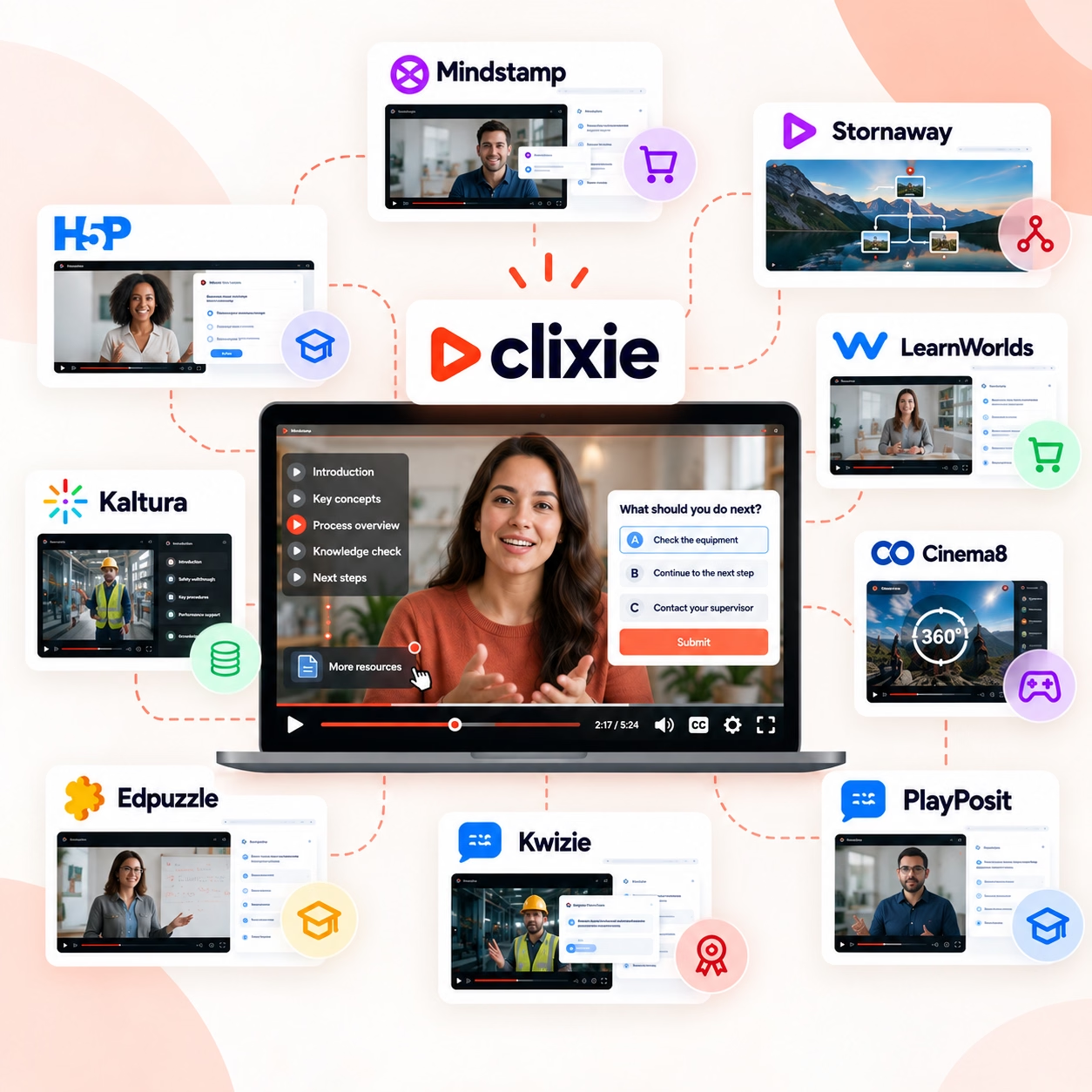
Interactive Video Perfect for complex decision-making in nursing, business, or engineering. Interactive videos transform the viewer from a passive observer into an active participant. By using clickable hotspots or branching scenarios, these videos allow you to make a choice—like selecting a diagnostic test or a line of code—and immediately see the consequence. This "fail-safe" environment is one of the most effective ways to build clinical or technical judgment because it forces your brain to retrieve information in real-time rather than just nodding along to a lecture.
How to Choose the Right Video Fast (Without Wasting an Hour)
Here is a practical way to filter videos quickly.
Step 1: Match your course, not just the topic
Search with your course language:
- “Gen Chem limiting reagent percent yield”
- “Calc 2 Taylor polynomial error bound”
- “Microeconomics deadweight loss tax”
- “CS data structures time complexity examples”
Course-specific phrasing usually finds instructors who teach at the same level.
Step 2: Preview the middle, not the intro
Skip to the middle where the real explanation happens.
- Are they explaining or performing?
- Are they defining terms or assuming them?
- Are they writing clearly and speaking clearly?
If the middle is chaotic, the rest will be too.
Step 3: Look for signs of structure
Even before you watch:
- Chapters or timestamps
- A clear outline
- A summary at the end
- Practice problems mentioned
Those features correlate strongly with quality.
Step 4: Check for “common mistake” language
Phrases like:
- “Most people mess up here…”
- “This is where students get confused…”
- “Here’s the trap…”
That is usually a good sign the instructor has taught real students, not just made content.
How to Use Videos Without Falling Into the “I Watched It, So I Must Know It” Trap
Watching a video is not studying. It can be part of studying, but only if you turn it into an active process.
Here is a simple method that works across most courses.
1) Watch in short blocks
Do not binge an entire chapter playlist.
Watch 6 to 12 minutes, then stop.
2) Take “output” notes, not “copy” notes
Instead of copying what they wrote, write:
- the goal of the method
- the conditions where it applies
- the steps in your own words
- one example of a common mistake
If you cannot summarize, you did not learn it yet.
3) Recreate the example from scratch
Close the video. Solve the same example with a blank page.
If you get stuck, reopen only the part where you got stuck. That is where your learning lives.
4) Do one new problem immediately
If you stop after the video example, you feel confident. If you do one new problem, you find out what you actually know.
This one move does more for grades than watching five extra videos.
If You Are Making College Explainer Videos, Here’s What Actually Moves the Needle
If your goal is to make educational videos that students share and return to, focus on these.
Start with the exact student problem
Not “today we will discuss Fourier series.”
More like:
- “If your professor says ‘expand this periodic function into a Fourier series’ and you freeze, this is the missing step.”
- “If you never know whether to use substitution or integration by parts, this is how you decide.”
Students click when the video mirrors their frustration.
Teach the prerequisites inside the lesson
Do not assume everyone remembers the earlier unit. Add a 30-second bridge:
- “Quick reminder: this property means…”
- “If you don’t remember this identity, here is why it works.”
That bridge is often the difference between retention and dropout. This is where scaffolding lessons becomes essential. By providing these reminders and context within your lessons, you're effectively reducing cognitive load and enhancing learning retention.
Use one visual language consistently
If you use colors, keep them consistent. If you label axes, label them every time. If you use symbols, define them once and reuse them.
Cognitive friction kills learning.
End with a summary and a next step
Students love:
- “Here are the three patterns to remember.”
- “Here are two practice problems.”
- “Next, watch this if your class covers X.”
It turns a single video into a learning path.
Leverage Interactivity to Break the "Passive Trance"
If you want to maximize retention, don't just let the video play from start to finish. Use interactive elements like embedded quizzes, "jump-to" markers for prerequisites, or toggleable overlays that show extra hints. When a student has to physically click an answer to move forward, their engagement levels spike. This turns the video into a two-way conversation, ensuring the student is actually processing the "why" before they move on to the "how."
.png)
A Simple “Video Stack” That Works for Most Courses
When a topic is not clicking, stack your resources in this order:
- One concept explainer (to get intuition)
- One worked example video (to see steps)
- Your textbook or notes (to match course language)
- Practice problems (to lock it in)
Most students do the reverse and wonder why nothing sticks.
FAQ: College Courses Explained (Videos That Click)
What’s the best length for an educational video?
Usually 8 to 15 minutes for a single concept. Longer is fine if it is chaptered and includes pauses for practice.
Why do some videos feel clear, but I still fail the homework?
Because clarity while watching is not the same as recall while solving. You need to reproduce the method without the instructor, then do at least one new problem immediately.
Should I watch multiple creators for the same topic?
Yes, if you are stuck. Different explanations can trigger understanding. Just avoid watching five versions back to back without doing problems in between.
Is it better to watch lecture recordings or short tutorials?
Lecture recordings help for context and course alignment. Short tutorials are better for specific skills and exam-style problems. Many students benefit from using both.
How do I know if a video is too advanced or too basic?
If it assumes definitions you do not know, it is too advanced. If it spends most of the time on obvious setup and never reaches the hard step you need, it is too basic. The right video makes you work, but not drown.
Can I rely on videos instead of attending class?
Videos can fill gaps, but your exams are usually aligned to your instructor’s emphasis, notation, and problem style. Use videos to support your course, not replace it.
What should I do if I keep getting the same type of problem wrong?
Find a video that focuses on that exact problem type and specifically includes common mistakes. Then redo three similar problems in a row, checking your work only after each attempt.
.png)
.png)