


Training Video Localization With AI: Tools, Workflows, and Best Practices [2026]
Learn how to localize training videos with AI using subtitles, dubbing, interactive elements, LMS workflows, and multilingual analytics.
![Training Video Localization With AI: Tools and Workflows [2026]](https://cdn.prod.website-files.com/646b666669cbb97ed8baef9f/6a0770de9273cc273d68fe58_training-video-localization.avif)


TL;DR
- Most teams treat training video localization as a translation problem. It is an operational workflow problem.
- Native-language training can improve comprehension, completion, and retention — especially for compliance-heavy or technical material, where cognitive load from processing a second language is a direct factor.
- AI-assisted workflows can compress transcription, translation, dubbing, and subtitle generation from traditional multi-week timelines into much shorter production cycles.
- The layer most localization tools skip: preserving quizzes, branching paths, and interactive elements across every language version without a manual rebuild.
- A five-layer localization workflow — transcript, translation consistency, voice localization, interactive adaptation, and regional analytics — gives teams a repeatable production model.
Who This Guide Is For: This guide is for L&D teams, HR training managers, customer education teams, compliance managers, and enablement teams that need to localize training videos across multiple languages without rebuilding the production workflow for every market. If you are evaluating AI localization tools, designing a scalable multilingual workflow, or trying to understand where your current process is breaking down, this is written for you.
Key Takeaways
- Training video localization is the process of adapting video-based learning content — audio, subtitles, captions, and interactive elements — so global teams can engage with it in their primary language.
- AI dubbing is a voice synthesis technique that replaces original audio with AI-generated speech in a target language, sometimes with lip-sync synchronization depending on the platform, often with lower production overhead than traditional studio recording.
- SCORM is the packaging standard that allows localized training videos to integrate with any LMS while preserving learner tracking and completion data across language versions.
- Interactive localization is the practice of preserving branching paths, quizzes, and clickable overlays when adapting video training content for new languages — a production layer most AI translation tools do not handle natively.
- Multilingual onboarding is a global HR practice that delivers employee orientation content in each hire's primary language, reducing early attrition and improving time-to-productivity.
- The five-layer localization workflow is an operational model that sequences transcript generation, translation consistency, voice localization, interactive adaptation, and engagement analytics into a repeatable production pipeline.
Introduction
If your team manages training content for employees or customers across more than one country, you already know the problem. Creating the original video is the easy part. Getting that same video working in five languages — with accurate subtitles, localized audio, translated quiz questions, and a SCORM package that actually loads in your LMS — is where timelines collapse and production budgets evaporate.
According to iSpring Solutions' 2026 eLearning statistics report, approximately 98% of organizations now use or plan to use online learning as part of their training infrastructure, in a global training market that reached $401 billion in 2024. Yet most localization workflows inside those organizations were designed for static slide decks, not interactive video. The result: teams end up coordinating a separate vendor for transcription, another for translation, a voice recording agency, a QA round, and a re-publishing cycle — every time they want to add a language. And none of that accounts for the quizzes, branching scenarios, and compliance checkpoints that make modern training effective.
This guide covers the full operational picture: why localization matters, where traditional workflows fail, what AI tools actually do, how to choose the right approach for your content type, a practical five-layer workflow, the mistakes most teams make, and the tools available in 2026 — including where each one fits and where each one stops.
Localize interactive training without rebuilding every language version: Explore Clixie AI Localization
Already running AI training videos? See how AI-powered training video tools are changing the production model.
Why Training Video Localization Matters for Global Teams
Training video localization is the operational process of adapting video-based learning content — including audio, subtitles, captions, and interactive elements — so employees and learners in different regions can engage with it in their primary language.
The business case is no longer marginal. Distributed and remote-first teams are standard in most mid-size and large organizations. A product training published in English in January may need to reach sales teams in Brazil, Germany, and South Korea within the same quarter. Customer education teams running onboarding for international users face the same pressure on a faster cycle. HR and compliance teams operating across multiple jurisdictions face it as a regulatory requirement, not a preference.
Research from HSI on workplace safety training found that workers who receive training in their native language report better understanding of safety protocols and greater adherence to safe practices — with employers noting corresponding improvements in compliance outcomes. The same dynamic applies across training categories. When employees process content in a second language, cognitive load increases and learning effectiveness decreases, regardless of how well the content is designed. KnowledgeCity's analysis of eLearning localization identifies organizations that deploy training in learners' primary languages as consistently seeing higher knowledge retention and completion rates compared to second-language delivery.
From a regulatory standpoint, localization has become increasingly non-negotiable. Compliance training across the EU, UK, and major Asia-Pacific markets requires that organizations demonstrate employees received training they could reasonably understand. Brandon Hall Group's research on global compliance programs identifies true localization — adapting content to local laws, regulatory context, and cultural norms — as significantly more effective than translation alone, with a centralized LMS serving as the critical audit trail.
The AI dubbing market, now central to scalable video localization, was valued at approximately $1.35 billion in 2026 and is growing at 17.7% annually, according to Intel Market Research. That growth reflects where training investment is moving: toward multilingual content production at scale, not single-language video libraries with a growing backlog of pending translations.
For teams building multilingual onboarding programs specifically, the multilingual onboarding video workflow guide covers the end-to-end process.

The Real Cost of Traditional Training Video Localization
Traditional training video localization is a multi-vendor, multi-step production process — separate workflows for transcription, translation, voice recording, quality review, and LMS publishing — where each handoff adds time, cost, and the opportunity for something to break.
Traditional agency localization can run from several thousand to tens of thousands of dollars per video per language, depending on duration, language pair, and whether dubbing is included — a cost structure that compounds quickly across training libraries spanning multiple markets. On turnaround time, RWS's 2026 analysis of AI dubbing adoption found that traditional agency workflows commonly run four to eight weeks per language version, and that hybrid AI-plus-human-review approaches are reducing both costs and timelines by approximately 40 to 60 percent compared to fully manual methods. That progress is meaningful. But the cost and timeline issues are, in practice, the second problem.
The biggest localization bottleneck is not translation accuracy. It is that most workflows strip away interactive elements entirely — and require teams to rebuild them manually in every language version.
When a training video moves through a standard translation and dubbing pipeline, the output is typically a new video file or a subtitle track. That works for passive content. For interactive training — where the video includes branching compliance scenarios, embedded knowledge checks, clickable product hotspots, and timed CTAs — the exported file contains none of that logic. Every quiz question needs to be re-authored in the new language. Every branching path needs to be rebuilt. Every clickable element needs to be re-mapped.
Articulate's analysis of why organizations translate training makes the case directly: processing training in a second language consumes working memory that should be used for learning itself. The delivery friction compounds the content challenge.
The six most common failure points in traditional localization workflows:
- Subtitle timing breaks after translation — text commonly expands in many language pairs relative to English, breaking synchronization with the original audio
- Dubbing agencies miss brand-specific terminology and product names, creating inconsistencies across the training library
- Interactive elements — quizzes, branches, clickable overlays — are lost in export and require full manual reconstruction per language
- SCORM packages fail after content edits because localized files were not rebuilt within the original authoring environment
- QA happens in email threads without version control, creating review bottlenecks and conflicting edit states
- No regional engagement data is collected, so teams cannot identify which language version is underperforming or why
For a deeper look at why interactive training design matters before localization is even considered, see why interactive training videos outperform passive formats.
What Modern AI Localization Tools Actually Do
Modern AI localization tools are platforms that automate one or more layers of the translation and adaptation pipeline — replacing what previously required multiple vendors and manual handoffs between them.
The category breaks into six distinct capability layers. Most commercial tools handle two or three of them well. Very few address the full production stack.
Automatic transcription converts spoken audio to a timed text file. This is the foundation every other layer builds on. Errors at this stage multiply downstream — a mistranscribed product name will be mistranslated in every language version.
AI translation applies neural machine translation to convert the transcript into target languages. Terminology customization — where teams define how brand names, product references, and compliance terms should be handled — is the meaningful differentiator between tools at this layer.
AI dubbing replaces the original audio with synthesized speech in the target language. Quality varies meaningfully across language pairs and content types, and human review remains valuable for compliance-sensitive material.
Subtitle and caption generation exports timed SRT or VTT files in target languages. The challenge is timing synchronization: translated text often expands or contracts relative to the source, and if timing is not adjusted automatically, subtitles run ahead of or behind the audio.
Voice cloning captures the original presenter's vocal characteristics and produces localized audio that sounds like the same speaker in the new language — an advanced capability increasingly viable for customer-facing content where presenter consistency matters.
Interactive overlay and multilingual branching preservation is the highest-complexity layer: maintaining quiz logic, branching scenario structure, clickable hotspots, and in-video CTAs across all language versions without requiring manual reconstruction in each one. This is where most tools stop. It is also where the choice of production platform has the largest downstream impact on training effectiveness.
According to Business Research Insights, the broader dubbing and voice-over market is projected to grow from $4.94 billion in 2026 to $11.18 billion by 2035. That trajectory reflects the scale at which organizations are moving multilingual content production in-house — and the corresponding demand for tools that handle more of the production chain automatically.
AI Tools Used for Training Video Localization in 2026
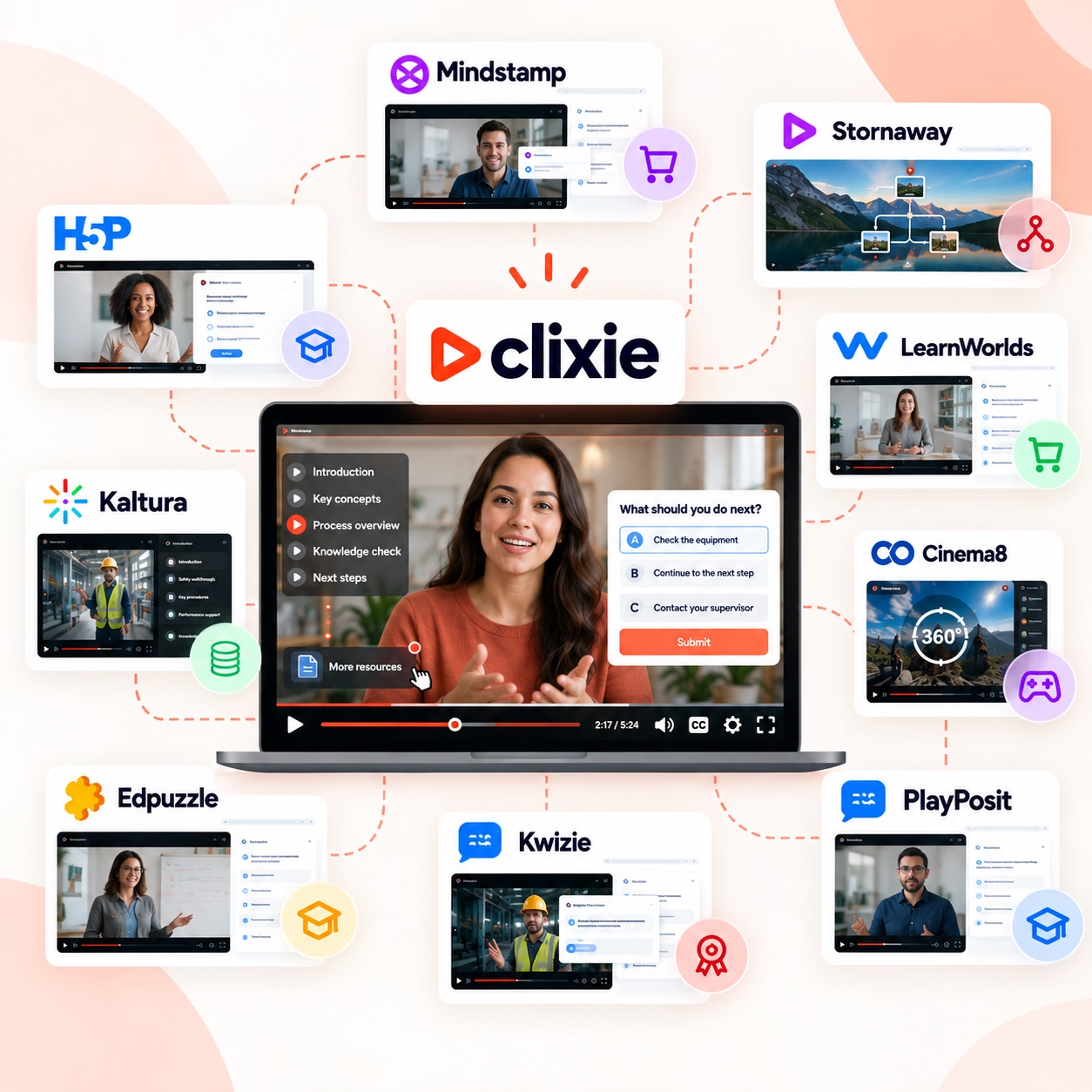
The right tool for training video localization depends on which production layer is your primary constraint — subtitle translation, AI dubbing, avatar-based video generation, or preserving interactive training structures when publishing across languages.
Best Tool by Use Case
Capabilities change frequently. Verify current features on each provider's product page before making a production decision.
If your training content is passive — slide-based presentations, recorded walkthroughs, explainer videos — tools like Synthesia, HeyGen, and VEED are strong options depending on volume, quality requirements, and budget. If your training design includes interactive elements — compliance branching, knowledge checks, decision-tree onboarding scenarios — the localization choice involves an additional production layer that most standard tools do not address without a separate manual rebuild cycle.
See how multilingual interactive training works: Explore Clixie AI Localization Workflows
Choosing the Right Training Video Localization Workflow
Choosing the right localization workflow means matching your production approach to the specific requirements of your content type, audience, compliance context, and delivery environment. These are the decisions that drive the choice.
Subtitles vs. dubbing
Subtitles are faster to produce, more cost-effective, and universally compatible with LMS environments. For compliance and internal HR training, subtitles are often sufficient and sometimes preferred — they retain the original speaker's voice, which can matter for authority in sensitive topics. Dubbing creates a higher-fidelity experience for audiences who find reading subtitles alongside instructional content cognitively demanding, and it improves accessibility for learners with reading difficulties.
AI voices vs. human voices
AI-generated voices reach sufficient quality for most internal training applications across common language pairs. If brand consistency, emotional tone, or presenter recognition matter — in executive communications or high-stakes customer education — AI voice cloning or human voice recording is worth the additional investment.
Passive vs. interactive training
This is the most consequential workflow decision. Passive video can be localized using any tool in the comparison table. Interactive training — where learners make choices, answer questions, follow branching paths, or trigger conditional content — requires a localization approach that accounts for the logic layer, not just the audio and text. Getting this wrong means publishing a localized video where the language is correct but the learning experience is broken.
On the case for interactive training design before localization is even in scope, see why interactive training videos outperform passive formats.
Internal HR training vs. customer education
Internal HR training typically prioritizes speed, compliance coverage, and LMS compatibility. Customer education typically prioritizes experience quality, brand consistency, and engagement. These priorities drive different tool choices and different quality thresholds for the localized output.
Compliance-sensitive content
Safety, regulatory, and legal compliance training has an additional localization requirement: legal terminology accuracy. A translation that is fluent but imprecise about a regulatory obligation creates liability. Compliance content localization should always include review by a subject matter expert in the target region, regardless of which AI tool handles the initial translation pass.
Speed vs. fidelity
If you need twelve language versions published before a product launch next month, the tradeoff leans toward AI-first workflows with human spot-check QA. If you are building a compliance training library intended to run for three years, investing in higher-fidelity voice and more rigorous terminology review is worth the additional time on the first production cycle.
LMS requirements
If your training content needs to pass through a SCORM-compliant LMS and track learner completion data, verify SCORM export compatibility before selecting any tool. Not all video localization tools produce LMS-ready packages — some deliver video files only. Brandon Hall Group's compliance training research identifies a centralized LMS as the audit trail for compliance demonstration, which means localized content that cannot integrate cleanly with that system creates a documentation gap.
When Interactive Training Requires a Different Localization Approach
Interactive training video localization is a distinct production challenge from standard video localization — one that requires preserving quiz logic, branching paths, clickable elements, and learner tracking alongside the audio and subtitle layers.
Most localization tools are built on a reasonable assumption: the video is the training. In interactive training design, the video is the delivery mechanism for a branching learning experience. Translate the video, and the learner still cannot answer the quiz questions. Dub the audio, and the branching paths still prompt in English. Export the SCORM package, and the interactive logic may not survive the transfer intact.
This is not a translation quality problem — it is a workflow architecture problem. Standard localization pipelines process one layer: the language. Interactive training localization requires processing two: the language and the logic.
Teams that use interactive training for compliance scenarios, product certification flows, or scenario-based onboarding need a localization workflow that accounts for both. The choice of tool is not just about translation accuracy or dubbing quality. It is about whether the full training architecture survives the language switch intact — quiz scoring, conditional branching, learner tracking, and all.
How Clixie.ai Simplifies Training Video Localization
Clixie.ai simplifies training video localization by centralizing transcript generation, AI translation, subtitle publishing, and interactive element preservation in a unified workflow — reducing the number of production steps teams manage across language versions.
Clixie.ai is designed for teams that need to maintain quizzes, clickable overlays, and branching paths across localized training versions from a single editing environment. The platform treats the interactive layer as part of the localization process, not a separate production task that follows it.
Here is how the production sequence works in practice.
The source training video is uploaded once. Clixie.ai generates a timed transcript automatically. The team reviews and approves the transcript before any translation runs — catching terminology issues at the source, before they propagate across every language version.
AI translation is applied to the approved transcript. Teams define terminology preferences for brand names, product references, and compliance-specific language. Changes to the central terminology glossary update across all language versions, rather than requiring a correction pass through each one individually.
Subtitles and captions are generated with timing preserved for the translated text. The platform adjusts for length and pacing to maintain synchronization — avoiding the timing drift that manually timed subtitle translations routinely produce.
Interactive elements — quiz questions, branching path text, clickable overlay labels, and in-video CTAs — are adapted to the target language within the same editing environment rather than requiring a return to the original authoring tool for a manual rebuild.
Multilingual versions are published from a centralized interface. When source content changes — a compliance update, a product revision, a new brand guideline — the update can be applied centrally without re-running a full localization cycle for every language version.
Regional engagement analytics track completion rates, quiz performance, and interactive element engagement by language, giving L&D and HR teams actionable data on where specific localized versions are underperforming.
For a closer look at how interactive video analytics work in practice, see training video analytics by region.
The Five-Layer Training Video Localization Workflow
The five-layer localization workflow is an operational model that sequences every production stage — from initial transcript to regional analytics — into a repeatable pipeline that L&D, HR, and customer education teams can run consistently at scale.
Most localization failures are not random. They happen at predictable points in the production chain, and they are preventable if the workflow is sequenced correctly.
.avif)
Layer 1: Transcript Generation
Every localization workflow begins with a transcript. An accurate, timed transcript is the single point from which every downstream layer is built. Translation errors trace back to transcript errors more often than to the translation tool itself. Before any translation runs, the transcript should be reviewed by someone who knows the source content — catching speaker misattributions, technical terminology errors, and mistranscribed acronyms here costs almost nothing. Catching them after dubbing is complete costs a full re-record.
Layer 2: Translation Consistency
Building a terminology glossary before running translation is the highest-ROI step in the localization process. Define how brand names, product names, regulatory terms, and internal jargon should appear in each target language. This glossary prevents the terminology drift that is endemic to multi-vendor localization — where different localization cycles render the same feature or concept differently across modules in the same training library.
KnowledgeCity's research on eLearning localization consistently identifies terminology consistency as a core driver of whether localized content achieves the same comprehension outcomes as the source.
Layer 3: Voice Localization
Choose the appropriate voice modality for the content and audience. For most internal training applications, AI dubbing produces sufficient quality for common language pairs. For content where the original presenter's identity carries weight — executive communications, high-stakes customer education — AI voice cloning or human voice recording is worth the additional investment. For compliance training where legal precision is critical, a subject matter expert should review the dubbed audio before publish.
Layer 4: Interactive Adaptation
This is the most complex layer and the one most frequently omitted from standard localization workflows. Interactive adaptation means reviewing and updating every element in the video that requires learner action: quiz questions and answer options, branching path decision points, clickable hotspot labels, scenario descriptions, and in-video CTAs.
Beyond translation, this layer also requires cultural review. A compliance scenario built around specific workplace context in one region may not map to equivalent regulatory reality elsewhere. Some branching scenarios require structural revision, not just linguistic translation.
For teams building scenario-based training that needs to hold up across cultural contexts, see scenario-based training that sticks.
Layer 5: Multilingual Engagement Analytics
Publishing the localized version is not the end of the workflow. Tracking how each language version performs is the feedback loop that determines whether the localization is actually working.
A global completion rate of 87% can hide a 52% completion rate for one specific language version — which might indicate a terminology problem, a cultural adaptation gap, a technical SCORM failure, or audio quality issues in that language. Without per-language analytics, those signals are invisible. Metrics worth tracking by language version: completion rates, quiz pass and fail rates by question, drop-off timestamps, and interactive element engagement rates.
The nine-step production sequence:
- Upload source training video to your localization platform
- Generate and review the auto-transcript; resolve all terminology issues before translating
- Build or update a terminology glossary for each target language
- Run AI translation on the approved transcript
- Apply voice localization appropriate to content type, audience, and fidelity requirements
- Adapt all interactive elements — quizzes, branching paths, clickable overlays — to the target language and cultural context
- QA review by a native-language subject matter expert; compliance content reviewed by a regional SME
- Test and publish multilingual versions as a verified SCORM package in your LMS
- Track engagement analytics by language and region; iterate on underperforming versions
Common Mistakes Teams Make When Localizing Training Videos
The most common training video localization mistakes are operational oversights that produce technically complete but functionally broken multilingual content — where the language conversion worked but the learning experience fails.
Leaving on-screen text untranslated. Slides, title cards, lower-thirds, and UI screenshots embedded in video are routinely missed in transcription-based workflows. AI translation tools convert spoken audio — they do not detect text inside the video frame. A fully dubbed video with untranslated on-screen text delivers a fragmented learner experience regardless of dubbing quality.
Subtitle timing drift after translation. Text expands in many language pairs relative to the source, and if subtitle timing is not adjusted after translation, subtitles run ahead of or behind the audio. Both conditions reduce comprehension, and neither is a translation quality problem — it is a timing problem.
Untranslated quiz logic and branching text. Teams often translate the video content and forget that quiz question text, answer option labels, feedback messages, and branching scenario descriptions are stored separately from the video file. These require their own localization pass. A learner completing a compliance module in Spanish who encounters English quiz questions at the end has not completed localized training.
SCORM packaging failures after content edits. Editing video content, retranslating a section, or updating a quiz question after the initial SCORM export commonly breaks the package — resulting in lost completion tracking, missing quiz scores, and no LMS record. Compliance training depends on reliable LMS tracking and audit trails, which makes SCORM testing a required step before publishing localized versions — a point Brandon Hall Group's compliance training research reinforces in its guidance on global program management.
Inconsistent terminology across language versions. Without a centralized glossary, different localization cycles produce different translations for the same terms. A compliance training series that uses different language for the same regulatory concept across modules creates ambiguity in both learner comprehension and compliance records.
Ignoring regional engagement analytics. Publishing localized content without monitoring per-language performance means teams cannot distinguish between a localization quality problem, a cultural adaptation issue, and a technical delivery failure. A language version with a significantly lower completion rate is a signal. Without per-language analytics, it remains invisible.
Treating localization as a one-time event. Training content changes. Products update, regulations shift, company processes evolve. Teams that build localization workflows as single-event production cycles find themselves rebuilding the full localization stack every time the source content changes. Centralized editing and version control built into the workflow from the start converts a recurring bottleneck into a routine update.
Best Practices for Localizing Training Videos
The best practices for training video localization are operational standards that protect translation accuracy, preserve interactive functionality, maintain compliance integrity, and ensure the localized version performs comparably to the original.
Plan for text expansion at the source. When recording the original training video, build deliberate pacing into the script. Compressed, fast-spoken English with dense text will create timing problems in languages where translation adds significant length. Writing for localization from the start is far cheaper than fixing timing issues after dubbing.
Build a terminology glossary before translation runs. One centralized glossary prevents brand name and compliance term drift across vendors, language versions, and update cycles. Update it centrally when terminology changes, and those changes propagate through the system rather than requiring a correction pass through every localized version.
Adapt for context, not just language. Compliance scenarios, workplace examples, performance expectations, and visual references may require cultural adaptation. A scenario built around a specific type of workplace situation or legal context may be contextually irrelevant or misleading to employees in a different regulatory environment.
Treat interactive elements as a separate production layer. Quiz questions, branching text, hotspot labels, and CTA text require a dedicated localization pass. They are not captured in audio transcription workflows, and they require authoring judgment — not just translation — to adapt correctly.
Use localized CTAs. An in-video call to action designed for one market's sales cycle or onboarding flow may not drive the same response in another region. Consider whether the action itself needs regional adaptation, not just the language of the label.
Test the SCORM package in the actual LMS before publishing. This means testing completion tracking, quiz scoring, branching logic, and playback — not just visual review of the video. Localization edits break SCORM packages frequently enough that this step is non-negotiable before any publish.
Track engagement by language version on a fixed cadence. Completion rates and quiz performance per language version are the most actionable quality signals a localization team has. A version performing significantly below baseline for the same content in other languages is telling you something specific.
Build for iterative updates, not one-time delivery. Localization infrastructure that requires a full rebuild every time source content changes creates a compounding production debt. Centralized editing and template-based workflows pay for themselves on the second update cycle.
FAQ
What is interactive training video localization?
Interactive training video localization adapts not only the audio and subtitles, but also quizzes, branching paths, clickable hotspots, feedback messages, and learner tracking logic for each target language. It is distinct from standard video localization, which typically addresses the language layer only. Interactive localization requires that all learner-facing logic — not just the audio — is reviewed, translated, and tested in each target language.
What is the best AI tool for localizing training videos?
The best AI tool for training video localization depends on your content type. For passive video — recorded presentations, explainer content, voiceover slides — tools like Synthesia, HeyGen, and VEED offer fast and cost-effective subtitle and dubbing workflows. For interactive training content, look for a platform that preserves quiz logic, branching paths, clickable overlays, and LMS tracking across language versions without requiring a manual rebuild in each language. Clixie.ai is one option built specifically around that workflow, though the right choice depends on your content type, team structure, and LMS environment.
How much does it cost to localize a training video?
Traditional agency localization can run from several thousand to tens of thousands of dollars per video per language, depending on duration, language pair, and whether dubbing is included. AI-assisted workflows reduce those costs substantially — industry benchmarks point to reductions of roughly 40 to 60 percent for standard passive content, according to RWS's 2026 AI dubbing analysis. The specific cost depends on language count, video length, content complexity, and whether interactive elements require adaptation.
Can AI dub employee training videos accurately?
AI dubbing can be suitable for many internal training applications in common language pairs. Current systems deliver strong results for primary pairs including English-Spanish, English-French, and English-German. For less common language pairs, or for compliance-sensitive content where legal terminology precision is critical, human expert review of AI-generated audio before publishing is a reasonable addition to the workflow.
How do you translate onboarding videos quickly?
The fastest approach is an AI-first workflow: generate the transcript automatically, run AI translation, export localized subtitle files, and apply AI dubbing if needed. Building a terminology glossary and running a spot-check QA pass on the first version in each language saves significant re-work time on subsequent updates. Teams running a complete AI-first workflow can typically publish localized onboarding content in a fraction of the time traditional agency timelines require.
What is the difference between subtitles and dubbing for training?
Subtitles display translated text on screen while the original audio continues to play. Dubbing replaces the original audio with a new recording or AI-synthesized voice in the target language. For training purposes, subtitles are faster to produce and more universally compatible with LMS environments. Dubbing creates a higher-fidelity experience for learners who find reading subtitles during instructional content cognitively demanding. Many organizations use subtitles for internal training and dubbing for customer-facing education.
Can localized training videos work inside an LMS?
Yes, provided the localized content is packaged in a SCORM-compliant format your LMS supports. Not all video localization tools produce SCORM output — some deliver video files only. If LMS integration and completion tracking are requirements, verify SCORM export capability before selecting a tool, and test the SCORM package in the actual LMS environment before publishing to learners.
How long does it take to localize a training video with AI?
For passive training content, AI-assisted localization can produce a localized version in a fraction of traditional agency timelines. For interactive training content that includes quizzes and branching logic, additional time is needed for the interactive adaptation layer. Traditional agency timelines run four to eight weeks per language version, per RWS's 2026 analysis. AI-assisted workflows with human QA review typically complete the same process in one to three days depending on content complexity and language pair.
Conclusion
Global training programs are becoming multilingual by default — not because it has become easier, but because the operational and regulatory cost of not localizing has become harder to justify.
The bottleneck has shifted. Modern AI tools handle transcript, translation, dubbing, and subtitle generation at a level of accuracy and speed that makes single-language training libraries increasingly difficult to defend on production grounds. What limits most multilingual training programs now is not translation quality. It is whether the full training experience — the quiz logic, the branching scenarios, the compliance checkpoints, the regional engagement data — survives the localization process intact. Most standard localization workflows convert the language and discard the rest.
Teams that treat localization as a language-conversion task will keep encountering the same production wall: translated video files that require manual interactive rebuilds per language, SCORM packages that break on re-import, and no per-region data to diagnose what is failing. Teams that treat localization as a production layer — addressed systematically through the five stages from transcript to analytics, with the right tool matched to their content type — convert it from a recurring constraint into a repeatable operation.
That is the shift Clixie.ai is built for. The platform centralizes transcript, translation, interactive adaptation, and multilingual publishing in a unified workflow — so teams can publish localized training across languages without rebuilding the interactive layer each time a new language is added or source content changes.
Explore interactive AI localization workflows: Start Localizing Training Videos
.png)
.png)



.avif)
