What Is Training Engagement? Definition & Why It Matters
Training engagement is the active mental, emotional, and behavioral involvement learners show during training. Learn the video engagement rate formula and more.


TL;DR
- Training engagement is the degree to which learners are mentally, emotionally, and behaviorally invested in a training experience, not just physically present or clicking "next."
- Global employee engagement hit just 20% in 2025 (Gallup), and only 12% of employees actually apply what they learn in training to their jobs. The stakes are enormous.
- Video engagement rate measures how actively viewers interact with video content: Video Engagement Rate = (Total Engagements / Total Views) × 100. In training, "engagements" include quiz responses, hotspot clicks, and chapter navigation, not just likes and shares.
- Interactive video boosts training engagement dramatically: 20-40% higher completion rates, up to 66% higher engagement, and up to 60% better knowledge retention compared to passive video.
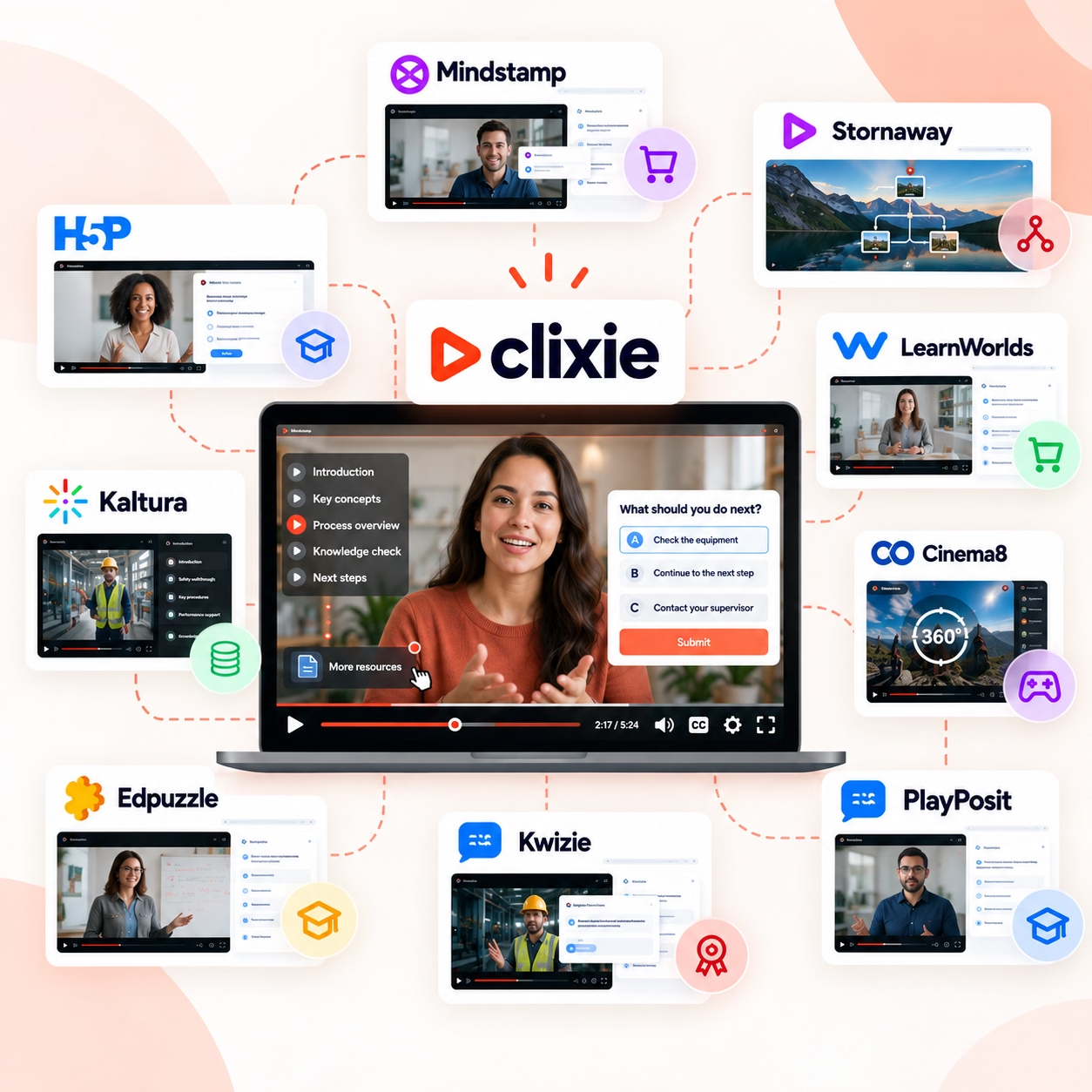
- Tools like Clixie AI let you transform any video into an interactive training experience with quizzes, branching scenarios, hotspots, and real-time analytics, all without writing code or re-filming content.
The Training Engagement Crisis (And Why You Can't Ignore It)
Only 20% of employees worldwide were engaged at work in 2025, according to Gallup's 2026 State of the Global Workplace report. That's the lowest level since 2020, and it's costing the global economy an estimated $10 trillion in lost productivity every year.
Now layer this on top: organizations spend over $350 billion globally on training (Harvard Business Review), yet 70% of employees say they lack mastery of the skills needed to do their jobs well (Gartner). Something is fundamentally broken.
The gap between delivering training and producing actual learning outcomes has a name: training engagement. And closing that gap is no longer a "nice-to-have" for L&D teams. It's the difference between training that transforms performance and training that wastes everyone's time.
This post breaks down exactly what training engagement means, how it differs from surface-level participation, what video engagement rate is (and how to calculate it), and how interactive video, specifically tools like Clixie AI, is changing the equation entirely.
What Is Training Engagement?
Training engagement is the level of active mental, emotional, and behavioral involvement a learner demonstrates during a training program. It goes beyond attendance and completion rates to measure whether someone is actually absorbing, processing, and connecting with the material.
Think of it this way: a learner who watches a 30-minute compliance video while answering emails is "completing" training. A learner who pauses the video to answer an embedded quiz, clicks a hotspot to explore a scenario deeper, and scores 90% on the assessment is engaged in training. Same video, completely different outcomes.
The Three Dimensions of Training Engagement
Training engagement isn't a single metric. According to research from Docebo and TalentLMS, it operates across three distinct dimensions:
Here's the critical insight most L&D teams miss: behavioral engagement alone is misleading. A learner can complete an entire course without improving a single skill. According to research from TalentLMS, 64% of employees multitask during online training sessions, responding to emails or checking notifications. They're behaviorally present but cognitively absent.
Training engagement isn't about checking a box. It's about whether learners are mentally invested enough to retain and apply what they've learned. If you're only measuring completion rates, you're measuring the wrong thing.
What Is Engagement in Training? Why It Actually Matters
Engagement in training refers to the extent to which participants are actively involved in the learning process, encompassing their mental, emotional, and behavioral investment, not merely their physical or online presence. When we talk about "engagement in training" versus general "employee engagement," the distinction matters: we're specifically measuring learning quality, not overall job satisfaction.
The Business Cost of Low Training Engagement
The numbers paint a stark picture:
- Only 12% of employees actually apply the skills learned in training programs to their jobs (360Learning). That means 88% of your training investment is producing negligible ROI.
- Up to 70% of newly learned material is lost within days without reinforcement, according to the Forgetting Curve theory (Docebo).
- Only 25% of respondents to a McKinsey survey believed that training has measurably improved their performance.
These aren't abstract statistics. For every dollar your organization spends on passive, low-engagement training, roughly $0.88 is wasted. The training gets delivered, the compliance checkbox gets ticked, and nothing changes on the job.
Why the Forgetting Curve Is Your Biggest Enemy
The Forgetting Curve, first described by Hermann Ebbinghaus, shows that people start forgetting information almost immediately after learning it. Without active reinforcement, learners retain as little as 30% of material after just a few days.
This is exactly where engagement changes the equation. When learners actively interact with content (answering questions, making decisions, receiving immediate feedback), they create stronger memory pathways. The act of retrieval, of being forced to recall and apply what you just watched, is one of the most powerful learning mechanisms we know.
This is why passive video training fails, and interactive video succeeds. But more on that shortly.
The Role of Video in Training Engagement
Video has become the dominant format for corporate training, and the data backs it up. According to Research.com, e-learning increases learner retention rates to 82%, and 70% of employees prefer online, self-paced courses as their learning mode (LinkedIn Learning). Video combines visual and auditory channels, which aligns with Dual Coding theory: information processed through both systems is easier to encode and recall.
The Problem with Passive Video
But there's a catch. Not all video training is created equal.
A landmark study by Guo, Kim, and Rubin (2014), analyzing 6.9 million video-watching sessions on the edX platform, found that median viewer engagement drops sharply after just 6 minutes. That means your 45-minute training recording is losing most of its audience before the 10-minute mark.
The same research found that:
- Videos under 3 minutes had the highest engagement, with 75% of viewers watching at least three-quarters of the content.
- Khan-style tutorials (tablet-drawn visuals with narration) kept viewers engaged 1.5 to 2 times longer than traditional PowerPoint recordings.
- Videos followed by embedded quiz questions generated significantly higher engagement and retention.
The takeaway is clear: passive, long-form video is a broken training format. Pressing play and hoping for engagement is not a strategy.
The Shift to Interactive Video
Interactive video solves the passive problem by requiring learners to do something while watching. Instead of a one-way broadcast, the video becomes a two-way conversation. Learners answer questions, click hotspots, choose branching paths, and navigate at their own pace.
According to a study by Kaltura, interactive videos with quizzes, clickable elements, and branching scenarios boost engagement rates by 66% compared to passive video. Research from Interakly shows that interactive videos see completion rates 20-40% higher than non-interactive equivalents.
This isn't a marginal improvement. It's a fundamentally different approach to training delivery.
What Is Video Engagement Rate?
Video engagement rate is a metric that quantifies how actively viewers interact with video content, expressed as a percentage of total views. Unlike a simple view count, which only tells you how many people pressed play, engagement rate reveals how many people actually did something meaningful with the content.
Training Video vs. Social Media: Different Engagement Signals
On social media, "engagement" typically means likes, comments, shares, and saves. In a training context, the signals that matter are different:
This distinction is important. A training video with a 95% completion rate but zero quiz interactions tells a very different story than one with 85% completion and 90% quiz participation. In training, the quality of engagement matters more than the quantity of views.
Key metrics for training video analytics
How to Calculate Video Engagement Rate
The standard formula for video engagement rate is: Video Engagement Rate = (Total Engagements / Total Views) × 100. This gives you a percentage representing the proportion of viewers who actively interacted with the video.
Step-by-Step Calculation
- Count total engagements. In a training context, this includes quiz responses, hotspot clicks, chapter navigation, button clicks, bookmarks, form submissions, and any other tracked interaction.
- Count total views. This is the number of unique video plays (not impressions). Some platforms count a "view" after a minimum watch threshold, like 3 or 10 seconds.
- Divide engagements by views, multiply by 100.
Example: Your onboarding video received 500 views. Across those views, learners generated 1,200 total interactions (quiz answers, hotspot clicks, chapter jumps). Your engagement rate is: (1,200 / 500) × 100 = 240%. An engagement rate above 100% means viewers are generating multiple interactions per view, which is a strong indicator of active learning.
Three Ways to Slice Video Engagement
For training purposes, I recommend the weighted engagement approach. Not all interactions are equal. A correct quiz answer signals deeper cognitive engagement than a simple chapter click. Weighting your formula lets you distinguish between surface-level navigation and genuine learning behavior.
Benchmark Data
According to Umbrex research, the average video engagement rate across platforms typically ranges from 1% to 5% for standard video. However, interactive training videos consistently outperform this baseline. The Kaltura study found that interactive elements boost engagement by 66%, and Spiel Creative reports that interactive video content achieves an average engagement rate of 66% overall.
How Interactive Video Transforms Training Engagement
Interactive video doesn't just improve engagement metrics. It fundamentally changes how learners process and retain information. Here's what the research shows:
The Evidence
20-40% higher completion rates. According to research compiled by Interakly, interactive videos see completion rates 20-40% higher than passive equivalents. The mechanism is behavioral momentum: once a learner has answered a few questions, they've made micro-commitments that make them more likely to finish.
Up to 66% higher engagement. The Kaltura study found that interactive elements (quizzes, clickable hotspots, branching scenarios) boost overall engagement rates by 66%. That's not a rounding error. It's a transformation.
Up to 60% improvement in knowledge retention. Multiple studies show that interactive video can improve retention by up to 60% compared to traditional e-learning methods. This aligns with the testing effect in cognitive psychology: being tested on material during learning strengthens memory more than simply re-reading or re-watching.
User activity increases by over 590%. Research from Spiel Creative shows that user activity (clicks, answers, choices, form submissions) jumps dramatically when passive video is replaced with interactive content. More activity means more data points, which means better insights for your L&D team.
Why It Works: The Psychology
Three psychological principles explain why interactive video outperforms passive content:
1. The Testing Effect. Embedded questions force learners to retrieve information from memory, which strengthens retention. Critically, the benefit extends beyond the questions themselves: learners pay more attention to content between questions because they anticipate being tested.
2. Micro-Commitments and Behavioral Momentum. Each interaction a learner completes builds momentum. A learner who has answered three questions in the first five minutes is psychologically invested in finishing the video. This is why interactive videos have dramatically lower drop-off rates.
3. Learner Autonomy. Branching scenarios and navigation menus give learners control over their path. Research on self-determined learning consistently shows that perceived autonomy increases both motivation and satisfaction, especially for adult learners in professional settings.
How Clixie AI Solves the Training Engagement Problem
Knowing that interactive video works is one thing. Building it without a production studio, a team of developers, or a six-figure budget is another. That's where Clixie AI comes in.
Clixie AI is an AI-powered interactive video platform that transforms any video or audio file into a dynamic, interactive training experience, without writing code or re-filming content. You upload your existing videos (including Zoom, Webex, or Teams recordings), and Clixie's AI engine auto-generates chapters, transcriptions, and interactive elements. From there, you customize with a drag-and-drop authoring tool.
Key Features That Drive Engagement
Quizzes and Assessments. Embed multiple-choice, true/false, and multi-answer questions directly inside your videos. Clixie can dynamically show different content based on quiz scores, creating personalized learning paths without manual branching.
Hotspots and Clickable Areas. Add call-to-action icons or invisible clickable zones that trigger actions: opening supplemental resources, jumping to a different chapter, displaying additional context, or linking to external tools. Hotspots can even follow objects in the video.
Branching Scenarios. Build decision-tree narratives where learner choices shape the experience. Perfect for compliance training, sales role-play, conflict resolution, or any scenario where "what would you do?" matters more than "what should you know?"
AI-Powered Auto-Chaptering and Summarization. Clixie's AI automatically segments your video into logical chapters with summaries. Learners can navigate directly to the section they need, reducing friction and improving relevance.
Gamification with Badges. Incentivize completion and performance with badges, leaderboards, and rewards. Gamified elements transform mandatory training from a chore into a challenge.
Real-Time Analytics Dashboard. This is where Clixie truly differentiates. The "Data-at-a-Glance" dashboard gives you micro-level and macro-level engagement data: who watched what, where they hesitated, which quiz questions tripped them up, which branching paths they explored, and where your content loses attention. You don't just measure completion. You map the entire cognitive journey.
Multilingual Support. Clixie automatically translates all interactive elements (transcript, captions, quizzes, chapter titles, summaries) into 40+ languages using AI-generated voiceovers and subtitles. Global teams get localized, interactive training without separate production runs.
LMS Integration. Clixie supports 20+ LMS platforms natively, including Canvas, Blackboard, Moodle, Brightspace, and Docebo, through SCORM 1.2, SCORM 2004, LTI, xAPI, and custom APIs. Integration typically takes about 10 minutes.
Real-World Results: Grupo DASS Case Study
Grupo DASS, a leading Latin American retailer, used Clixie to revamp their sales training across three languages. Instead of static video playlists, they built interactive videos with chapters, bookmarks, quizzes, and branching dialogue. The result: more engaged learners, higher knowledge retention, and a streamlined onboarding process that scaled across departments and geographies.
Before implementing interactive video, we faced the same industry-wide challenge where up to 72% of employees fail to fully engage with conventional, linear training content. However, after transitioning our basic video library into a dynamic, gamified learning portal using Clixie—mirroring the approach taken by Grupo DASS for their 28,000 employees—we saw a complete transformation in our retail sales training. By integrating interactive quizzes, chapter navigation, and in-video bookmarks, our sales force transitioned from passive viewers to active participants. This shift drastically improved our time-to-competency; our teams spent significantly less time bogged down in training while actually retaining more critical product knowledge, ultimately allowing them to spend more time on the floor driving sales.
FAQ
Q: What is a good training video engagement rate?A: For standard passive video, engagement rates typically range from 1-5% (Umbrex). Interactive training videos consistently perform much higher, with studies showing average engagement rates of 66% (Kaltura). If your training videos are below 10% engagement, adding interactive elements like quizzes and hotspots can dramatically improve performance.
Q: How is training engagement different from employee engagement?A: Employee engagement measures a worker's overall commitment, motivation, and emotional connection to their organization and role. Training engagement is narrower: it measures how actively a learner participates in and absorbs a specific training experience. You can have a highly engaged employee who is completely disengaged during a poorly designed training session, and vice versa.
Q: Can I make existing videos interactive without re-filming?A: Yes. Platforms like Clixie AI are specifically designed for this. You upload your existing video files (including Zoom, Webex, and Teams recordings), and the AI automatically generates chapters and transcriptions. You then add quizzes, hotspots, branching paths, and other interactive elements using a no-code, drag-and-drop interface.
Q: What interactive elements improve training engagement the most?A: Research consistently shows that embedded quizzes have the highest impact on both engagement and retention. The testing effect forces active recall, which strengthens memory. Branching scenarios rank second, especially for soft skills and decision-making training. Hotspots and clickable resources add supplemental value but are most effective when combined with quiz-based interactions.
Q: How do I track training engagement across multiple LMS platforms?A: Use a platform that supports xAPI (also known as Tin Can API), which tracks granular learner interactions across any LMS or learning environment. Clixie AI supports xAPI alongside SCORM and LTI standards, so engagement data flows into your existing reporting infrastructure regardless of which LMS your teams use.
What to Do Next
Training engagement isn't a soft metric. It's the bridge between spending money on training and actually getting results from it. With only 20% of employees engaged globally and 88% of training failing to transfer skills to the job, the status quo is expensive.
Here's your action plan:
First, audit your current metrics. If you're only tracking completion rates, you're flying blind. Start measuring cognitive engagement signals: quiz scores, interaction rates, and time spent per section.
Second, stop relying on passive video. The research is unambiguous. Passive, long-form video loses most learners within 6 minutes. Add interactive elements, at minimum embedded quizzes every 60-90 seconds, to transform watching into learning.
Third, use the right tool. Platforms like Clixie AI let you convert your existing video content into interactive, measurable training experiences without a production team or technical skills. The analytics alone will change how you think about L&D.
The gap between "training delivered" and "training that works" is engagement. Close it.
.png)
.png)