


The 10-20-70 Rule for AI: Key Frameworks, Rules & Principles Every L&D Leader Should Know
BCG's 10-20-70 rule shows 74% of AI programs fail because they ignore people. Learn the golden rule, 4 pillars, and 30% rule — and fix your training program.


TL;DR
- BCG research shows 74% of companies fail to scale AI value — and the fix is almost never a better algorithm.
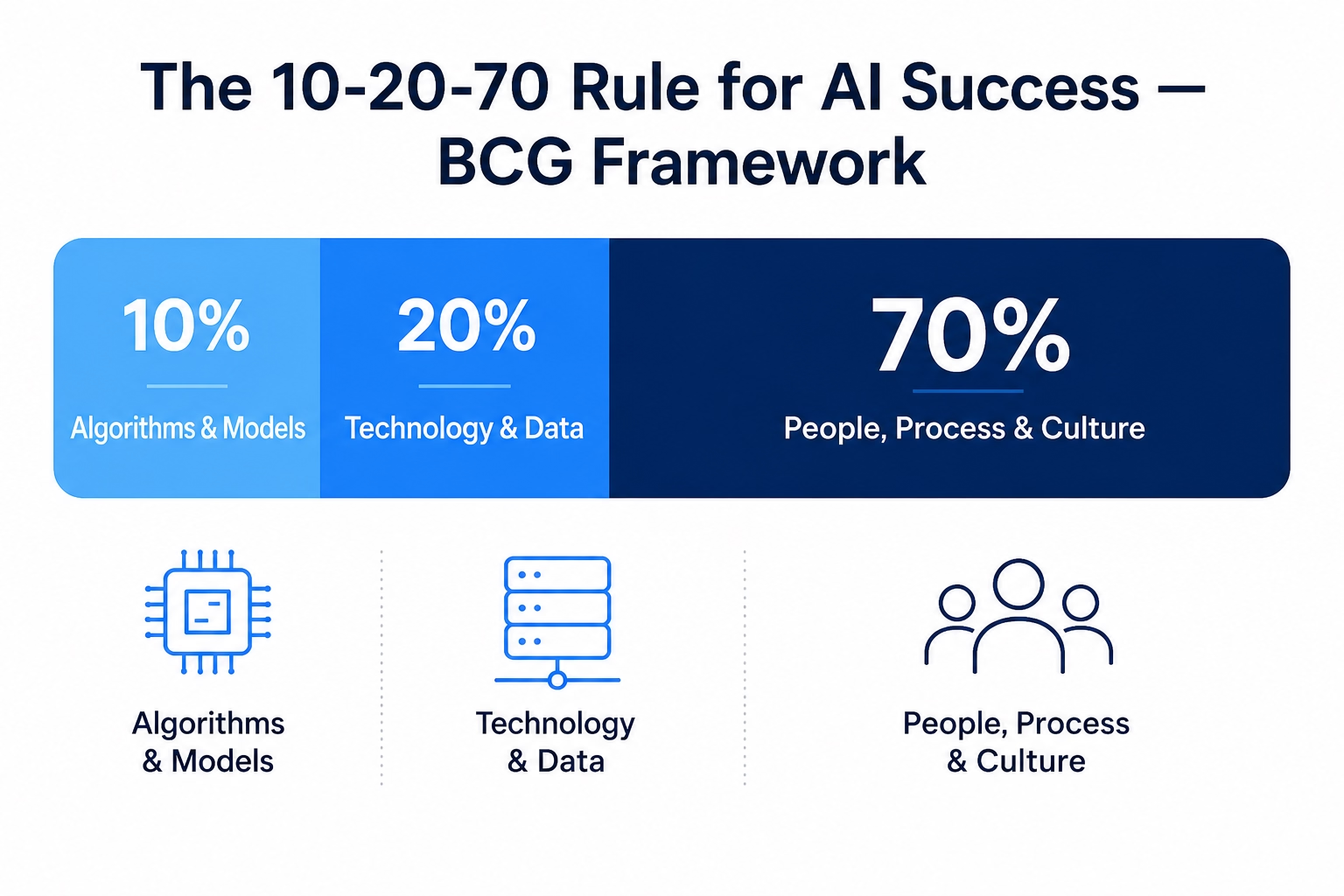
- The 10-20-70 rule says allocate 10% of effort to AI models, 20% to technology, and 70% to people and process change.
- The golden rule of AI is simple: transform your workflows and people before you deploy the tools.
- The 4 pillars of AI governance are transparency, accountability, safety, and fairness — every L&D program must reflect all four.
- The 30% rule sets a human-judgment floor: AI should never author more than 30% of your training output.
Key Takeaways
- The 10-20-70 rule is a BCG-originated AI deployment framework that allocates 10% of effort to algorithms, 20% to technology, and 70% to people and process transformation.
- The golden rule of AI is a strategic principle stating that organizations must redesign workflows and build human capability before deploying AI tools to generate measurable returns.
- The 4 pillars of AI are core governance principles — transparency, accountability, safety, and fairness — that define how responsible AI systems must behave across organizations.
- The 30% rule in AI is a human-AI collaboration guideline that caps AI-generated output at 30%, ensuring human judgment, critical thinking, and original research remain the dominant force.
- The 4 principles of AI ethics, as defined by OECD and UNESCO, are inclusivity, transparency, accountability, and robustness — the backbone of any responsible AI training program.
- Clixie.ai is an interactive video platform that operationalizes the 70% people-and-process layer by converting passive training content into branching, decision-based learning experiences that drive measurable behavior change.
Introduction
Here is the stat that should stop every L&D leader cold: according to BCG's landmark 2024 research, 74% of companies fail to achieve and scale value from AI — and only 4% create substantial value from their investments. The technology works. The models are good. The tools are genuinely capable. So why are three out of four organizations stuck?
The answer is almost never the algorithm. It is almost always the 70% that most programs ignore: the people, the processes, the behavior change infrastructure that determines whether a workforce actually uses AI in ways that move the business forward.
That is precisely what the 10-20-70 rule addresses — and why every L&D and HR leader needs to understand it deeply. The same goes for the other four frameworks this article covers: the golden rule of AI, the 4 pillars of AI governance, the 30% rule, and the 4 principles of AI ethics. Together, they form a complete strategic map for anyone responsible for building an AI-ready workforce.
Understanding what the AI-powered workforce actually demands from L&D is the first step. Knowing what training engagement actually means — and how to measure it is the second. This article gives you the frameworks to connect both.
Already running an AI training program? See how Clixie's interactive video platform helps L&D teams execute the 70% people layer — the part most programs get wrong.Book a 20-minute demo →
What Is the 10-20-70 Rule for AI?
The 10-20-70 rule is a BCG-originated AI deployment framework showing that successful transformations allocate 10% of effort to algorithms, 20% to technology infrastructure, and 70% to people, culture, and process redesign — not the other way around.
BCG developed this framework after studying AI adoption patterns across hundreds of organizations. Their 2024 research made the magnitude of the gap impossible to ignore: 74% of companies struggle to scale AI, and when BCG's teams traced the failure point, roughly 70% of the problems were people- and process-related, 20% were technology problems, and only 10% involved the algorithms themselves.
Think about what that means in practice. Most L&D programs — and most IT departments — spend their AI budget in exactly the opposite ratio. They allocate the lion's share to tools, platforms, and models, then treat the human adoption layer as a footnote: a two-hour onboarding session, a PDF guide, maybe a webinar.
Layer BCG RecommendsWhere Most Organizations Actually SpendAlgorithms / Models10%~30%Technology / Data Infrastructure20%~40%People, Process & Culture70%~30%
The inversion is the problem. Organizations are investing hardest in the layer that matters least for outcomes, and investing least in the layer that determines whether the whole program delivers.
Trust Insights, writing in April 2026, put it plainly: the 10/20/70 rule "flips the common assumption" because success depends far more on people and processes than on the sophistication of the technology. The algorithm is rarely the binding constraint. The workforce is.
In working with L&D teams across the tech and financial sectors, the pattern is incredibly consistent: the IT tool rollout goes perfectly, but the adoption curve completely flatlines within a month. The most common complaint I hear on discovery calls is, "We bought organization-wide AI licenses for our entire department, but six months later, they are still only using it to draft basic emails." The organization successfully deployed the 20% technology layer, but because they abandoned the 70% behavior change layer, they are paying full-license prices for a glorified spellchecker.
Why L&D Leaders Own the 70% Layer
The 70% people-and-process layer is the highest-leverage zone in any AI program — and it falls almost entirely within the remit of L&D and HR leaders, not IT.
This is not a technology handoff. IT can build the infrastructure. The model vendor can deliver the tools. Only L&D can change the behavior of a workforce at scale.
The macro data underlines just how high the stakes are. According to the World Economic Forum's Future of Jobs Report 2025, nearly 60% of the global workforce will need upskilling or reskilling by 2030, and 77% of employers say they plan to address it through workforce development. That is not a small program. That is an organizational transformation — and it lands squarely on L&D's desk.
Meanwhile, the failure signals are flashing. NTT DATA's 2024 research found that between 70% and 85% of generative AI deployments are failing to meet their desired ROI — not because the technology is flawed, but because the human adoption architecture wasn't built to support real behavior change.
The budget math makes this concrete. If your total AI program spend is $100,000, the 10-20-70 rule prescribes the following:
LayerRule-Based AllocationWhere Most Teams Actually SpendAlgorithms / Models$10,000~$30,000Technology / Data$20,000~$40,000People / Process$70,000~$10,000
That $60,000 gap in the people layer — replicated across every AI program in your organization — is where most AI investment quietly bleeds out. The tools get bought. The behavior never changes. The ROI never arrives.
The 70% layer has three specific obligations for L&D:
- Capability building — giving employees the skills to use AI tools correctly, critically, and confidently.
- Behavior change — redesigning workflows so that AI outputs are actually incorporated into daily decisions, not viewed with skepticism or bypassed entirely.
- Confidence calibration — helping employees develop the judgment to know when to trust AI outputs and when to override them.
Passive training formats — one-and-done LMS modules, recorded webinars, static slide decks — cannot reliably deliver any of these three outcomes. They are built for information transfer. What the 70% layer demands is decision-making practice, repetition under realistic conditions, and feedback loops.
That is why scenario-based learning that actually changes behavior is increasingly the standard for high-stakes AI training programs — not a nice-to-have, but the correct delivery format for the problem.
What Is the Golden Rule of AI?
The golden rule of AI is a strategic principle stating that organizations must first redesign their workflows and build genuine human capability before deploying AI tools — because AI amplifies whatever is already present, and if the underlying skills are weak, the amplification makes things worse, not better.
The sequence matters enormously. The version that wins looks like this:
Process redesign → Role clarity → Capability building → Tool deployment → Iteration
The version that fails:
Tool purchase → Mandate adoption → Hope for behavior change
Most organizations run the second sequence. They buy the tool, announce the rollout, and expect adoption to follow. It rarely does. Employees who haven't been prepared to use AI critically — who haven't had their workflows redesigned to incorporate it, who haven't practiced the judgment calls that AI outputs demand — treat the tools as optional, experimental, or untrustworthy. Adoption flatlines within 90 days.
The golden rule reframes AI as a multiplier, not a magic fix. A well-structured sales team with strong discovery skills becomes dramatically more effective with AI-powered call intelligence. A poorly structured team with weak discovery skills becomes more consistently bad at scale, because the AI is now reinforcing the wrong behaviors across every rep.
For L&D, the practical implication is clear: training must precede rollout, not follow it. The pre-deployment window is where L&D earns its seat at the AI strategy table — by ensuring that by the time the tools go live, the people using them have the judgment, the vocabulary, and the confidence to use them well.
We recently saw this "adoption tax" play out with a mid-sized healthcare network. They deployed a generative AI documentation tool to their administrative staff first, and followed up with a static training module a week later. The result was chaos: error rates spiked, trust in the tool plummeted, and it took them nearly 14 weeks to reach baseline utilization. By contrast, when we helped another division in the same network run Clixie's interactive, scenario-based training before their rollout, they bypassed the adoption tax entirely and hit full, confident utilization in just 3 weeks.
The Fair Counter-Case: When Process Focus Slows Innovation
The golden rule has a well-founded critic, and the objection is worth taking seriously. In fast-moving competitive environments — where a 90-day process redesign cycle means a rival ships first — front-loading the people layer can feel like a recipe for paralysis. Some innovation theorists argue that moving fast and accepting a messy adoption curve is preferable to waiting for a perfect training program that never arrives.
The honest answer: the critics are right about the risk, but wrong about the remedy. The antidote to over-preparing is not skipping preparation — it is scoping it correctly. A minimum viable behavior-change program covers the specific skills, workflows, and judgment calls that matter most for the first use case, and nothing else. It does not require a six-month change management initiative. The healthcare case above took three weeks. That is faster than most organizations take to finalize a software procurement decision.
The deeper issue is that "move fast" programs often create invisible debt. The adoption failure arrives 90 days later, after the rollout announcement has been made and the ROI case has been presented to leadership. Recovering from low utilization — rebuilding trust in a tool a workforce has already written off — takes far longer than a focused pre-deployment sprint. In most cases, the "slow down to prepare" path is actually the faster route to real utilization.
What Are the 4 Pillars of AI?

The 4 pillars of AI are the governance principles — transparency, accountability, safety, and fairness — that define how responsible AI systems must be built, deployed, and evaluated inside any organization.
These four pillars show up consistently across the major international AI governance frameworks, including the OECD AI Principles (most recently updated in 2024) and UNESCO's Recommendation on the Ethics of Artificial Intelligence. They are not compliance checkboxes. They are design principles — and every L&D leader building an AI training program needs to understand what each one demands in practice.
Transparency
Stakeholders must be able to understand how an AI system reaches its conclusions. For L&D, this means communicating clearly to learners which elements of their training program were designed or generated with AI, how decisions about content are made, and how performance data is used. Learners who don't trust the system don't engage with it.
Accountability
There must be clearly defined ownership of AI decisions and their outcomes. In training programs, this means L&D leaders are accountable not just for deploying AI-generated content, but for the behaviors and competencies that content is meant to produce. "The AI wrote it" is not an acceptable defense when a training program produces incorrect or harmful guidance.
Safety
AI systems must be reliable, secure, and unlikely to cause harm. For training content specifically, this means human review of all AI-generated learning materials before deployment — checking for factual errors, outdated information, bias in language, and gaps in coverage that a model won't flag on its own.
Fairness
AI must not perpetuate or amplify existing bias. In practice, L&D teams need to audit AI-generated training content for representation gaps, language accessibility, and cultural assumptions that may disadvantage certain employee groups. A compliance training module that uses industry jargon inaccessible to frontline workers is a fairness failure, even if the AI followed instructions correctly.
[CALLOUT BOX: "The 4 pillars are not compliance checkboxes — they are design principles. Build them into your training program architecture from day one, not as a legal review at the end."]
Bottom line: if your AI training program cannot pass the four-pillar test on paper, it will not survive contact with a real workforce — or a regulator.
What Are the 4 Principles of AI Ethics?
The 4 principles of AI ethics, as codified by the OECD and UNESCO, are inclusivity, transparency, accountability, and robustness — the operational standards every responsible AI training program must demonstrate.
Many articles treat "pillars" and "principles" as synonyms. They are not. The pillars describe the governance architecture — the structural properties an AI system must have. The principles describe the operational standards — the behaviors an organization must demonstrate to show that governance is actually working. The distinction matters because you can have all four pillars on paper and still fail on every principle in practice.
Here is how each OECD principle translates to L&D decision-making:
Inclusivity means AI systems must support inclusive growth and human well-being — not just for the most technically literate employees, but for the entire workforce. For L&D, this is a direct challenge to programs that focus AI training exclusively on knowledge workers, managers, or high-potential employees. If 60% of your workforce needs upskilling by 2030 (WEF, 2025), the 60% includes frontline, hourly, and non-English-speaking employees. Inclusive AI training reaches all of them.
Transparency and explainability means AI systems should be interpretable. For L&D, this means not just telling employees "we use AI in our training platform," but explaining what data is collected, how it's used, and how employees can access or contest it.
Robustness and safety means AI systems must be reliable and resistant to manipulation or failure. Training content generated or curated by AI must be tested for accuracy before deployment, not assumed to be correct because it was produced efficiently.
Accountability means someone must be responsible for AI outcomes. In L&D, that is the program owner — not the vendor, not the algorithm, and not the IT team that set up the integration.
One governance development that L&D leaders in regulated industries cannot ignore: the EU AI Act entered into force in August 2024, with substantive obligations beginning in February 2025. If your organization deploys AI tools that influence hiring, performance evaluation, or employee development decisions, you likely have compliance obligations already in effect.
Bottom line: the distinction between pillars and principles matters — pillars tell you what to build, principles tell you whether it's actually working.
What's the 30% Rule in AI?
The 30% rule in AI is a human-AI collaboration guideline stating that no more than 30% of any work product should be AI-generated — the remaining 70% must reflect human judgment, research, and original critical thinking.
According to WisdomPlexus, the rule draws a clear line: AI handles roughly 70% of repetitive, pattern-matching, data-heavy tasks, while humans retain ownership of the 30% that requires creativity, ethical judgment, nuanced interpretation, and relationship context. In the context of L&D specifically, the rule creates a useful guardrail against a failure mode that is becoming more common: training content that is fast to produce, technically coherent, and genuinely wrong in the ways that matter most.
Here is how the 30% rule applies across the three core L&D functions:
Course design. AI can generate a course outline, draft module scripts, and suggest assessment questions in minutes. That is a genuine productivity gain. The 30% rule says the human must then validate every claim against actual job requirements, enrich the content with real examples and first-hand expertise, and make the editorial judgments that give the program credibility with learners who know the domain.
Assessment design. AI can propose test questions. Human designers must verify that those questions are genuinely diagnostic — that they test for the judgment and decision-making a role requires, not just the ability to recall a definition.
Facilitation and coaching. AI can flag knowledge gaps in real time, surface patterns across learner cohorts, and identify where a training program is losing people. Human facilitators must respond to those signals, coach the outliers, and build the trust that makes people willing to try new behaviors.
The reason the 30% rule matters so much for L&D is that training content that is 100% AI-generated cannot carry first-hand expertise, real client stories, or the nuanced judgment that makes learning transfer happen. Learners can tell the difference. The question of why static training videos are no longer enough — in either their production or their delivery format — is worth asking before the next program launch.
Bottom line: use AI to build faster, but use human judgment to build better — the 30% rule is the line between the two.
Case Study: What Executing the 70% Layer Actually Looks Like
Most L&D teams have the 10% covered and the 20% sorted — but almost none have deliberately designed the 70% layer that determines whether any of it sticks. The pattern that closes that gap consistently involves three things: pre-training diagnostics, decision-forcing practice during training, and post-training reinforcement with measurable feedback loops.
Here is what each phase looks like when organizations build the 70% layer properly, illustrated through Clixie's interactive video platform — the tool used in both the healthcare and logistics cases referenced in this article.
The platform addresses the 70% layer in three specific phases:
Before training begins, interactive video briefings assess current AI literacy across the workforce, surface individual knowledge gaps before the formal program launches, and create a baseline that lets L&D teams personalize what each learner needs — rather than running everyone through the same generic module.
During training, branching scenario modules force real decision-making. Instead of watching an explainer video about how to review AI-generated outputs, a learner must actually decide: "This AI recommendation contradicts my judgment based on what the customer just told me. What do I do?" The branching path captures the decision, provides immediate feedback, and adjusts the next content block based on the response. This is how behavior change gets built — through practice under realistic conditions, not passive consumption of information.
After training ends, timed CTAs and check-in prompts embedded inside video content measure whether behavior change is holding 30, 60, and 90 days out. Most L&D programs have no visibility into what happens after the course completion certificate is issued. Clixie's analytics provide micro-level data: who revisited which modules, where learners hesitated, which branching paths surfaced the most confusion, and where the program is losing people.
The engagement data is hard to argue with. There is a reason why interactive video outperforms passive training in every category that matters for behavior change. Research.com's 2024 data shows interactive video delivers 2–3× higher engagement rates than linear video, and microlearning formats — the structure Clixie's modules are built around — achieve 80% completion rates versus 20% for long-form courses.
The most dramatic case in Clixie's track record: Google achieved a 3,500% increase in learner engagement after implementing Clixie's interactive platform to train its global partners on Android. That is not a marginal improvement. That is a different category of outcome.
One global logistics customer ran their company-wide AI onboarding through Clixie's branching video format and saw a 94% completion rate, compared to just 28% with their previous linear LMS video format. The real win wasn't just the completion metric — because their workforce was actually practicing realistic AI judgment calls inside the branching scenarios, the company reduced their time-to-first-productive-use from a sluggish four weeks down to just eight days.
Want a free interactive video template designed specifically for AI literacy training?We've built one around the 10-20-70 framework so your team can start executing the 70% layer immediately.Grab your free template →
FAQ
What is the 10-20-70 rule for AI?
The 10-20-70 rule for AI is a BCG-originated framework that allocates 10% of AI transformation effort to algorithms and model work, 20% to technology and data infrastructure, and 70% to people, process redesign, and culture change. BCG's 2024 research confirmed that roughly 70% of AI implementation failures trace to the people-and-process layer — the exact same layer the rule says organizations should invest in most heavily. For L&D leaders, this means the majority of an AI rollout budget should go toward training design, behavior change programs, and adoption infrastructure, not platform licenses.
What is the golden rule of AI?
The golden rule of AI is the principle that organizations must transform their workflows and build genuine human capability before deploying AI tools if they want measurable results. The sequence matters: process redesign and training must come first, tool deployment comes second. Organizations that reverse this order — buying the tool before preparing the people — consistently experience low adoption, wasted investment, and a workforce that treats AI as optional rather than essential.
What are the 4 pillars of AI?
The 4 pillars of AI are transparency, accountability, safety, and fairness. These governance principles, reflected in the OECD AI Principles and UNESCO's ethics framework, define the structural properties every responsible AI system must have. For L&D programs, they translate into specific design requirements: communicating clearly about AI use (transparency), owning the outcomes of AI-generated content (accountability), reviewing all AI content before deployment (safety), and auditing for bias and accessibility gaps (fairness).
What's the 30% rule in AI?
The 30% rule in AI is a human-AI collaboration guideline stating that no more than 30% of any work product should be AI-generated — the remaining 70% must come from human judgment, expertise, and original thinking. In L&D, this rule is a guardrail against over-reliance on AI-generated course content, assessment questions, and facilitation scripts. AI handles the pattern-matching and efficiency gains; humans provide the contextual expertise, real-world examples, and editorial judgment that make learning transfer happen.
What are the 4 principles of AI ethics?
The 4 principles of AI ethics, as defined by the OECD's 2024 updated framework, are inclusivity, transparency and explainability, robustness and safety, and accountability. These operational standards determine whether an organization's AI governance is actually working in practice, not just documented in policy. For L&D leaders, they set a clear benchmark: AI training programs must reach all employee segments (inclusivity), explain how AI is used in learning design (transparency), test content before deployment (robustness), and assign clear human ownership of outcomes (accountability).
Why do most AI transformation programs fail?
Most AI transformation programs fail because they underinvest in the 70% people-and-process layer and overinvest in technology and models. NTT DATA's 2024 research found that 70–85% of generative AI deployments miss their ROI targets — and the failure mode is almost always adoption-related, not technical. Employees who haven't been prepared to use AI tools critically, who haven't had their workflows redesigned to incorporate them, and who haven't practiced the judgment calls AI outputs demand, simply don't use the tools in ways that generate value.
How should L&D teams apply the 10-20-70 rule in practice?
L&D teams can apply the 10-20-70 rule by auditing their current AI program budget against the three layers, identifying where they are over-invested and under-invested, and reallocating accordingly. In practice, this typically means reducing spend on additional tool licenses and increasing investment in scenario-based training, behavior change programs, manager coaching for AI adoption, and reinforcement mechanisms that extend beyond the initial rollout. The goal is to build a workforce that can use AI tools confidently, critically, and consistently — not just a workforce that has access to them.
Conclusion
Every framework in this article points to the same truth: AI success is a human problem, not a technology problem.
The 10-20-70 rule tells you where to invest. The golden rule tells you the sequence that works. The 4 pillars give you the governance architecture. The 30% rule sets the human-judgment floor. The 4 principles give you the operational standards to hold yourself to. Together, they form a complete strategic map — not for the IT department, but for L&D and HR leaders who are the real architects of AI-ready organizations.
The stakes are not abstract. The World Economic Forum projects that 60% of the global workforce will need upskilling or reskilling by 2030. That clock is running. The question is not whether your organization will need to build AI capability at scale. The question is whether your training architecture is designed to actually deliver it — or whether it is built on formats and assumptions that will produce 20% completion rates and 60% forgetting curves.
Three things to do this week:
- Audit your current AI program budget against the 10-20-70 allocation. Where are you over-invested?
- Run a workforce AI readiness assessment before your next tool rollout. Find the gaps before they become adoption failures.
- Pilot one branching video scenario in your next AI module. Measure completion and decision-point data. Compare it against your current baseline.
Bring one AI training initiative that's stalled or underperforming.Book a 20-minute Clixie demo and we'll show you exactly where the 70% layer is breaking down — and how to fix it.Book your demo →
.png)
.png)




.avif)
