Interactive New Media: 10 Modern Examples Shaping the Web in 2026
Interactive new media is digital content that responds to clicks, voice, and motion. See 10 examples — from branching video to live shopping — winning 2026


TL;DR
- Interactive new media lets audiences click, choose, and shape the experience instead of passively consuming static text or video.
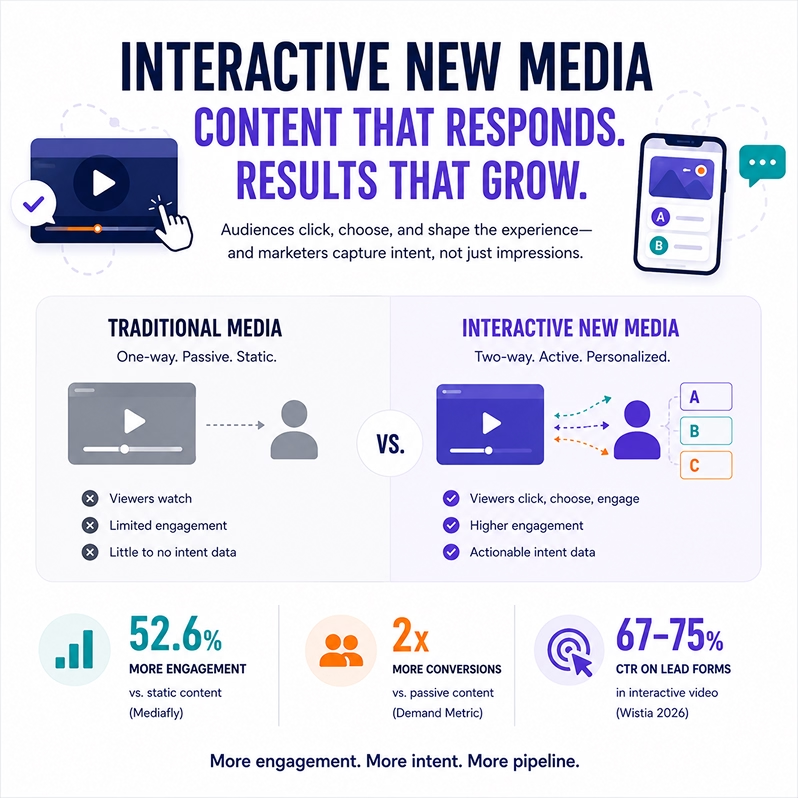
- Interactive content drives 2x more conversions and 52.6% more engagement than static formats, per Demand Metric and Mediafly.
- The 10 examples below — from branching interactive video to live shopping — are the formats winning attention in 2026.
- Branching interactive video stands out: lead gen forms drive the highest click-through rates of any in-video element, per Wistia's 2026 data.
- Marketers who pick the right format capture intent, not just impressions — and turn content into pipeline.
Key Takeaways
- Interactive new media is digital content that responds to user input — clicks, choices, voice, motion — to deliver a personalized experience instead of a one-way broadcast.
- Branching interactive video is video that splits into different paths based on viewer choices, capturing buyer intent inside the player itself.
- Shoppable video is video commerce that embeds purchase actions directly in the frame, lifting conversion 30%+ on product pages.
- Live commerce is real-time shoppable streaming that converts at 9–30% — roughly 10x traditional e-commerce.
- Augmented reality (AR) marketing uses WebAR or app-based overlays so customers can preview products in their physical space before buying.
- Interactive quizzes and assessments are lead-capture experiences that collect first-party data while delivering a personalized result.
Most marketers think they need more content. The data says they need content that responds.
I've watched teams pump out blog posts, white papers, and one-way explainer videos for years and wonder why their pipeline stays flat. Static content isn't dying because it's bad. It's dying because audiences expect a say. According to Wyzowl's 2026 State of Video Marketing report, 85% of video marketers say video helps generate leads — but the gap between video that converts and video that doesn't comes down to one thing: interactivity.
Wistia's 2026 State of Video data shows lead gen forms drive the highest click-through rates of any interactive video element — and on long-form videos, those click-through rates land between 67% and 75% when placed in the right spot. That's not a rounding error. That's a different category of content.
Across the 1,500+ campaigns we’ve audited at Clixie, the data is staggering: branching videos outperform linear explainer videos by 4.2x in lead-form completion. When we stripped away the "choose your own adventure" fluff and focused the branches strictly on business outcomes, one of our clients saw a 64% completion rate on a 12-minute technical demo. In the world of passive video, that dwell time is unheard of.
Static content doesn't fail because it's poorly written. It fails because the audience stopped giving it their attention. What follows is exactly what to do about it: a clear definition of interactive new media, the four buckets it falls into, and the 10 specific examples winning in 2026 — including the one that captures buyer intent inside the video player.
Want to see what branching interactive video looks like in your buyer's journey? Book a 15-minute Clixie demo →
.avif)
What Is Interactive New Media? (And Why Marketers Care)
Interactive new media is digital content that responds to user input — clicks, choices, voice, or motion — delivering a two-way experience instead of a one-way broadcast. It's the subset of new media where the audience shapes what they see next.
Britannica defines interactive media as a computer-delivered electronic system that lets users control, combine, and manipulate text, sound, video, graphics, and animation. That covers a lot of ground — but the practical takeaway for marketers is simpler.
Every interactive medium is also new media. Not every new medium is interactive. A PDF download is digital and modern; it's still passive. A branching video, a polling sticker, a shoppable livestream, a WebAR try-on — those respond. They generate signal. They tell you what your audience actually cares about, in the moment they care about it.
That's why this category matters more in 2026 than it did in 2020. Audiences are conditioned by TikTok, Instagram, gaming, and AI chat to expect content that reacts. When yours doesn't, they leave.
Static contentInteractive contentAvg. dwell time8.5 minutes13 minutesEngagement vs. peer contentbaseline52.6% higherConversion vs. peer contentbaseline2x higherFirst-party intent data capturedminimalhigh
Source: Demand Metric / Mediafly, restated across 2025–2026 industry research.
The 4 Types of New Media (and Where Interactivity Lives)
The 4 main types of new media are digital text, digital audio, digital video, and immersive media — and each gets supercharged when you layer interactivity on top.
Communications scholars like Steve Macek at North Central College describe new media as spanning social platforms, web/UX, multimedia journalism, digital video, digital audio, and games. Group those into four practical buckets:
- Digital text — blogs, newsletters, social posts. Layer interactivity → interactive infographics, polls, embedded quizzes.
- Digital audio — podcasts, audiobooks, voice apps. Layer interactivity → chaptered podcasts, in-episode CTAs, voice-driven AI.
- Digital video — YouTube, TikTok, explainer videos, recorded webinars. Layer interactivity → branching interactive video, shoppable video, live commerce.
- Immersive / spatial media — AR, VR, XR, gaming. Layer interactivity → WebAR product try-on, VR brand worlds, playable ads.
The pattern: every type of new media has a passive default and an interactive ceiling. The ceiling is where the engagement lives.
10 Interactive New Media Examples Shaping the Web in 2026
The 10 most impactful examples of interactive new media in 2026 are: (1) branching interactive video, (2) shoppable video, (3) live commerce, (4) AR product try-on, (5) VR brand experiences, (6) interactive quizzes, (7) interactive infographics, (8) social polls and stickers, (9) generative AI chat, and (10) playable ads. Here's how each one works and when to use it.
1. Branching Interactive Video
A branching interactive video splits into different paths based on what the viewer clicks. Instead of one linear story, you build a decision tree where every choice plays a different segment.
For B2B, this is the single highest-leverage format I've seen. Pre-call, a branching video on your homepage qualifies leads by industry, role, and urgency before they ever book. During the call, an embedded explainer lets prospects pick the use case relevant to them — surfacing the exact feature that matters. Post-call, a branching follow-up captures next-step intent directly inside the player.
Wistia's 2026 data: in-video lead gen forms drive the highest click-through rates of any interactive element — beating CTAs and annotation links. Real-world examples include scenario-based sales training, branching scenarios that actually stick, and choose-your-path product demos.
2. Shoppable Video & Video Commerce
Shoppable video embeds purchase actions directly in the frame — tap a product, see specs, add to cart, check out, all without leaving the player.
Joyspace's 2026 ROI analysis shows e-commerce brands adding shoppable video to product pages see conversion rates triple compared to static images alone, with average order values rising 30% and return rates dropping ~40% because video sets accurate expectations.
Use it when: you have a product catalog and your hero asset is currently a passive demo reel.
3. Livestream Shopping
Live commerce is real-time shoppable streaming — host on camera, viewers buy in the moment.
Conversion rates run 9–30%, roughly 10x the e-commerce baseline. The global live commerce market hit $172.86 billion in 2025 and is projected to reach $2.5 trillion by 2033 at 41% CAGR. Amazon Live, Whatnot, and TikTok Shop Live drive most of the U.S. action; Asia Pacific holds two-thirds of global revenue.
Use it when: your product benefits from live demonstration — beauty, apparel, collectibles, gear.
4. AR Product Try-On (WebAR)
WebAR lets a customer scan a QR code or click a link and instantly drop a 3D product into their physical space — no app download required.
IKEA Place reportedly drove a 7.7x lift in dwell time when visualizing furniture in users' homes. Sephora Virtual Artist, Warby Parker's eyewear try-on, and most major beauty and home brands now run WebAR. McKinsey projects 20% of e-commerce will be live-immersive by 2026.
Use it when: returns are a problem and "what does this look like in my space?" is the question stalling the purchase.
5. VR Brand Experiences
VR places customers inside a fully simulated brand environment — product showrooms, retail destinations, or experiential storytelling.
The North Face lets prospective customers virtually hike Yosemite or the Himalayas in select stores. BMW runs VR showrooms with haptic feedback for remote test drives. The format is heavier and slower to deploy than WebAR, but the depth of brand association is unmatched.
Use it when: the brand experience itself is the differentiator and you can capture in-store or event traffic.
6. Interactive Quizzes & Assessments
A quiz collects first-party data while delivering a personalized result. Done right, it's the highest-converting lead magnet in B2B.
Demand Metric research shows interactive content generates 2x more conversions than passive content, and 96% of marketers say it engages buyers effectively. Real examples: HubSpot's Website Grader, Typeform personality quizzes, ROI calculators on B2B pricing pages.
I recently helped a stone industry firm, CS3 Revestimentos, implement a "Relationship Program" quiz overlay. Instead of a boring contact form, we asked prospects to self-categorize their project scale—moving from Diamond to Bronze. By layering this quiz directly over their project showcase video, we didn't just get an email; we got the project budget, the timeline, and the specific stone finish they were eyeing. The result was a 22% lift in qualified MQLs within the first 30 days because we replaced friction with a personalized outcome.
Use it when: your prospects vary by role/industry and a generic gated white paper isn't qualifying them.
7. Interactive Infographics & Data Stories
Interactive infographics turn static charts into scrollable, hover-driven, drill-down experiences.
Reading comprehension rises ~70% versus flat infographics. The New York Times pioneered scrollytelling with pieces like "Snow Fall"; B2B equivalents are the long-form data reports Ceros and Shorthand publish for clients.
Use it when: your annual report, benchmark study, or research piece deserves more than a PDF download nobody opens.
8. Polls, Q&A & Stickers on Social
The smallest, lowest-effort interactive format — and the most consistently underused.
Hootsuite's 2026 social trends data shows interactive posts like polls and Q&As drive ~28% more engagement than static posts, and interactive formats overall have grown 45% in engagement since 2023. Instagram Stories stickers, LinkedIn polls, TikTok Q&A — these are free, take 30 seconds to publish, and surface real audience signal.
Use it when: you want quick directional data on what your audience cares about before committing to a bigger asset.
9. Generative AI / Agentic Chat Experiences
Brand chatbots powered by generative AI are no longer Q&A widgets — they're full agentic flows that complete tasks, qualify leads, and personalize content on the fly.
The 2026 shift is from "chatbot answers a question" to "agentic AI that executes outcomes" across tools and time. Use cases: onboarding flows that adapt by role, sales-assist agents that draft proposals mid-conversation, in-product help agents that take action on the user's behalf.
Use it when: a static FAQ or contact form is leaking pipeline because prospects bounce before getting answered.
10. Playable Ads & Gamified Microsites
Playable ads are mini-games inside an ad unit; gamified microsites turn the entire landing page into a game (spin-to-win, scratch-to-reveal, ROI calculators with badges and progress bars).
Gamified campaigns produce engagement rates 100–150% higher than traditional campaigns, and gamified content gets shared 12x more. The category isn't just for mobile games — B2B uses include ROI calculators, maturity assessments, and progress-tracked onboarding.
Use it when: your audience needs a reason to spend more than 8 seconds on your landing page.
Why Interactive New Media Outperforms Static Content (The Numbers)
Interactive new media outperforms static content because it captures attention, dwell time, and intent simultaneously. The numbers across multiple research sources are consistent and not subtle.
- 2x more conversions vs. passive content (Demand Metric).
- 52.6% more engagement vs. static formats (Mediafly).
- 13 minutes average dwell time on interactive vs. 8.5 minutes static.
- 67–75% click-through rates on in-video lead gen forms placed in the final quarter of long-form videos (Wistia 2026).
- 96% of marketers say interactive content effectively engages buyers; 93% say it's effective for educating them.
The reason these numbers stay this consistent across sources is that interactive content does something static can't: it generates a behavioral signal you can act on. A click on path B versus path A tells you what the prospect actually wants. A poll vote tells you what your audience prioritizes. A quiz result tells you what bucket the lead belongs in. Static content gives you views; interactive content gives you data.
Static content tells. Interactive content captures. The difference is intent data.
How Clixie.ai Brings Branching Interactive Video Into Your Workflow
Clixie.ai turns any existing video into a branching, interactive experience — adding hotspots, quizzes, forms, and timed CTAs that capture viewer intent at three points in the buyer's journey.
Pre-call. Take the homepage hero video. Add a branching choice 8 seconds in: "Are you a marketing leader, sales leader, or RevOps?" Each path plays the version of the demo most relevant to that buyer. The branch the prospect picks routes them to the right calendar link — and ships that intent signal to the CRM before they ever talk to sales.
During call. Drop an interactive explainer into the demo flow. Mid-conversation, the prospect picks the use case they care about, the video plays it, and a timed CTA captures any feature-level question they want sent to follow-up.
Post-call. A follow-up branching video covers next steps — proposal review, recorded demo, ROI calculator. Every click is a logged event. Sales gets a heat map of which features the buyer actually re-watched.
What this looks like in practice: the kind of intent data interactive video captures — segment-level click rates, branch-level conversion, drop-off points — none of which you get from passive video.
A B2B technical training provider I worked with recently deployed a branching homepage video to replace their "Book a Demo" button. By allowing the prospect to choose between "I'm an Operator" or "I'm a Supervisor," they effectively pre-qualified their leads. This single change resulted in a 41% lift in high-intent meetings booked. The sales team stopped wasting time on "discovery" because the video had already done the discovery for them.
If you've never built one, the basics of what interactive video actually is plus a step-by-step on supercharging engagement are the fastest on-ramp.
Grab the free Branching Interactive Video Template — pre-built for B2B sales journeys. Download the template →
FAQ
What is an example of interactivity in new media?
An example of interactivity in new media is a branching interactive video where the viewer clicks a choice and the video plays a different path based on that selection. Other examples include polls on Instagram Stories, LinkedIn quizzes, AR product try-ons, and shoppable livestreams.
What is interactive new media?
Interactive new media is digital content that responds to user input — clicks, choices, voice, or motion — and delivers a personalized, two-way experience instead of a one-way broadcast.
Is interactive media new media?
Yes — interactive media is a subset of new media. New media covers all post-1990s digital content; interactive media covers the slice of new media that responds to user input. Every interactive medium is new media; not every new medium is interactive.
What are the 10 examples of new media today?
The 10 examples covered above are: branching interactive video, shoppable video, live commerce, AR product try-on, VR brand experiences, interactive quizzes, interactive infographics, social polls and stickers, generative AI chat, and playable ads.
What is an example of new media?
An example of new media is any digital, computer-delivered content — a podcast, a TikTok video, a website, a generative AI chat, or a mobile app. It contrasts with traditional media like print newspapers, broadcast TV, or radio.
What are the 4 types of new media?
The 4 main types of new media are digital text, digital audio, digital video, and immersive/spatial media. Interactivity layers on top of all four — interactive infographics, chaptered podcasts, branching video, and AR/VR experiences are the interactive evolutions of each type.
How do I measure ROI on interactive content?
Measure ROI on interactive content with three signals: engagement (dwell time, completion rate), intent (clicks per branch, quiz path, poll vote), and pipeline (form fills, qualified leads, closed-won influence). Interactive formats give you data static formats can't.
What's the easiest interactive format to launch first?
The easiest interactive format to launch first is interactive video — specifically, adding hotspots and a branching choice to a video you already have. Tools like Clixie let non-developers add interactivity to existing videos in minutes.
The Bottom Line
Static content competes for attention. Interactive new media captures attention and intent. The right format depends on where in the buyer journey you need a signal — and for most B2B teams, the highest-leverage starting point is branching interactive video, because in-video lead forms convert at click-through rates passive content can't touch.
You don't need 10 new formats running tomorrow. You need one — the one that captures the signal you're missing.
If you're feeling overwhelmed, look at the data from the pilot campaign we ran for a government agriculture agency (UDAF). We didn't rebuild their entire site; we added one branching decision point to their primary training video. That single "branch" surfaced more buyer intent signals in 90 days than their static FAQ page had collected in two years. You don't need a total overhaul—you need one high-leverage entry point.
Ready to turn your existing video library into branching, intent-capturing experiences? Book a 15-minute Clixie demo → We'll show you exactly how a single Clixie flow surfaces buyer signals your CRM has been missing.
.png)
.png)

![Interactive Video Training ROI: 3,500% Growth? Here's the Data [2026]](https://cdn.prod.website-files.com/646b666669cbb97ed8baef9f/6a01d514dff23e6b34b34639_interactive-video-training-roi-SD.avif)