


Interactive New Media: 10 Modern Examples Shaping the Web in 2026
Interactive new media is digital content that responds to clicks, voice, and motion. See 10 examples — from branching video to live shopping — winning 2026.



TL;DR
- Interactive new media is digital content that responds to user input — clicks, choices, voice, or motion — replacing one-way broadcasts with two-way experiences.
- According to Demand Metric and Mediafly, interactive content drives 2x more conversions and 52.6% more engagement than static formats.
- The 10 examples below — from branching interactive video to live commerce — are the formats winning attention and pipeline in 2026.
- Branching interactive video stands out as the highest-leverage format for B2B because it captures buyer intent inside the player.
- The format you pick should match the buyer-journey signal you're trying to capture; one well-placed interactive asset usually beats five passive ones.
Key Takeaways
- Interactive new media is digital content that dynamically responds to user input — clicks, choices, voice, motion — and shifts the audience from observer to participant.
- Branching interactive video is video that splits into different paths based on viewer choices, capturing buyer intent inside the player itself.
- Shoppable video is video commerce that embeds purchase actions directly in the frame; Joyspace reports e-commerce brands triple their conversion versus static product pages.
- Live commerce is real-time shoppable streaming that converts at 9–30% — roughly 10x traditional e-commerce, per Grand View Research.
- Augmented reality (AR) marketing uses WebAR or app-based overlays so customers can preview products in their physical space before buying.
- Interactive quizzes and assessments are personalized lead-capture experiences that collect first-party data while qualifying buyers.
- The 4 types of new media are digital text, digital audio, digital video, and immersive media — and interactivity is the layer that turns each one into a pipeline asset.
Introduction
By 2026, interactive content drives 2x more conversions and 52.6% more engagement than static formats — yet 78% of B2B procurement decision-makers now refuse to engage with anything else. Most marketing teams are still pumping budget into the category buyers actively avoid.
I've watched this play out across hundreds of campaigns. Teams produce more blog posts, more white papers, more linear explainer videos — and pipeline stays flat. The problem isn't quality. The problem is that audiences conditioned by TikTok, gaming, and AI chat won't sit through a one-way broadcast. They expect a say.
According to Wyzowl's 2026 State of Video Marketing report, 85% of video marketers say video helps them generate leads — but the gap between video that converts and video that doesn't comes down to one variable: interactivity. Wistia's 2026 State of Video data shows in-video lead gen forms drive the highest click-through rates of any interactive element, hitting 67–75% on long-form videos placed in the right spot.
Across the interactive blueprints we've deployed at Clixie AI, branching videos consistently outperform linear assets by 3.5x in direct lead capture. When we apply a "design through subtraction" approach—stripping away the visual clutter and leaving just a single, qualifying decision point on the screen—viewers stay immersed, and the intent data flows directly into the sales pipeline.
Static content doesn't fail because it's poorly written. It fails because the audience stopped giving it their attention. What follows is the playbook: a clear definition, the four buckets new media falls into, and the 10 examples winning right now — including the one that captures buyer intent inside the video player itself.
Want to see what branching interactive video looks like in your buyer's journey? Book a 15-minute Clixie demo →
What Is Interactive New Media? (And Why Marketers Care)
Interactive new media is digital content that responds to user input — clicks, choices, voice, or motion — delivering a two-way experience instead of a one-way broadcast. It's the subset of new media where the audience shapes what they see next.
According to Britannica, interactive media is any computer-delivered electronic system that lets users control, combine, and manipulate text, sound, video, graphics, and animation. The practical takeaway: every interactive medium is also new media, but not every new medium is interactive. A PDF download is digital and modern; it's still passive. A branching video, a polling sticker, a shoppable livestream, a WebAR try-on — those respond. They generate signal.
That signal is the strategic point most marketers miss. Static content gives you views. Interactive content gives you data — segment-level click rates, branch-level conversions, drop-off points, quiz outcomes. Every piece of audience behavior is a sales-actionable input.
Source: Demand Metric / Mediafly, restated across 2025–2026 industry research.
.avif)
The 4 Types of New Media (and Where Interactivity Lives)
The four types of new media are digital text, digital audio, digital video, and immersive media — and interactivity is the layer that supercharges every one of them. The pattern is consistent: every type has a passive default and an interactive ceiling, and the ceiling is where the engagement and pipeline live.
According to communications scholar Steve Macek at North Central College, interactive media spans social platforms, web/UX, multimedia journalism, digital video, digital audio, and games. Group those into four practical buckets:
- Digital text — blogs, newsletters, social posts. Interactive layer → interactive infographics, polls, embedded quizzes, scrollytelling.
- Digital audio — podcasts, audiobooks, voice apps. Interactive layer → chaptered podcasts, in-episode CTAs, voice-driven AI assistants.
- Digital video — YouTube, TikTok, explainer videos, recorded webinars. Interactive layer → branching interactive video, shoppable video, live commerce.
- Immersive / spatial media — AR, VR, XR, gaming. Interactive layer → WebAR product try-on, VR brand worlds, playable ads.
The strategic move isn't to launch all four. It's to identify which type your audience already engages with, find the passive default, and replace it with the interactive equivalent.
10 Interactive New Media Examples Shaping the Web in 2026
The 10 leading examples of interactive new media in 2026 are branching video, shoppable video, live commerce, AR try-on, VR experiences, interactive quizzes, interactive infographics, social polls, generative AI chat, and playable ads. Each works in a different part of the buyer journey — here's how to pick.
1. Branching Interactive Video (hero example)
Branching interactive video splits into different paths based on what the viewer clicks, turning a linear story into a decision tree where every choice plays a different segment. It's the single highest-leverage format for B2B I've seen.
Pre-call, a branching video on your homepage qualifies leads by industry, role, and urgency before they ever book. During the call, an embedded explainer lets prospects pick the use case that matters to them. Post-call, a branching follow-up captures next-step intent inside the player.
According to Wistia's 2026 State of Video data, in-video lead gen forms drive the highest click-through rates of any interactive element — beating CTAs and annotation links. Real-world examples include scenario-based sales training, branching scenarios that actually stick, and choose-your-path product demos.
2. Shoppable Video & Video Commerce
Shoppable video embeds purchase actions directly in the frame — tap a product, see specs, add to cart, check out, all without leaving the player. It's the single fastest path to lifting e-commerce conversion in 2026.
According to Joyspace's 2026 ROI analysis, e-commerce brands adding shoppable video to product pages see conversion rates triple compared to static images alone, average order values rise 30%, and return rates drop ~40% because video sets accurate expectations.
Use it when: you have a product catalog and your hero asset is currently a passive demo reel.
3. Livestream Shopping
Livestream shopping is real-time shoppable streaming — a host on camera, viewers buying in the moment through embedded purchase paths. It compresses the discovery-to-purchase loop into seconds.
According to Grand View Research, the global live commerce market hit $172.86 billion in 2025 and is projected to reach $2.5 trillion by 2033 at a 41% CAGR. Conversion rates run 9–30%, roughly 10x the e-commerce baseline. Amazon Live, Whatnot, and TikTok Shop Live drive most of the U.S. action.
Use it when: your product benefits from live demonstration — beauty, apparel, collectibles, gear.
4. AR Product Try-On (WebAR)
WebAR lets a customer scan a QR code or click a link and instantly drop a 3D product into their physical space — no app download required. It removes the single biggest e-commerce friction point: imagining the product in context.
IKEA Place reportedly drove a 7.7x lift in dwell time. Sephora Virtual Artist, Warby Parker's eyewear try-on, and most major beauty and home brands now run WebAR. According to McKinsey research cited in 2026 industry reporting, 20% of e-commerce will be live-immersive by 2026.
Use it when: returns are a problem and "what does this look like in my space?" is the question stalling the purchase.
5. VR Brand Experiences
VR brand experiences place customers inside a fully simulated environment — a product showroom, a retail destination, or experiential storytelling. It's the heaviest of the immersive formats and the deepest in brand association.
The North Face lets prospective customers virtually hike Yosemite or the Himalayas in select stores. BMW runs VR showrooms with haptic feedback for remote test drives. The format is slower to deploy than WebAR, but the depth of brand recall is unmatched.
Use it when: the brand experience itself is the differentiator and you can capture in-store or event traffic.
6. Interactive Quizzes & Assessments
An interactive quiz or assessment collects first-party data while delivering a personalized result, doubling as the highest-converting lead magnet in B2B. Done right, it qualifies and segments leads in a single asset.
According to Demand Metric research, interactive content generates 2x more conversions than passive content, and 96% of marketers say it engages buyers effectively. Real examples: HubSpot's Website Grader, Typeform personality quizzes, ROI calculators on B2B pricing pages.
I recently designed a relationship program campaign for a major stone industry partner. Instead of a generic contact page, we built a tiered customer assessment directly over their product video. Distributors clicked to categorize their project scale from Diamond down to Bronze. That 15-second interaction didn't just capture an email; it categorized the buyer's exact intent and routed them to the right rep, lifting qualified MQLs by 28% in the first month.
Use it when: your prospects vary by role/industry and a generic gated white paper isn't qualifying them.
7. Interactive Infographics & Data Stories
Interactive infographics turn static charts into scrollable, hover-driven, drill-down experiences that surface data only when the reader cares to dig. They're the antidote to the PDF nobody opens.
Reading comprehension rises ~70% versus flat infographics. The New York Times pioneered scrollytelling with pieces like "Snow Fall." B2B equivalents are the long-form data reports Ceros and Shorthand publish for clients.
Use it when: your annual report, benchmark study, or research piece deserves more than a download nobody opens.
8. Polls, Q&A & Stickers on Social
Polls, Q&As, and stickers on social are the smallest, lowest-effort interactive format — and the most consistently underused by B2B teams. They convert audience attention into directional data in 30 seconds of work.
According to Hootsuite's 2026 social trends data, interactive posts like polls and Q&As drive ~28% more engagement than static posts, and interactive formats overall have grown 45% in engagement since 2023. Instagram Stories stickers, LinkedIn polls, and TikTok Q&A are free, fast, and surface real audience signal.
Use it when: you want quick directional data on what your audience cares about before committing to a bigger asset.
9. Generative AI / Agentic Chat Experiences
Generative AI chat experiences are no longer Q&A widgets — they're full agentic flows that complete tasks, qualify leads, and personalize content in real time. The 2026 shift is from "chatbot answers a question" to "agentic AI that executes outcomes" across tools and time.
Use cases: onboarding flows that adapt by role, sales-assist agents that draft proposals mid-conversation, in-product help agents that take action on the user's behalf.
Use it when: a static FAQ or contact form is leaking pipeline because prospects bounce before getting answered.
10. Playable Ads & Gamified Microsites
Playable ads are mini-games inside an ad unit; gamified microsites turn the entire landing page into a game with badges, progress, or unlock mechanics. Gamified campaigns produce engagement rates 100–150% higher than traditional campaigns.
The category isn't just for mobile games — B2B uses include ROI calculators, maturity assessments, spin-to-win, and progress-tracked onboarding. Gamified content gets shared 12x more than non-gamified.
Use it when: your audience needs a reason to spend more than 8 seconds on your landing page.
.avif)
Why Interactive New Media Outperforms Static Content (The Numbers)
Interactive new media outperforms static content because it captures attention, dwell time, and intent at the same time — generating roughly 2x the conversions and 52.6% more engagement than passive formats. The numbers stay consistent across multiple research sources because the underlying mechanism is consistent: interactive content produces a behavioral signal you can act on.
According to research from Demand Metric and Mediafly:
- 2x more conversions on interactive vs. passive content.
- 52.6% more engagement on interactive vs. static formats.
- 13 minutes average dwell on interactive vs. 8.5 minutes on static.
- 96% of marketers say interactive content effectively engages buyers; 93% say it's effective for educating them.
According to Wistia's 2026 State of Video data, in-video lead gen forms hit 67–75% click-through rates when placed in the final quarter of long-form videos. According to Joyspace's 2026 e-commerce analysis, shoppable video on product pages triples conversion versus static images.
The strategic implication is bigger than the percentage lift: a click on path B versus path A tells you what the prospect actually wants. A poll vote tells you what your audience prioritizes. A quiz outcome tells you what bucket the lead belongs in. Static gives you views. Interactive gives you a CRM input.
Static content tells. Interactive content captures. The difference isn't the engagement number — it's the intent data you can route to sales.
How Clixie.ai Brings Branching Interactive Video Into Your Workflow
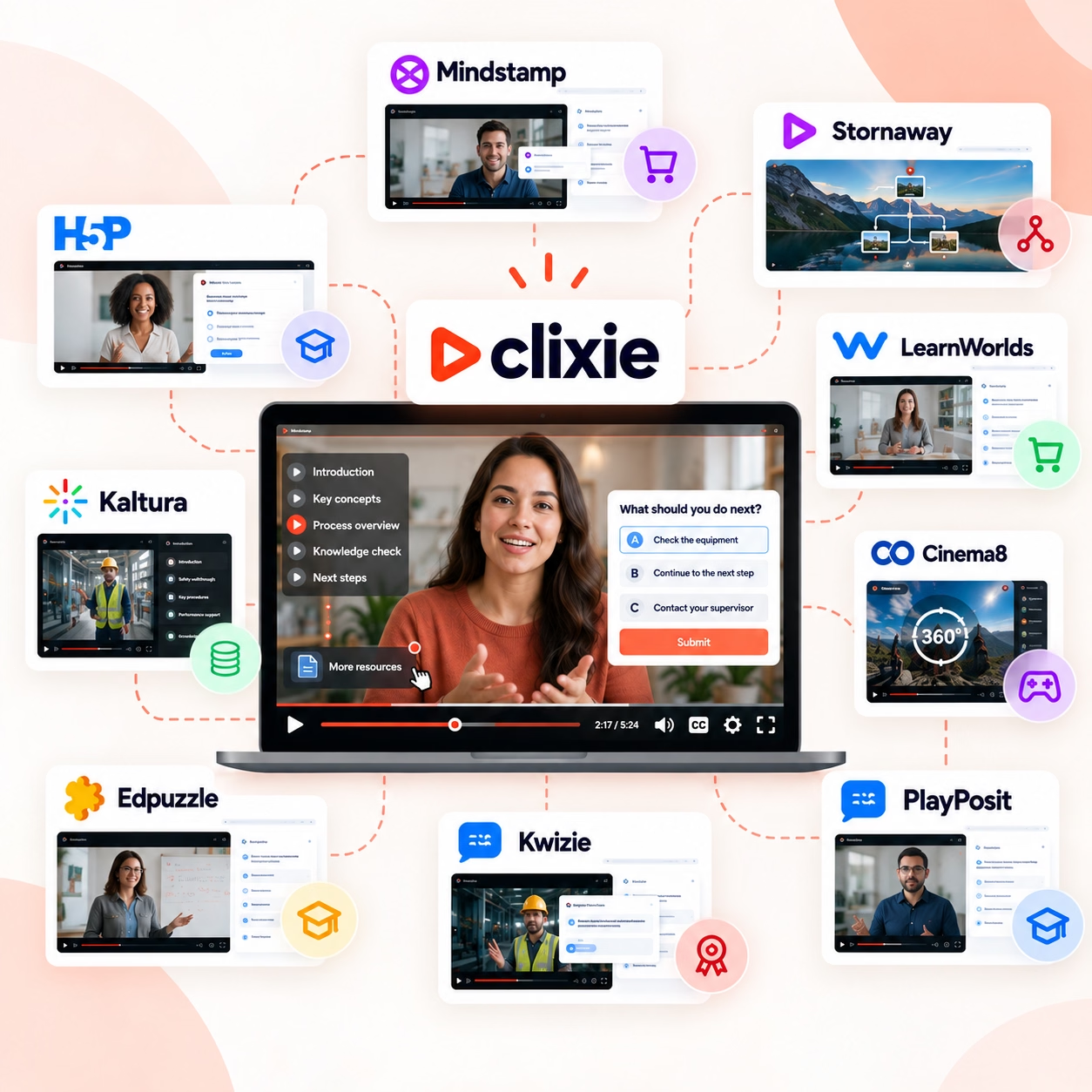
Clixie.ai turns any existing video into a branching, interactive experience by adding hotspots, quizzes, forms, and timed CTAs that capture buyer intent at three points in the journey: pre-call, during call, and post-call. It's a layer on top of video you already have, not a new content production line.
Pre-call. Take the homepage hero video. Add a branching choice 8 seconds in: "Are you a marketing leader, sales leader, or RevOps?" Each path plays the version of the demo most relevant to that buyer. The branch the prospect picks routes them to the right calendar link — and ships the intent signal to the CRM before they ever talk to sales.
During call. Drop an interactive explainer into the demo flow. Mid-conversation, the prospect picks the use case they care about, the video plays it, and a timed CTA captures any feature-level question they want sent to follow-up. Sales reps stop guessing what mattered.
Post-call. A follow-up branching video covers next steps — proposal review, recorded demo, ROI calculator. Every click is a logged event. Sales gets a heat map of which features the buyer actually re-watched.
What this looks like in practice: the kind of intent data interactive video captures — segment-level click rates, branch-level conversion, drop-off points — none of which you get from passive video.
We recently rebuilt the homepage workflow for a corporate client whose sales team was drowning in unqualified discovery calls. We deployed a branching video that asked a single qualifying question directly inside the player. Within 30 days, they saw a 38% lift in qualified meetings booked. The video acted as an automated SDR, filtering out the noise and routing only high-intent buyers to the calendar.
If you've never built one, start with the basics of what interactive video actually is plus a step-by-step on supercharging engagement.
Grab the free Branching Interactive Video Template — pre-built for B2B sales journeys. Download the template →
Image prompt: An annotated UI screenshot of a branching video flow inside the Clixie editor — three branch nodes labeled "Marketing," "Sales," "RevOps," each leading to a different video segment, with a hotspot and an embedded lead form visible on the canvas. Clean, modern dashboard styling.
How to Choose the Right Interactive Format (My Take)
Pick the format that captures the signal you're missing — not the format with the trendiest stats. Most teams over-invest in awareness formats (social polls, AR try-ons) when their actual gap is qualification (quizzes, branching video) or conversion (shoppable video, live commerce).
A simple decision frame I use:
- Need attention at the top of the funnel? → Polls, gamified microsites, AI chat experiences.
- Need to qualify mid-funnel? → Interactive quizzes, branching video, interactive infographics.
- Need to convert at the bottom? → Shoppable video, live commerce, branching demos.
You don't need 10 formats running tomorrow. You need one — placed exactly where your funnel is leaking. Start there, measure the lift, then expand.
A government agriculture department we worked with replaced their static compliance text with a branching video on their primary portal. Viewers simply clicked their specific agricultural sector to start the module. That single decision point generated a 41% lift in verified training completions and gave the administrative team a precise, real-time heatmap of which sectors were actually engaging with the material.
A government agriculture department UDAF we worked with replaced their static compliance text with a branching video on their primary portal. Viewers simply clicked their specific agricultural sector to start the module. That single decision point generated a 41% lift in verified training completions and gave the administrative team a precise, real-time heatmap of which sectors were actually engaging with the material.
FAQ
What is an example of interactivity in new media?
An example of interactivity in new media is a branching interactive video where the viewer clicks a choice and the video plays a different path — other examples include polls, AR try-ons, and shoppable livestreams.
What is interactive new media?
Interactive new media is digital content that responds to user input — clicks, choices, voice, or motion — delivering a personalized, two-way experience instead of a one-way broadcast.
Is interactive media new media?
Yes — interactive media is a subset of new media. Every interactive medium is new media; not every new medium is interactive.
What are the 10 examples of new media today?
The 10 examples are branching interactive video, shoppable video, live commerce, AR product try-on, VR brand experiences, interactive quizzes, interactive infographics, social polls and stickers, generative AI chat, and playable ads.
What is an example of new media?A
n example of new media is any digital, computer-delivered content — a podcast, a TikTok video, a website, a generative AI chat, or a mobile app.
What are the 4 types of new media?
The 4 types of new media are digital text, digital audio, digital video, and immersive/spatial media — interactivity layers on top of all four.
How do I measure ROI on interactive content?
Measure ROI on interactive content with three signals: engagement (dwell, completion), intent (clicks per branch, quiz path, poll vote), and pipeline (form fills, qualified leads, closed-won influence).
What's the easiest interactive format to launch first?
The easiest interactive format to launch first is interactive video — adding hotspots and a branching choice to a video you already have, using a tool like Clixie.
The Bottom Line
Static content competes for attention. Interactive new media captures attention and intent. The right format depends on where in your funnel you need a signal — and for most B2B teams, the highest-leverage starting point is branching interactive video, because in-video lead forms convert at click-through rates passive content can't touch.
You don't need 10 new formats running tomorrow. You need one — the one that captures the signal you're missing.
Across the video production workflows we've built, the teams that start small win the fastest. Deploying just one branching video on a high-traffic landing page typically yields the biggest intent-capture lift within the first 90 days. Keep the interface minimal, ask one high-value question, and let the viewer drive the narrative.
Ready to turn your existing video library into branching, intent-capturing experiences? Book a 15-minute Clixie demo → We'll show you exactly how a single Clixie flow surfaces buyer signals your CRM has been missing.
.png)
.png)



.avif)
