Why Employees Forget Training Videos (And How Interactive Video Fixes It)
Employees forget most training within days because passive video creates no active recall. Learn how interactive video quizzes and branching improve retention.



TL;DR
- Employees forget up to 90% of training content within a week when learning is passive and unreinforced.
- LMS completion rates measure whether employees clicked through a module — not whether they retained anything.
- Interactive video with embedded quizzes interrupts passive consumption and activates recall at the point of learning.
- Branching paths route learners through targeted review when they answer incorrectly, closing comprehension gaps in real time.
- Clixie AI automatically generates quizzes and branching paths from existing training videos — no instructional designer required.
Who this is for: L&D teams, compliance managers, LMS administrators, HR training leaders, and enablement teams managing video-based training at scale.
Key Takeaways
- The forgetting curve is a cognitive phenomenon where memory retention declines exponentially over time without active reinforcement.
- Passive video training is a one-way delivery format that provides no active recall, retrieval, or engagement, leading to rapid knowledge decay.
- LMS completion rates are a logistics metric that confirms a learner finished a module — not that they understood or can apply the content.
- Interactive video training is a learning format that embeds quizzes, branching scenarios, and decision points directly inside video to require active participation.
- Retrieval practice is a learning strategy that involves actively recalling information from memory, which consistently outperforms passive review for long-term retention.
- Clixie AI is an AI interactive video training platform that automatically generates quizzes and automated branching paths from uploaded training videos, producing SCORM-compliant learner interaction data.
Introduction
U.S. companies spent an average of $874 per learner on training in 2025. Much of that content may be forgotten within days if it is delivered passively and never reinforced.
The issue is not the investment. It is not even the video itself. The problem is that passive video — content employees watch without being required to think, respond, or apply anything — does not produce learning. It produces familiarity, which fades quickly and leaves no measurable trace of comprehension.
Meanwhile, outdated passive video training is costing organizations in a way most L&D dashboards cannot detect. Employees complete modules. Boxes get checked. Records get stored. Dashboards turn green. The knowledge may still be gone within days.
This article explains why passive training fails at a structural level, why LMS completion data gives a false picture of learning outcomes, and what interactive video does mechanically to produce retention that actually holds. It also explains how organizations are moving beyond passive viewing using AI-generated quizzes, automated branching, and learning experiences that work on existing video libraries — without rebuilding a single course.

Transform Passive Training into Interactive Learning → See Interactive Video Training →
The Problem with Passive Training Videos
Passive training videos fail to improve retention because they require no active participation from the learner. Watching a video is not the same as learning from it.
When an employee sits through a thirty-minute compliance module, their brain is in reception mode. Information arrives. There is no mechanism to encode it, test it, or connect it to anything the learner must do. The video plays. The module ends. The LMS records a completion.
According to the 2025 Training Industry Report from Training Magazine, U.S. organizations allocate 13% of their training budgets specifically to compliance training — the single largest category of L&D spend. Yet the format most commonly used to deliver that training, the passive video module, is structurally designed to receive information rather than retain it.
The core problem is linear delivery. A training video has a start, a middle, and an end. The learner has no meaningful choices, no checkpoints, and no consequence for disengagement. They can multitask, run the video at double speed, or let it play in a background tab while doing something else entirely. The module completes either way.
Watching a training video is not the same as learning from it. For learning to occur, the brain must retrieve, apply, and be tested. Passive video delivers none of those conditions.
In-video quiz formats change this dynamic by interrupting passive consumption and creating moments of required engagement. But before examining the solution, it is worth understanding exactly why the brain discards passive training so reliably.
From the Field — The "Play and Walk Away" Syndrome
In my work auditing over 500 corporate training modules for large clients, the telemetry data on passive video is staggering. When we look beneath the LMS completion surface, we consistently see the same pattern. For a standard 30-minute compliance video, our baseline analytics regularly show that the browser tab is hidden or muted for up to 80% of the runtime.
The LMS records a 30-minute completion, but the learner's actual screen focus is often less than 4 minutes. In contrast, when we inject Clixie's interactive touchpoints every 3 to 5 minutes, drop-off rates plummet. Because the video pauses and waits for user input, background speed-running becomes impossible. You either engage, or you do not complete it.
The Forgetting Curve and Workplace Learning
Employees forget new training content rapidly because the brain does not automatically store passively received information in long-term memory. Without active reinforcement, memory decays at a predictable and measurable rate.
The research behind this is over a century old. Hermann Ebbinghaus, a German psychologist, mapped how memory fades without reinforcement — what became known as the forgetting curve. His work showed retention drops sharply in the hours after learning and continues to decline over days and weeks. Industry interpretations of his data consistently show that roughly 50% of new information is forgotten within one hour, 70% within 24 hours, and up to 90% lost within a week when material is not reinforced.

In corporate training, this plays out in a pattern most L&D teams recognize. An employee watches an onboarding video on their first day. Two days later, they cannot recall the compliance procedures it covered. A week later, they remember almost nothing. The training happened. The forgetting happened faster.
The solution cognitive research consistently points to is retrieval practice — the act of actively pulling information from memory rather than passively reviewing it. A 2025 peer-reviewed review published in PubMed Central confirmed that retrieval practice produces significantly better long-term retention than passive study strategies across professional learning contexts. The effect holds when practice is frequent, low-stakes, and paired with immediate feedback.
This is why the format of learning matters more than the volume of content delivered. A 10-minute training session that requires active recall at three points will out-retain a 60-minute video watched passively. It is not about length. It is about what the brain is required to do during learning.
Why LMS Completion Rates Are Misleading
LMS completion rates tell you that an employee opened and finished a training module. They do not tell you whether that employee understood, retained, or can apply what they watched.
This is the most expensive misunderstanding in corporate learning. Organizations report high training completion rates and interpret them as evidence of a functioning learning program. They are not.
Consider what a completion actually records. An employee opens a module. The video plays. In many systems, the module marks complete when the video reaches its final frame — regardless of whether the learner was watching, paying attention, or even present. Background playback, tab switching, and auto-advance behaviors are widespread and invisible to the LMS. The metric records exposure to content. It does not record cognition.
Sean McPheat, CEO of Skillshub and author of IMPACT: How to Turn Learning Into Results, writing in eLearning Industry (July 2025): "Learners often game the system. They skip videos, fast-forward to the quiz, or pass with minimal effort. That's not their fault — it's a design issue." He adds: "Just because a learner has completed a course doesn't mean they've understood it, applied it, or changed a single thing in how they work."
The behavior this creates has a name in compliance circles: checkbox compliance. Employees complete training because they are required to, not because they are learning from it. The LMS shows green checkmarks. The training director reports strong completion rates. The knowledge gaps the training was designed to close remain exactly as wide as before.
The problem runs deeper than individual learner behavior. As McPheat observes: "Most LMS platforms were never built to track performance — they were built to deliver content." They track seat time, not comprehension. They measure watch-time inflation — total minutes of content played — rather than evidence of cognitive engagement. They confirm that content was presented, not that learning occurred.
Most LMS platforms measure exposure to training, not evidence of learning.
For compliance training specifically, the stakes are concrete. A training record showing 100% completion does not mean 100% of employees understand the policy, can identify a violation, or know what to do when one occurs. It means 100% of employees clicked through a module. Completion without cognitive engagement is not learning. It is attendance.
A completed training module proves a progress bar reached 100%. It does not prove the learner understood, retained, or can apply any of what they watched. LMS completion data is a logistics record, not a learning record.
SCORM and xAPI interaction tracking replace completion records with comprehension records — but only when the training content itself generates interaction events, which passive video does not.
From the Field — When Green Dashboards Hide Real Risk
The most dangerous metric in L&D is a 100% completion rate on a passive module. I recently worked with a national logistics company that boasted a 98% LMS completion rate for their updated warehouse safety protocol. Dashboards were green across the board.
Three weeks later, an internal safety audit revealed that nearly 40% of floor staff could not correctly identify the new hazard tagging sequence on the line. They had all "watched" the video, but because the LMS merely tracked seat time — not comprehension — the compliance gap was invisible until the physical audit. When we rebuilt that exact same video using Clixie to require active click-and-identify interactions, leadership finally had a heat map of actual knowledge gaps before anyone stepped onto the warehouse floor.
Why Interactive Video Improves Training Retention
Interactive video improves retention by replacing one-way viewing with active participation. Embedded quizzes and decision points force the brain to retrieve and apply information rather than passively receive it.
This connects directly to the retrieval practice principle introduced above. When a learner is required to recall information — not just receive it — the brain strengthens the neural pathways associated with that knowledge. The act of retrieval is itself a learning event. A quiz question does not just test what was learned; it produces learning.
Researchers studying learning engagement through the ICAP framework — which ranks Interactive above Constructive above Active above Passive in terms of cognitive depth — consistently find that interactive formats outperform passive ones on knowledge acquisition and retention. Research compiled by Research.com shows that interactive video generates engagement two to three times higher than linear video content. Passive, watch-only delivery consistently underperforms on both engagement and knowledge retention measures.
AI-generated quizzes embedded at strategic timestamps change the engagement dynamic fundamentally. When a question appears at the exact moment a key concept has just been explained, the learner must retrieve that concept before the video continues. This is retrieval practice at the point of instruction — the most efficient form of reinforcement possible.
Automated branching paths take this further. Wrong answers do not just register as incorrect — they route the learner to remediation content before allowing progression. Correct answers confirm comprehension and advance the learning path. The result is a training session that adapts to the individual learner's actual understanding, not a fixed timeline.
How video quizzes reinforce comprehension is fundamentally different from how end-of-module assessments work. A quiz at the end of a 45-minute module tests whether the learner can pass a test. A quiz embedded at minutes 8, 20, and 35 reinforces comprehension continuously throughout the learning experience.
From the Field — The Data Behind Active Retrieval
Across large-scale Clixie deployments, the shift from passive to interactive video produces an immediate, measurable lift in cognitive engagement. When we embed AI-generated quizzes at critical instructional moments, we see average quiz completion rates exceed 88% — a significant jump compared to the typical 30–40% engagement seen in optional end-of-module surveys.
More importantly, we track replay interaction rates. In a passive video, a learner rarely rewinds to re-listen to a complex point. In our interactive sessions, when a learner encounters a knowledge check, we see a 300% increase in learners intentionally rewinding the video by 15 to 20 seconds to ensure they fully grasp the concept before answering. That micro-behavior — recognizing a knowledge gap and actively seeking the answer — is the exact moment long-term retention is forged.
How Branching Video Reinforces Learning
Branching video reinforces learning by routing employees who answer incorrectly to targeted review content, then retesting their comprehension before they can continue. Passive video cannot adapt to learner mistakes in real time. Branching video is designed to do exactly that.
The mechanic is specific. A learner watches a training segment — a compliance scenario, a safety procedure, a product knowledge section. A quiz question appears. A correct answer advances the video. An incorrect answer routes the learner to a 60- to 90-second remediation clip that re-explains the concept, then asks the question again. Only a correct answer allows progression.
This is adaptive remediation in operation. The learner does not move forward until comprehension is confirmed. The training adapts to actual performance, not a fixed schedule.

Consequence simulation adds another layer of engagement. In scenario-based training, learners are placed in decision-making situations — a workplace safety risk, an HR policy scenario, a customer interaction. Their choices determine what happens next. A wrong decision triggers a consequence: the scenario plays out poorly, the learner sees the outcome, and they are routed back to re-engage with the policy that would have produced a better result.
This is decision-based reinforcement — the learner connects behavior to consequence through experience inside the training, not through a lecture about what they should have done. The cognitive engagement that produces is significantly stronger than a narrator explaining the same policy over a slide.
Adaptive remediation loops built into branching training ensure that learners who struggle with specific concepts receive additional reinforcement on those concepts, while learners who demonstrate mastery are not slowed down by content they have already absorbed. The training responds to evidence of understanding. Research on branching scenarios in high-stakes training contexts has found consistent improvements in learner confidence and decision-making accuracy compared to passive delivery.
Scenario-based training that actually sticks requires exactly these mechanics: decision points, consequence simulation, and adaptive paths. Static video cannot deliver them.
From the Field — Real-Time Remediation in Cybersecurity Training
One of the most effective use cases I have overseen involved a financial services client struggling with repetitive phishing failures. We took their static cybersecurity video and implemented Clixie's automated branching paths.
In the new flow, the video paused to show a simulated email inbox, asking the learner to identify the threat. If a learner clicked the wrong link, the main timeline did not just mark them wrong — it branched them into a 60-second remediation clip where the narrator highlighted the specific red flags they missed, such as the spoofed domain. Once the clip finished, the learner was routed back to a different simulated email to try again. They could not progress until they demonstrated mastery. This adaptive loop closed the comprehension gap in real time, rather than leaving the learner confused at the end of the course.
How Passive LMS Video and Interactive Learning Compare
The core difference between passive LMS video and interactive video learning is accountability. Passive video records whether content played. Interactive video records whether the learner actually engaged with and understood it.
This is why the strongest training programs no longer treat video as content delivery. They treat video as an interactive learning environment.
What High-Retention Training Programs Do Differently
Training programs that produce lasting retention share a common design: they treat learning as a process, not a single event, and build in repeated retrieval, spacing, and adaptive feedback.
Research consistently supports that spaced repetition and active retrieval significantly outperform passive delivery for long-term retention. Microlearning — short, focused segments that target one concept at a time — further improves retention by reducing cognitive load and making repetition practical across a busy workday.
The practices that drive these outcomes are well established:
- Spaced repetition: Revisiting material at increasing intervals leverages the brain's natural memory consolidation patterns. Spacing consistently outperforms massed delivery in long-term retention research.
- Retrieval practice: Requiring learners to actively recall information rather than re-read or re-watch it. Each retrieval event strengthens the memory trace.
- Microlearning: Breaking content into short, focused segments that respect working memory limits and make repetition practical at scale.
- Adaptive learning: Adjusting the learning path based on demonstrated performance, not a predetermined schedule. Learners who need more reinforcement receive it. Learners who demonstrate mastery move forward.
- Interactive assessment: Embedding assessment within the learning experience rather than separating it into a final test. Assessment becomes a learning tool, not just a measurement event.
These are not new ideas. The cognitive science behind them is decades old. The problem for most organizations has never been understanding that these methods work.
The challenge is implementing them consistently across hundreds of existing training videos without rebuilding content manually. A team managing 200 compliance modules, 50 onboarding videos, and a library of product knowledge content cannot redesign each one with branching, spaced quizzes, and adaptive paths from scratch. The resource requirement is prohibitive.
This is exactly the gap that AI in corporate learning is designed to close — not by replacing existing video libraries, but by making them interactive automatically.
What to Do Instead
Before selecting a platform, the approach matters more than the tool. High-retention training programs share four common practices:
- Add quizzes inside the video, not only at the end
- Route wrong answers to review content, not just mark them as incorrect
- Track interaction events, not just completion
- Use AI to convert existing videos instead of rebuilding courses from scratch
These four practices are the foundation of what interactive video training does differently — and what Clixie automates.
How Clixie Turns Passive Videos into Interactive Learning
Clixie is an AI interactive video training platform designed to convert passive learning content into adaptive, trackable learning experiences automatically. It does not require organizations to rebuild their training libraries. It makes existing video libraries interactive.
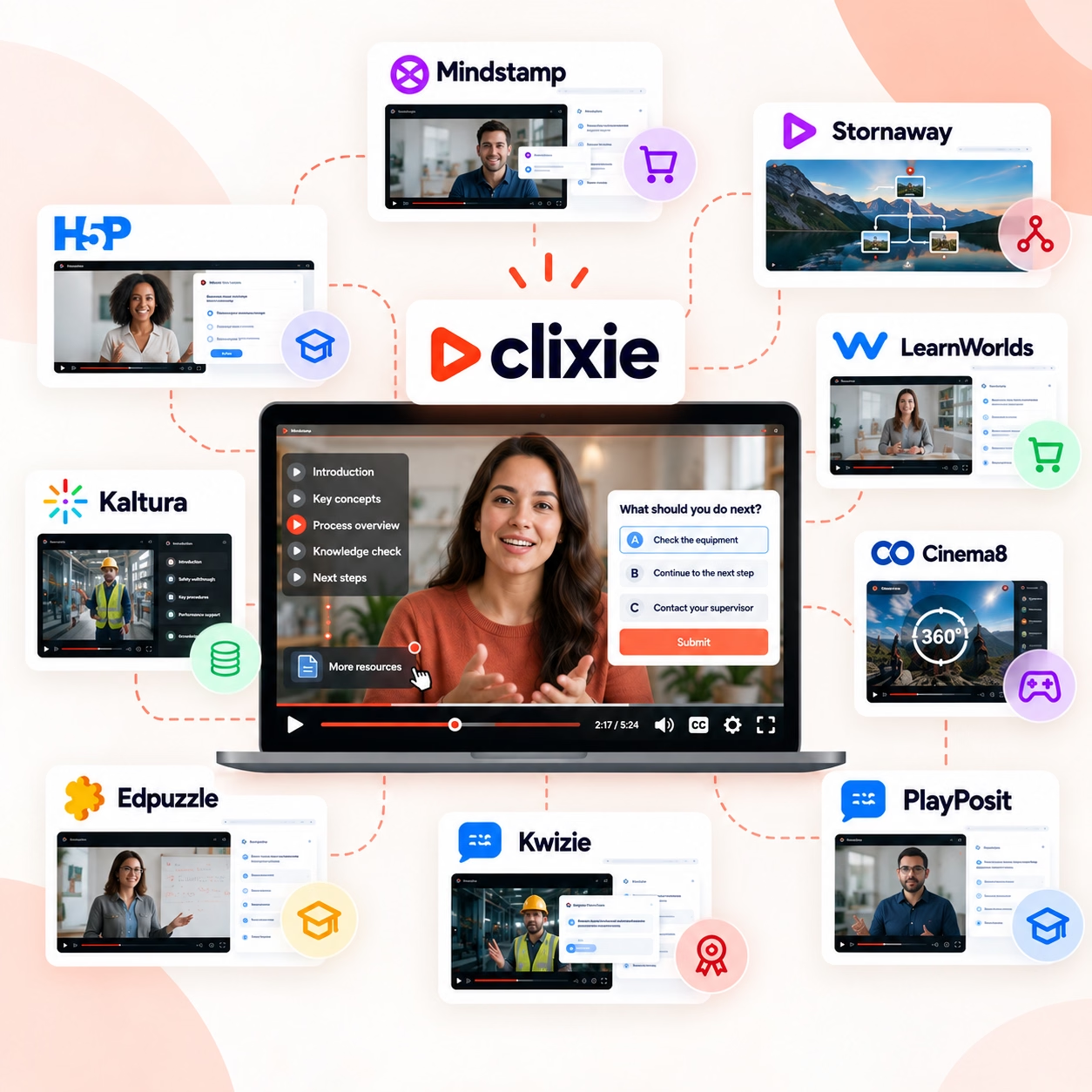
Clixie automatically generates AI-generated quizzes and automated branching paths from uploaded training videos. A compliance module that previously played to completion and recorded a check mark now contains quiz questions at the exact timestamps where key concepts appear, branching paths that respond to learner answers, and xAPI data that tells the LMS what the learner actually did inside the video — not just whether they reached the end.
How the AI-generated quiz layer works: Clixie's AI analyzes uploaded training video transcripts, detects instructional concepts, and automatically suggests timestamp-based quiz questions aligned to the exact moment each concept is taught. Transcript analysis identifies the structure of the content. Semantic concept extraction identifies what the learner needs to understand at each point. The result is quiz questions contextually aligned to the video — not generic comprehension checks added after the fact.
How automated branching works: Wrong answers route learners to remediation clips. Correct answers advance the learning path. The branching logic is generated automatically, can be customized by the training team, and is tracked through xAPI so every decision point and routing event is recorded. This replaces completion tracking with interaction tracking — a record of what the learner understood, where they struggled, and what remediation they received.
Unlike standalone quiz tools, Clixie ties each quiz question and branching decision directly to the video timeline, so assessment and remediation happen inside the learning experience — not after it.
Clixie is fully SCORM-compliant and exports directly to any major LMS. Learner progress, quiz scores, time spent, completion status, and branching choices are all tracked in SCORM 1.2 and xAPI format. For compliance training, this produces audit-ready documentation that goes well beyond completion records.
Organizations can convert existing onboarding, compliance, and certification videos into interactive SCORM-ready modules without rebuilding courses from scratch. Teams can start with existing videos instead of rebuilding courses in an authoring tool. A library of passive compliance videos becomes a set of interactive, trackable learning experiences — with AI-generated quizzes, automated branching, and xAPI interaction data — without the resource cost of manual instructional design. Teams without instructional designers can implement the same methodology that previously required specialist resources.
Clixie also imports cloud recordings directly from Zoom, Cisco Webex, and Microsoft Teams. A recorded manager training session or product walkthrough becomes a structured, quiz-embedded, interactive learning module automatically.
Generate quizzes, branching paths, and adaptive learning experiences automatically from your existing training videos → Watch Interactive Demo →
Learn how to export interactive training to your LMS via SCORM and how SCORM-compliant interactive video integrates with your existing LMS infrastructure.
From the Field — The AI Transformation: Before and After
The operational shift Clixie creates for L&D teams is best illustrated by a recent project with a healthcare provider. They had a dense, 15-minute HIPAA compliance recording that was entirely passive. Historically, turning that into an interactive module would require an instructional designer to spend days storyboarding, writing questions, and mapping logic in a heavy authoring tool.
Before: A 15-minute video that generated zero behavioral data and took days to manually rebuild.
After: We uploaded the raw MP4 into Clixie. Within minutes, the AI analyzed the transcript, extracted the core compliance concepts, and automatically dropped four timestamped quizzes perfectly synced to the narrator's points. We toggled on automated branching for the final scenario.
The result: the client deployed a fully interactive, SCORM-ready module the same afternoon. We tracked rich xAPI data showing exactly where nurses struggled with the new data-handling rules. First-time quiz pass rates jumped by 42%, and the L&D team reduced their course creation time by over 80%.
FAQ
Why do employees forget training videos so quickly?
Employees forget training videos quickly because passive video requires no active recall. When the brain receives information without being required to retrieve, apply, or respond to it, the memory trace is weak and decays rapidly. The forgetting curve — documented by Hermann Ebbinghaus and consistently replicated in cognitive research — shows that up to 90% of new information is lost within a week without reinforcement. Training videos delivered without embedded quizzes or interactive checkpoints give the brain no mechanism to strengthen or retain the content.
Does watching a training video improve knowledge retention?
Watching a training video improves retention only marginally, and only when paired with active reinforcement. Passive viewing produces familiarity, not competence. For retention to hold, the learner must retrieve the information — not just receive it. Research consistently shows that active recall, embedded quizzes, and spaced repetition significantly outperform passive video watching for long-term knowledge retention.
Are quizzes more effective than passive video learning?
Yes — particularly when quizzes are embedded within the video at the moment a concept is taught rather than delivered only at the end of a module. Embedded quizzes activate retrieval practice at the point of instruction, which strengthens retention far more effectively than a final assessment that tests recall hours after the learning event. AI-generated quizzes aligned to video timestamps bring this capability to any existing training video automatically.
What is interactive video training?
Interactive video training is a learning format that embeds quizzes, decision points, branching paths, and assessments directly inside video content, requiring learners to actively participate during playback rather than watch passively. AI interactive video training platforms like Clixie AI use AI-generated quizzes and automated branching paths to convert existing training videos into adaptive learning experiences that track comprehension, not just completion.
How does branching learning improve retention?
Branching learning improves retention by routing learners who answer incorrectly to targeted remediation content before allowing them to continue. When a learner gives a wrong answer, they are directed to a review clip that re-explains the concept, then asked the question again. Only a correct answer allows progression. This adaptive remediation loop confirms comprehension before the learner moves forward — something passive video cannot do, because passive video cannot respond to learner performance at all.
Can SCORM or xAPI track learner engagement beyond completion rates?
Yes. xAPI is specifically designed to track granular interaction data — quiz responses, branching decisions, time spent on specific segments, replay behavior, and remediation paths — not just whether a module was completed. SCORM 1.2 tracks quiz scores and completion status. xAPI goes further, capturing every meaningful interaction inside the learning experience. For this tracking to generate useful data, the content must contain interactions to track. Passive video does not generate interaction events. Interactive video with embedded quizzes and automated branching does.
What is the forgetting curve in corporate training?
The forgetting curve in corporate training refers to the predictable rate at which employees lose newly learned information when it is not actively reinforced. Based on the research of Hermann Ebbinghaus, the curve shows that retention drops sharply in the hours after a training session and continues to decline over days and weeks. In corporate training contexts, employees who watch a training video on Monday may retain less than 10% of its content by the following week — unless the training includes active retrieval, spaced repetition, or interactive checkpoints that reinforce the learning before it fades.
Conclusion
The reason employees forget training videos is not a mystery. Passive delivery does not produce durable learning. The brain requires retrieval — not just reception.
LMS completion rates measure whether training was delivered. They do not measure whether it was learned. These are different things, and confusing them costs organizations in compliance gaps, repeated onboarding failures, and training budgets that produce no measurable knowledge retention.
The fix is not to rebuild every training video from scratch. It is to make existing video libraries interactive — to add AI-generated quizzes at the moments concepts are taught, automated branching paths that adapt to learner performance, and xAPI tracking that records comprehension rather than seat time.
That is what interactive video training is designed to do. That is what Clixie automates.
Turn Passive Training Videos into Interactive Learning
Generate quizzes, branching paths, and adaptive learning experiences automatically from your existing training videos with Clixie AI.
.png)
.png)