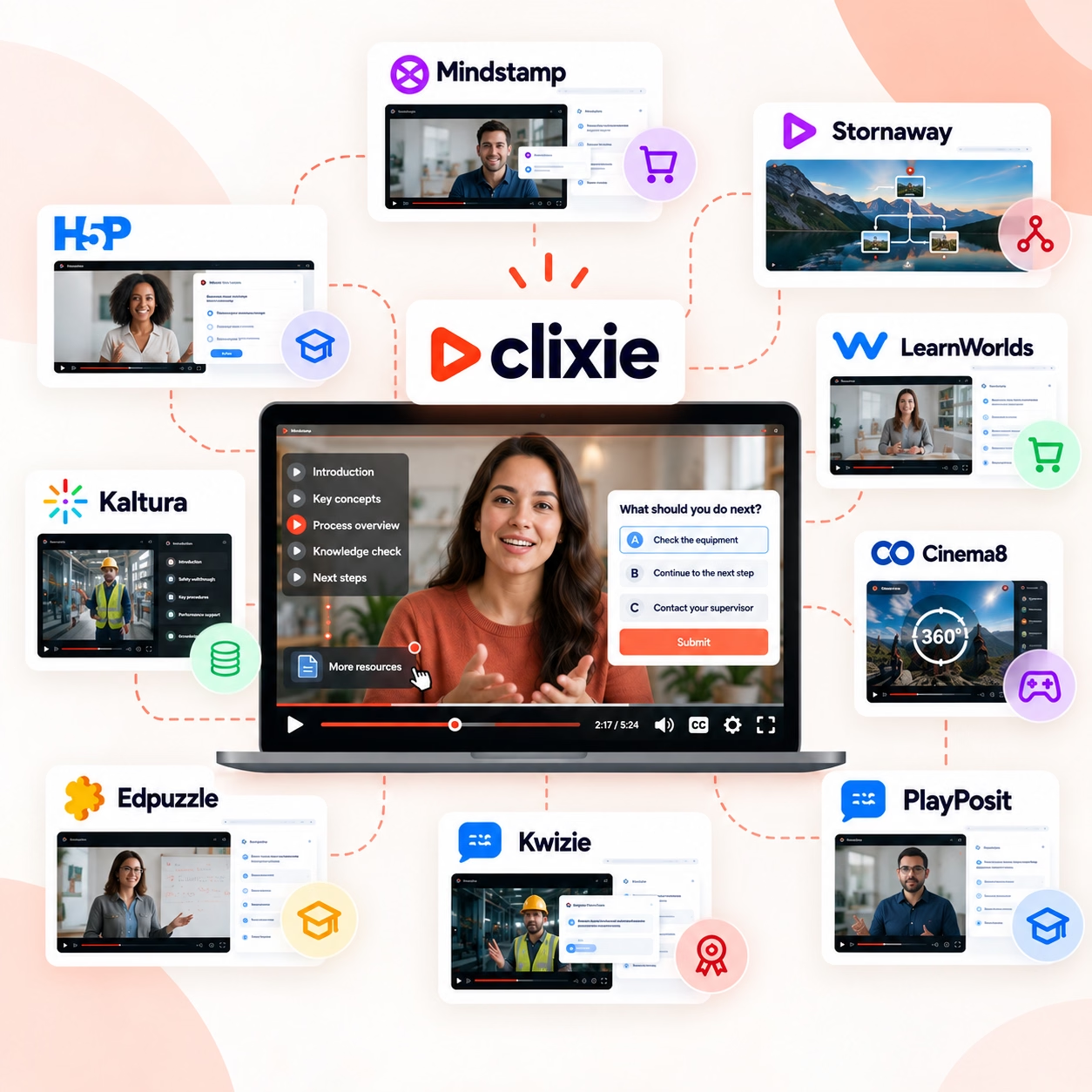
How Does Interactive Video Work? A Complete Breakdown
Interactive video works by layering clickable hotspots, overlays, and branching logic on an HTML5 video player. Here's exactly how the technology works.



Interactive video adds clickable hotspots, overlays, and branching paths on top of standard video. Viewers click, choose paths, and interact directly, driving 61% higher completion rates than passive formats
TL;DR
- Interactive video works by layering clickable elements (hotspots, overlays, time triggers, and branching paths) on top of a standard HTML5 video file. The source video itself never changes. The interactivity sits on a separate layer that the video player renders on top.
- The four core building blocks are hotspots (clickable regions on the frame), overlays (content that appears when triggered), time triggers (automatic timestamp-based events), and branching (viewer-choice-driven navigation).
- The technology runs entirely on the HTML5 element with JavaScript event listeners. No plugins, no Flash, no downloads. It works in any modern browser on any device.
- Only around 17% of marketers report interactive video as an effective platform (Wyzowl, 2025), yet 83% of marketers who use it say it succeeded. This gap is the opportunity.
- Performance data is lopsided in favor of interactive video: roughly 25% higher conversion rates, 18% more leads, and 10x the click-through rate of passive video (Brightcove / Vimeo).
Introduction
Here's a number that should stop any marketing team cold: according to Wyzowl's 2025 State of Video Marketing report, only 17% of marketers rate interactive video as an effective platform for their strategy. It sits near the bottom of the list, below LinkedIn, Facebook, and webinars.
Now look at the other side of the same data set: 83% of marketers who actually use interactive video say it's been successful. And Brightcove's research puts the performance delta over passive video at 25% higher conversions, 18% more leads, and 10x the click-through rate.
That contradiction is the whole story. Interactive video works brilliantly for the few who use it and remains a mystery to everyone else. This post is a full technical breakdown of what's actually happening when a viewer clicks a hotspot, how the video player decides what to do next, and why the architecture is simpler than most people assume.
How does interactive video work?
Interactive video works by layering clickable elements (hotspots, overlays, time triggers, and branching paths) on top of a standard HTML5 video file. When a viewer clicks or taps one of these elements, the player triggers an action, like opening a URL, displaying additional information, jumping to a different timestamp, or loading an entirely different video segment. The underlying video file itself never changes.
Think of it as two layers stacked on a page. The bottom layer is the video: an MP4 or streaming format playing through a standard HTML5 <video> element in the browser. The top layer is the interactivity layer: a transparent canvas of DOM elements (buttons, image cards, forms, invisible click regions) that the platform renders above the video and synchronizes with the video's timeline.
This layered architecture is the single most important thing to understand about the technology. You don't need to re-shoot, re-edit, or re-encode your source footage to add interactivity. You upload a finished video, overlay the interactive elements, and publish. The video file and the interactivity are decoupled, which is why you can update a product price in a hotspot without touching the original footage.
What are the core building blocks of an interactive video?
Every interactive video, no matter how complex, is built from four primitives: hotspots, overlays, time triggers, and branching paths. Understanding these four components is enough to understand any interactive video experience you'll ever see, from a Netflix Bandersnatch-style branching narrative to a simple shoppable fashion video. These are the same core types of interactive elements every major platform supports.
Hotspots
Hotspots are the most common interactive element. They're clickable regions placed at specific coordinates and timestamps on the video frame. A hotspot might sit on a product in a fashion video, a feature in a software demo, or a character in a training scenario. When a viewer clicks or taps the hotspot, it triggers an action.
Hotspots can be static (fixed to a position on the screen for a set duration) or object-tracking (following a moving element in the frame, like a piece of clothing worn by an actor walking across a scene). Common hotspot actions include opening a URL, displaying an overlay, jumping to a different timestamp, adding an item to a shopping cart, or launching a form.
Overlays
Overlays are the content that appears when a hotspot or time trigger fires. An overlay might be a text card with a product description, a full-screen image, an embedded form, a video-within-a-video, or even an entire webpage displayed in a side panel. The viewer can dismiss the overlay to return to the main content.
The distinction between a hotspot and an overlay matters: the hotspot is the clickable region that fires the action, the overlay is the content that appears as a result. One hotspot can open many different overlays depending on how it's configured.
Time triggers
Time triggers fire automatically when the video timeline reaches a preset timestamp, without requiring a click. They're how you deliver a CTA, surface a lead-capture form, or open a chapter menu at a strategic moment. If hotspots give viewers control, time triggers give the author control.
The highest-converting use of time triggers is placing a lead-generation form at the moment of peak engagement. Wistia's 2025 data found that forms placed in the third quarter of a 1–3 minute video convert at 58%, and forms at the end of a 60+ minute video hit 65%. The timestamp matters as much as the offer.
Branching paths
Branching is what turns interactive video from "a video with buttons" into a genuinely non-linear experience. A branching video presents the viewer with a choice, and each choice loads a different video segment. The viewer's path through the content is determined by their own decisions.
Branching is the primitive behind choose-your-own-adventure narratives, personalized product demos ("which feature matters most to your workflow?"), and scenario-based training (a compliance module where wrong choices lead to remediation segments, right choices advance to the next lesson).
What technology powers interactive video?
Interactive video is built on the HTML5 <video> element, with JavaScript listening for user events and the DOM rendering clickable elements on top of the video player. This architecture eliminated the need for Flash or browser plugins and is why interactive video runs natively in every modern browser on every device.
Here's the technical flow. The HTML5 <video> element gives developers programmatic access to the video's current playback time, duration, play/pause state, and a set of events (timeupdate, play, pause, ended) they can listen to. The interactive video platform uses JavaScript to attach event listeners to both the video element and the overlay DOM elements. When the video's timeupdate event fires (roughly every 250 milliseconds), the platform checks whether any time triggers should activate at the current timestamp. When a viewer clicks an overlay element, the platform fires a click event with a payload describing which hotspot was clicked and what action to run.
Open-source players like Kaltura's interactive video player expose this model directly: a hotspot:click event returns a JSON payload with the hotspot ID, position, and the configured action. A node:enter event fires when a viewer arrives at a new video segment in a branching experience. Everything that happens in an interactive video is an event with a payload, and the platform is just a very well-designed event loop.
This is also why interactive videos can be updated without re-uploading source footage. The interactivity configuration (which hotspot fires when, what action it runs) is stored as a JSON object separately from the video itself. Want to change a product price? Edit the hotspot's action payload. The video file stays put.
How does interactive video work for viewers, step by step?
From the viewer's perspective, interactive video works in five stages, executed in a fraction of a second and repeated continuously as the video plays:
- The page loads and the HTML5 player initializes. The browser requests the video file (or a streaming manifest) and the interactivity configuration file (a JSON document describing every hotspot, overlay, time trigger, and branch).
- The interactivity layer renders on top of the video player. Transparent click regions, buttons, and overlays are positioned in the DOM above the video element using CSS, but are invisible until their trigger timestamps arrive.
- As the video plays, the timeline fires events. Time triggers activate at preset timestamps, displaying CTAs, opening forms, or revealing chapter menus. Hotspots become clickable during their assigned time windows.
- Viewer clicks fire actions. A click on a hotspot can jump the playhead to a new timestamp, open an overlay, launch an external URL, add an item to a cart, submit a form, or in a branching experience, load an entirely different video segment.
- Every interaction is logged. Each click, choice, form submission, and drop-off point is sent to the platform's analytics backend, where it builds a behavioral profile of that viewer.
The viewer never sees any of this machinery. They just see a video that responds to them.
What can you actually do with an interactive video?
Interactive video has five dominant use cases, and each one maps to a specific business problem: shoppable video for e-commerce conversion, branching demos for B2B sales personalization, quiz-gated modules for training and compliance, in-video lead capture for marketing, and choice-driven onboarding for SaaS and HR. Every industry that currently relies on video can layer at least one of these patterns on top of existing content.
The enterprise training case is where the ROI numbers get loud. In a case study published by Clixie, Google used interactive video training to onboard its global Android partners and reported a 3,500% increase in learner engagement alongside 80% better knowledge retention and a 40% lift in course completion. These are compounding numbers, not marginal gains. When active participation replaces passive viewing, learning outcomes stop looking like a lecture and start looking like a video game, which is exactly the cognitive shift driving the result.
At Clixie, we recently partnered with the team behind the DICE Approach (a leading dementia care strategy) to modernize their global caregiver training. They were struggling to ensure that staff actually absorbed the material rather than just letting a static video play in the background. By implementing locked interactive video modules—where a user cannot advance to the next segment until they successfully interact with and pass a knowledge check in the current one—we transformed a passive viewing experience into a verified curriculum. Combined with our AI-driven multilingual audio translations, this interactive approach not only guaranteed comprehension but also led to a massive spike in global subscriptions and a 100% verified quiz completion rate among certified staff.
Why does interactive video outperform passive video?
Interactive video delivers roughly 25% higher conversion rates, 18% more leads, and 10x the click-through rate of passive video, according to Brightcove's research and Vimeo's data. The mechanism behind these numbers is simple: a viewer who clicks has already made a micro-commitment to your content. Participation predicts conversion in a way that passive watch time never could.
Passive video gives the viewer two choices: keep watching or leave. Interactive video gives them a dozen. Each interactive element is a small exit ramp to something more relevant, and when the relevant path is one click away, viewers stay. Vimeo's comparison is the cleanest illustration I've seen: interactive video averages around an 11% click-through rate, while standard YouTube annotations and Google Ads come in at less than 1%. That's not a marginal difference, that's a completely different format performing a completely different job.
[CALLOUT: The biggest lever interactive video pulls is not "more engagement." It's respecting the viewer's time. When you let someone skip to what they care about, they reward you by staying for the ask.]
The adoption data makes this even more interesting as a strategic opportunity. Only about 24% of marketers currently use interactive video, per Wyzowl. Meaning the format with 10x the CTR of standard video is being used by roughly a quarter of the market. That's the definition of an unexploited edge, and it's why teams willing to boost video engagement with even basic interactivity tend to see outsized lift.
We saw this exact dynamic play out when we partnered with DreamQuest Journeys (DQJ) to build their "Interactive Vacation Planner." They replaced their standard, passive promotional reel with a Clixie-powered branching video. Instead of forcing viewers to sit through a generic montage of beaches and mountains, we gave them clickable on-screen options to actively "design" their dream getaway as the video played. Because we respected the viewer's time and let them navigate instantly to the exact destinations they cared about, drop-off rates plummeted. The campaign ultimately drove a 25% higher lead conversion rate compared to their traditional, linear video campaigns.
How do you build an interactive video?
You need three things to build an interactive video: a source video, an interactive video platform, and a clear point of view on where interactivity adds genuine value to the viewer experience. The production process itself runs in five stages:
- Plan the interactions. Decide what you want the viewer to do and where a click would serve them. Every interactive element should earn its place by solving a specific problem: driving a conversion, collecting data, improving comprehension, or personalizing the path.
- Prepare the video. For hotspot-based experiences, any finished video works. For branching, you'll need multiple segments corresponding to each choice path, but these can be short and produced as separate clips rather than as one massive edit.
- Add the interactivity layer. Upload to your platform and use the drag-and-drop editor to place hotspots, overlays, time triggers, and branches on the timeline. Modern platforms use AI to analyze the video and suggest optimal interaction points (auto-generated chapters, quiz questions, and hotspot placements), which cuts setup time dramatically.
- Publish and embed. Interactive videos distribute via embed code, shareable links, or direct upload to an LMS through SCORM or xAPI. Most social platforms strip out interactive layers, so the right distribution channel is your own site, email, or learning system.
- Iterate on the data. The first version is never the final version. Every interaction generates data you can A/B test against.
The full step-by-step interactive video guide walks through the authoring workflow in more depth, but the critical insight is that no-code platforms have collapsed what used to be a multi-week development project into a single afternoon of work.
How do you measure interactive video performance?
Interactive video generates granular per-element analytics that passive video architecturally cannot produce: click-through rates on each individual hotspot, branching path selection frequency, quiz scores by question, drop-off timestamps down to the second, and form submission rates at each trigger point. This is the single biggest reason interactive video is worth the setup effort: it turns video from a one-way broadcast into a structured data source.
Traditional video metrics (views, watch time, completion rate) tell you what happened but not why. If a viewer watches 50% of your video and leaves, you know they left, but you don't know what made them leave or what they were looking for. Interactive video fixes this. A viewer who clicks the "pricing" hotspot at 1:23 has told you exactly what they came for. A viewer who chose "B2B" over "B2C" at the first branch has self-segmented for you. The clicks are the signal. The best interactive video analytics dashboards expose heatmaps, user path analysis, and CRM/LMS integration, so the behavioral data feeds directly into your lead scoring, your sales handoffs, or your learning outcomes.
The strategic shift is from vanity metrics to behavioral metrics. Views are a vanity metric. Clicks, choices, path completions, and quiz scores are behavioral metrics. Only the second set predicts business outcomes.
Frequently asked questions
Can I add interactivity to videos I've already produced?
Yes, and this is one of the biggest advantages of the format. The interactivity layer sits on top of your existing footage, so you upload a finished video and add hotspots, overlays, and branching without re-editing or re-shooting. Any MP4 or streaming file works.
Does interactive video work on mobile?
A: Yes. Interactive video is built on the HTML5 <video> element, which is fully supported across mobile browsers. Taps register the same way clicks do on desktop, and well-designed platforms use responsive layouts so hotspots and overlays reposition correctly on small screens.
Do viewers need to install anything to watch an interactive video?
No. Interactive video runs natively in any modern browser (Chrome, Safari, Firefox, Edge) with zero plugins, zero downloads, and no separate app required. This is the main reason HTML5 replaced Flash as the underlying technology in the 2010s.
Can interactive videos work on YouTube or social media?
Mostly no. Social platforms and YouTube strip out third-party interactive layers, which means hotspots and branching won't function there. For full interactivity, embed the video on your own website, in an email, or inside a learning management system.
What industries use interactive video most?
E-commerce (shoppable video), corporate training and HR (onboarding and compliance), education (quiz-based learning), real estate (360° property tours), and B2B marketing (product demos and sales enablement) see the strongest adoption. Any industry that already uses video can benefit from adding interactivity.
Is interactive video SCORM-compliant for LMS use?
Yes, with the right platform. Enterprise-grade interactive video tools export SCORM and xAPI packages that drop directly into learning management systems like Canvas, Cornerstone, and SAP SuccessFactors, preserving completion tracking and quiz scoring.
Conclusion
Interactive video is a fundamental shift in how video content works: from passive broadcast to active, two-way participation. The technology (hotspots, overlays, branching logic) sits on top of your existing footage and turns every viewing session into a data-rich, conversion-friendly experience. You don't need new videos. You don't need developers. You need a strategy and a platform.
The performance data is consistent across every study: higher engagement, higher completion rates, higher click-through rates, higher conversions. And the competitive window is still wide open, with only 17% of marketers currently using interactive video.
Your next step: Take one existing video that's already performing well for your brand. Upload it to an interactive video platform like Clixie AI. Add three hotspots at the moments where viewers would naturally want more information or be ready to take action. Publish it, track the interaction data for two weeks, and compare the results against your standard video metrics. That single experiment will tell you everything you need to know about whether interactive video belongs in your strategy.
.png)
.png)